Buveurs
Jan Steen · 1660s
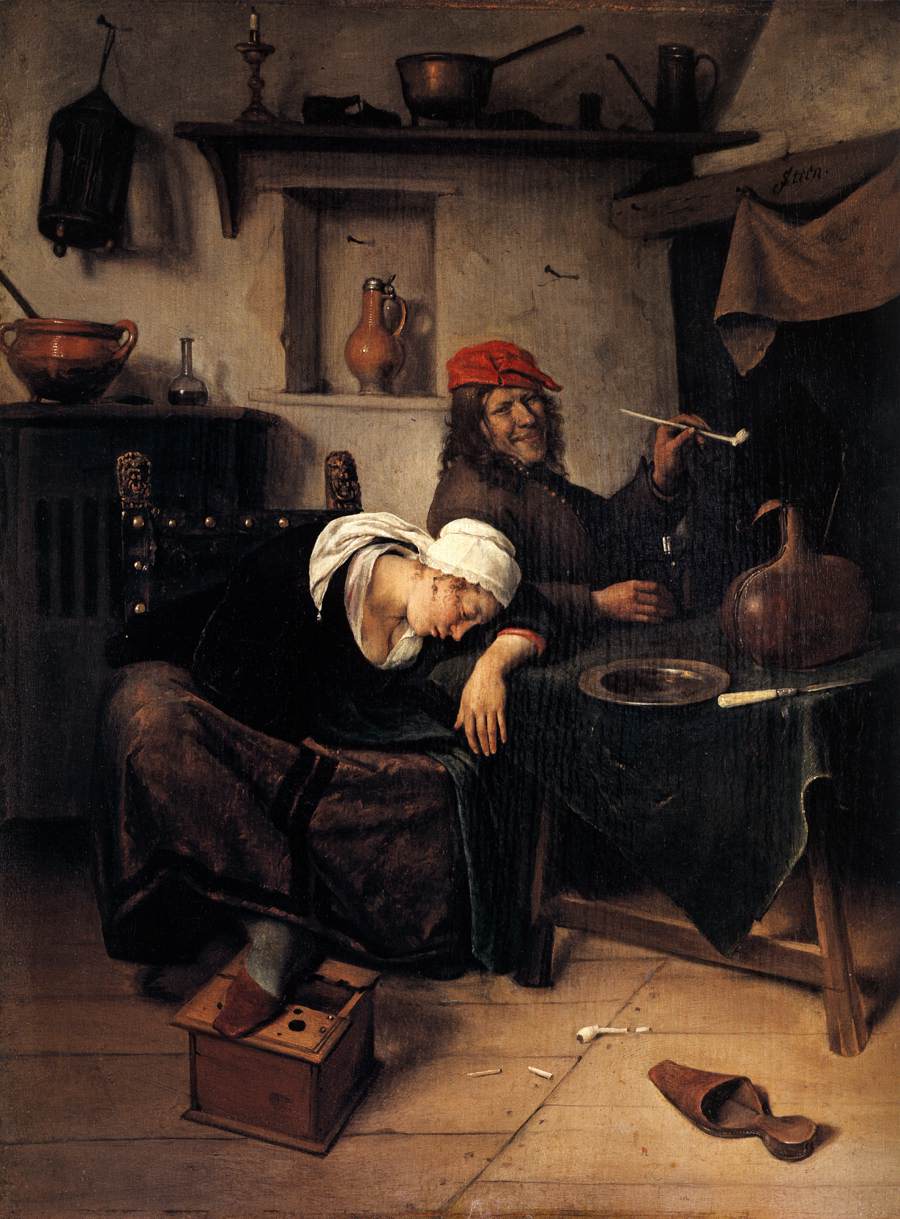
A man clings to his chair and his glass while his wife slumps over the table, half asleep. Jan Steen seems to have painted himself and his wife Margriet, and he smiles at us as if asking us not to judge too harshly.
The story behind the painting
This small panel by the Dutch painter Jan Steen, dated to the 1660s, is known by several names: Idlers, Drunkards, Revellers, or Self-portrait with his wife, drunk. The theme of revellers returns again and again in Steen's work, and the painter himself ran a tavern. The impression the scene makes is sharpened by the report that Steen painted himself here with his wife Margriet. It is also one of the few seventeenth-century paintings that still keep the original wooden panel on which the image was made.
What to look for
A couple sits comfortably by the fireplace. Their home is modest: cheap furniture, plain clothes with no satin, embroidery or lace. The man still holds onto his chair and his glass, but his wife, collapsed on the table, is falling asleep; a moment more and she might slide to the floor. A worn cloth is nailed to the chimney, the old tablecloth is torn with holes, and a broken clay pipe lies on the wooden floor. One of the woman's shoes has dropped to the floor; the other sits on a shelf among the plates.
Meaning and intent
Steen softens the scene with the man's kind smile and knowing glance at the viewer, as if saying nothing terrible happened, they only went a little too far. Yet, as was usual then and in his work, the comic picture carries a clear moral. The shoes recall a Dutch proverb about not putting your feet in someone else's shoes, and the Dutch word schoen could also mean a prostitute. The foot warmer under the woman's foot hints at desire, drinking and smoking were seen as sinful, and the snuffed candle is a memento mori. The whole works as a warning against idle, frivolous pleasures.
Legacy
The painting came from the first group of pictures assembled by the merchant Johann Gotzkowsky, meant for King Frederick II of Prussia. When Frederick could not pay for them in full and declined, the Russian empress Catherine II bought this and many other works in 1764, to show her own financial power. The lot included paintings by Frans Hals, Rembrandt, Rubens and Van Dyck, and helped found the imperial collection that later became the basis of the Hermitage Museum in Saint Petersburg, where Steen's tipsy couple still sits by the fire.
Le saviez-vous ?
- Painted in the 1660s, probably Steen with his wife Margriet.
- The shoes, foot warmer and snuffed candle carry moral warnings.
- Still on its original wooden panel.
- Bought by Catherine II in 1764, now in the Hermitage.
À propos de l'artiste
Jan Steen (1626-1679)
femme · homme · scène de genre · autoportrait · musée de l'Ermitage
Autres œuvres de Jan Steen
 La Fête de la Saint-Nicolas - Jan Steen (1660s)
 La Mangeuse d'huîtres - Jan Steen (1658)
 Portrait d'Adolf et Catharina Croeser - Jan Steen (1655)
 Beware of Luxury - Jan Steen (1663)
 Ce que chantent les vieux, les jeunes le fredonnent - Jan Steen (1665)
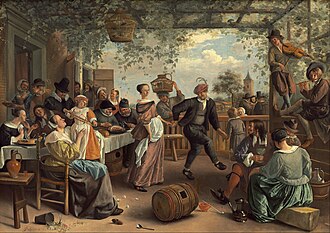 Le Couple dansant - Jan Steen (1663)
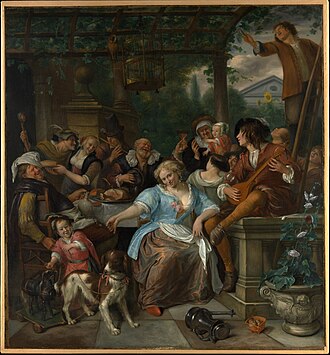 Joyeuse compagnie sur une terrasse - Jan Steen (1670)
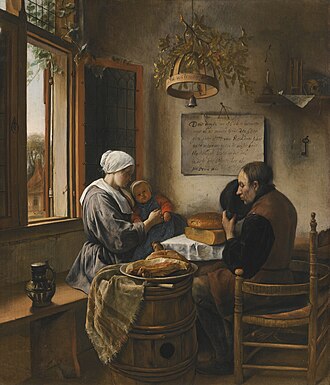 The prayer before the meal - Jan Steen (1660)
Œuvres d'artistes liés
 La Ronde de nuit - Rembrandt van Rijn (1642)
 Autoportrait - Rembrandt van Rijn (1659)
 La Jeune Fille à la perle - Johannes Vermeer (1665)
 La Laitière - Johannes Vermeer (c. 1658)
 Le Joyeux Buveur - Frans Hals (1620s)
 Le Cavalier riant - Frans Hals (1624)
 Le Moulin près de Wijk bij Duurstede - Jacob van Ruisdael (1670)
 Le Cimetière juif - Jacob van Ruisdael (1650s)
 La Cour d'une maison à Delft - Pieter de Hooch (1658)
 La Peleuse de pommes - Pieter de Hooch (1663)