L'Été
Claude Monet · 1874
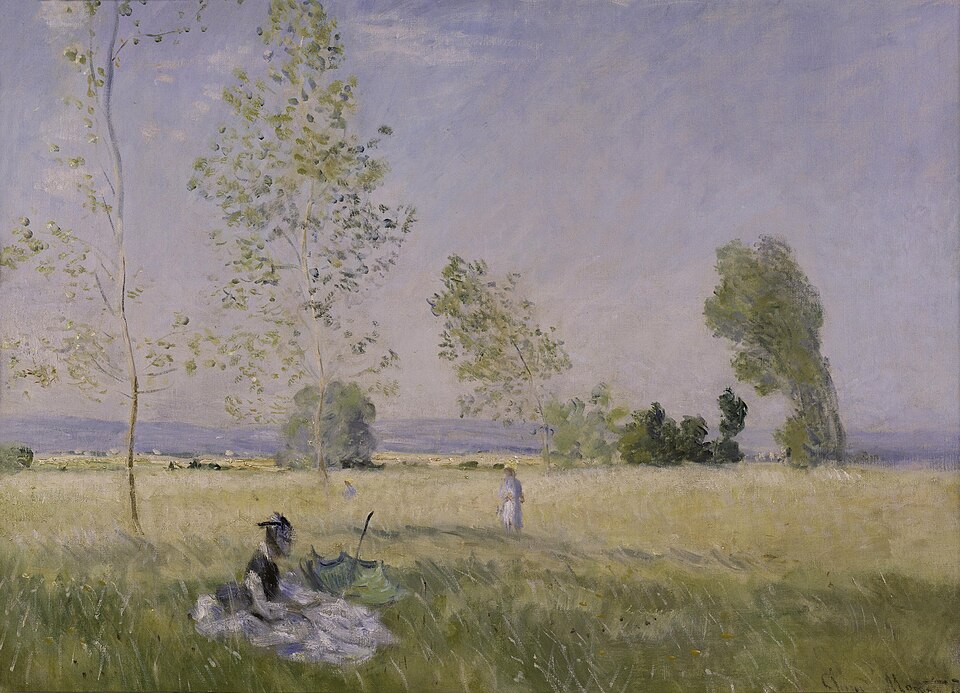
A hot summer meadow near Bezons, a woman in white reading in the shade, a boy almost lost in the tall grass. Monet painted his own family here in 1874, the year Impressionism got its name.
The story behind the painting
Monet lived with his wife Camille and their son Jean in Argenteuil from December 1871, a Paris suburb only fifteen minutes from the centre by train, where Parisians came at weekends to sail, row and relax. In spring 1874 Monet and friends whose work the official Salon kept rejecting exhibited in the studio of the photographer Nadar, where Impression, Sunrise gave the critic Louis Leroy the mocking word Impressionism. That summer Manet and Renoir visited Monet in Argenteuil and set up easels in his garden, and Monet himself painted about forty pictures. Meadow at Bezons, also called Summer, is one of them, painted on a meadow in the Seine valley between Argenteuil and Bezons.
What to look for
The picture is built in horizontal bands: a shady foreground where Camille sits in the grass, a sunlit meadow behind with two more figures, a line of blue hills, and a lightly clouded summer sky. Open at both sides, the meadow seems to stretch endlessly. Monet laid on thin yellows and greens in short, comma-like strokes, while the distant hills fade into haze. Camille, seen in profile, wears a black bodice with long white sleeves and a wide white skirt, her small hat pulled down so her face is hidden, reading a book, a green parasol lying open beside her. Jean, about seven, shows only a white shirt and a yellow hat above the grass. A third figure may be a nursemaid, as Dorothee Hansen suggests. The signature reads Claude Monet 74.
Meaning and intent
Monet painted no portraits here: the figures are staffage, subordinate to the landscape, and the art historian Angelika Wesenberg noted that the sketchy handling avoids anything anecdotal. It is one of the few pictures from that summer in which he turned away from the town to show open nature, yet the meadow is neither wilderness nor farmland. It is a place of leisure for the modern city dweller, and Camille in her fashionable dress, absorbed in her book, is recognisably an elegant Parisian at rest. Related works show the same idea: Poppy Field near Argenteuil of 1873, with Camille and Jean walking through flowers, and walkers in meadows painted in 1875.
Legacy
Monet exhibited the painting as La Prairie at the second Impressionist group show, held from 30 March to 30 April 1876 in Paul Durand-Ruel's rooms on the rue Le Peletier. A critic signing E. F. in the Moniteur des arts praised the astonishing accuracy of its tones and said Monet had rendered air and space wonderfully. Émile Zola, writing in Le Sémaphore de Marseille, found it simple and exquisitely charming, the greens and blues bleached by strong sun so that one feels the pale gold of the star burning in the air. In 1912 Karl Scheffler called it a spring landscape full of summer scent. Today it belongs to the Nationalgalerie in Berlin.
Le saviez-vous ?
- Painted in 1874 near Bezons, close to Argenteuil.
- Shows Camille Monet, their son Jean and possibly a nursemaid.
- Exhibited as La Prairie at the second Impressionist exhibition, 1876.
- Oil on canvas, 57 x 80 cm, Nationalgalerie Berlin.
À propos de l'artiste
Claude Monet (1840-1926)
Autres œuvres de Claude Monet
 Impression, soleil levant - Claude Monet (1872)
 Nymphéas - Claude Monet (1906)
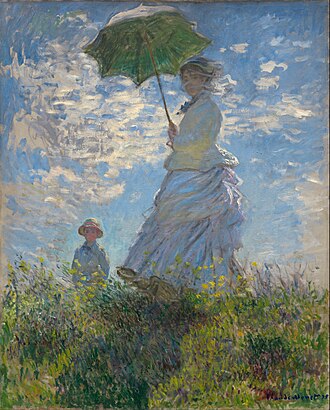 La Femme à l'ombrelle - Claude Monet (1875)
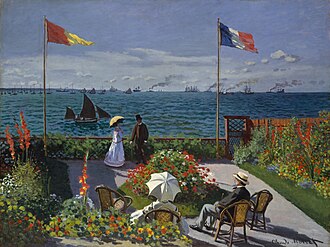 Terrasse à Sainte-Adresse - Claude Monet (1867)
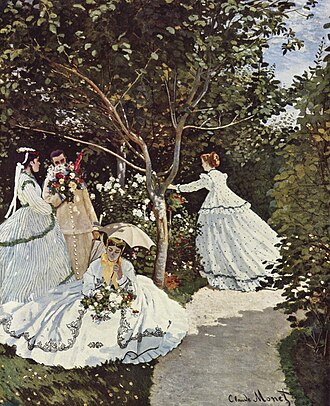 Femmes au jardin - Claude Monet (1866)
 La Pie - Claude Monet (1868)
 La Dame en blanc au jardin - Claude Monet (1867)
 Le Déjeuner sur l'herbe - Claude Monet (1866)
Œuvres d'artistes liés
 Le Dernier Voyage du Téméraire - J. M. W. Turner (1839)
 Pluie, Vapeur et Vitesse - J. M. W. Turner (1844)
 L'Origine du monde - Gustave Courbet (1866)
 Un enterrement à Ornans - Gustave Courbet (2020)
 Le Déjeuner sur l'herbe - Édouard Manet (1863)
 Olympia - Édouard Manet (1863)
 Bal du moulin de la Galette - Pierre-Auguste Renoir (1876)
 Le Déjeuner des canotiers - Pierre-Auguste Renoir (1881)
 Le Berceau - Berthe Morisot (1872)
 Jour d'été - Berthe Morisot (1879)
 L'Absinthe - Edgar Degas (1875)
 La Famille Bellelli - Edgar Degas (1858)