Autoportrait
Le Greco · 1595
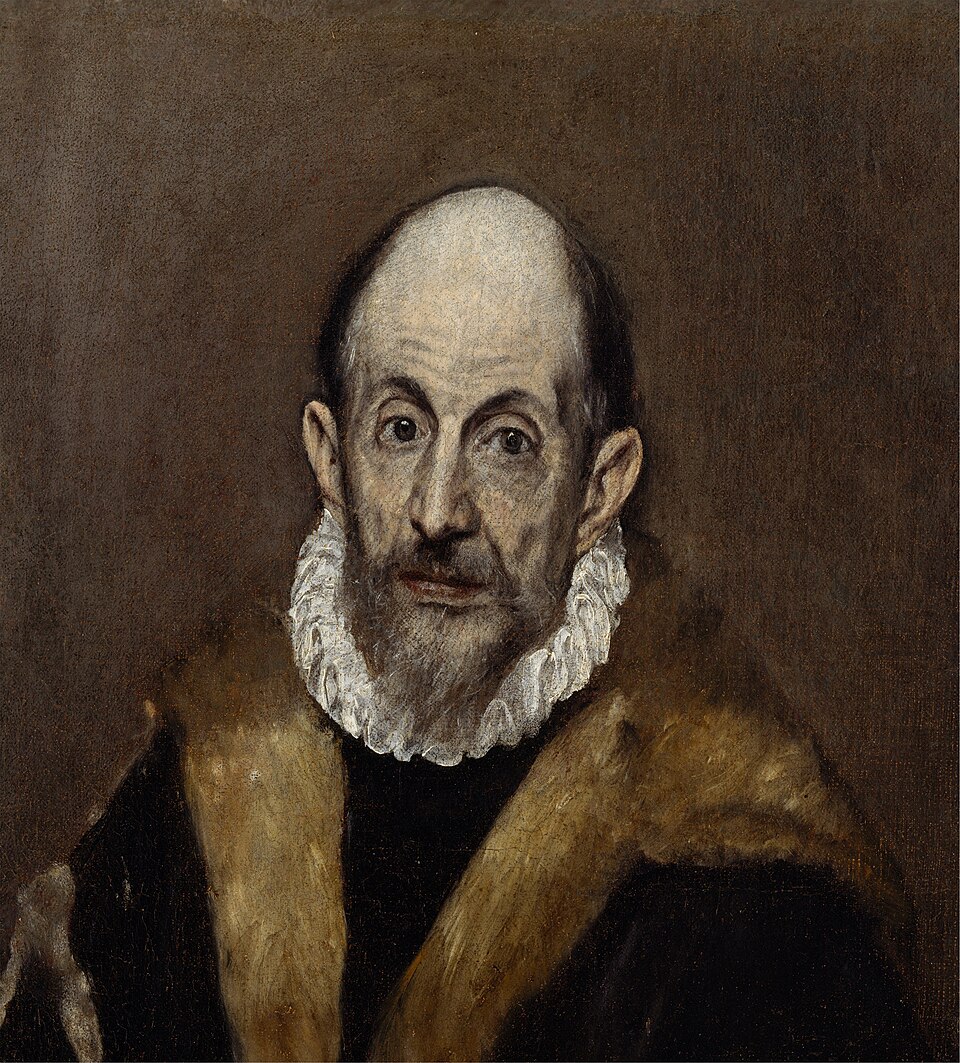
An old man with sunken eyes and a wide ruff looks out from a plain brown ground. Is this El Greco himself? Scholars have argued about it for more than a century, and the answer is still open.
The story behind the painting
This oil on canvas, now in the Metropolitan Museum of Art in New York, is known both as Self-Portrait and as Portrait of an Old Man. It is likely to date from between 1595 and 1600, though its exact date is unknown. In 1900 Salvador Sanpere y Miguel first identified it in print as a self-portrait. Its later owners are documented: the Marqués de Heredia sold it in 1892 to the art critic Aureliano de Beruete y Moret, it passed to his widow at his death in 1922, and the Metropolitan bought it in 1924. It has since been exhibited across Europe, North America and Japan.
What to look for
This is a half-length portrait of an older man set against a brown background. He wears a coat and, around his neck, a ruff in a style popular in the 1590s. His eyes are sunken and his hairline has receded, details that tell us of his age. Look at the coat: the brushwork there is loose, and the painter avoids hard contour lines, a sign, according to the scholar Richard G. Mann and others, of what El Greco learned in Venice from Titian and Tintoretto. The empty, single-coloured background, by contrast, recalls his first training on Crete as a painter of Christian icons.
Meaning and intent
The question of who the sitter is runs through the painting's history. Those who see a self-portrait note that the same face appears, aging with the artist, in other works such as The Disrobing of Christ and The Burial of the Count of Orgaz. August L. Mayer in 1926 linked it to an inventory of El Greco's son Jorge Manuel that lists a portrait of my father, and Fernando Marías later linked it to a half-length self-portrait in the same inventory. Others disagreed: Paul Lafond in 1906, Harry B. Wehle in 1940 and Harold E. Wethey in 1962 found the evidence insufficient, and Deborah Krohn suggested in 1992 it could show a relative.
Legacy
The date is debated too. Suggestions range from 1579 to 1610, but the width of the ruff points most experts to the 1590s. Whatever the final verdict, the painting has become one of the most familiar faces associated with El Greco. In 1965 Spain issued a postage stamp with this image to mark the 350th anniversary of the artist's death. It has travelled to exhibitions from Madrid to London, Leningrad, Athens, Osaka and Basel. For visitors, the uncertainty is part of the encounter: we look into the tired eyes of an old man and ask whether the painter is looking back.
Le saviez-vous ?
- Oil on canvas, likely about 1595-1600; size 52.7 × 46.7 cm
- Identity of the sitter debated since 1900
- Bought by the Metropolitan Museum of Art in 1924
- Reproduced on a 1965 Spanish postage stamp
À propos de l'artiste
Le Greco (1541-1614)
portrait · homme · Metropolitan Museum of Art · autoportrait · portrait
Autres œuvres de Le Greco
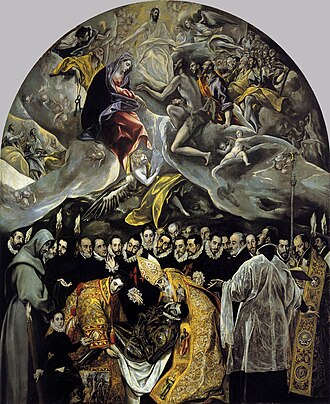 L'Enterrement du comte d'Orgaz - El Greco (1586)
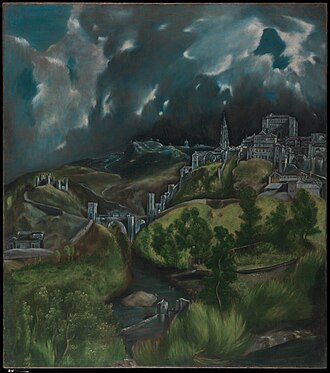 Vue de Tolède - El Greco (1596)
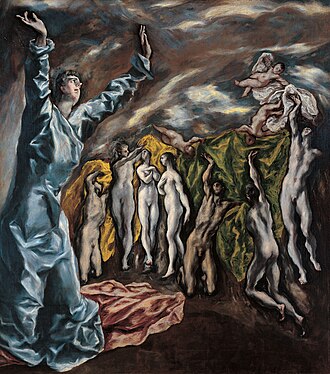 L'Ouverture du cinquième sceau - El Greco (1610)
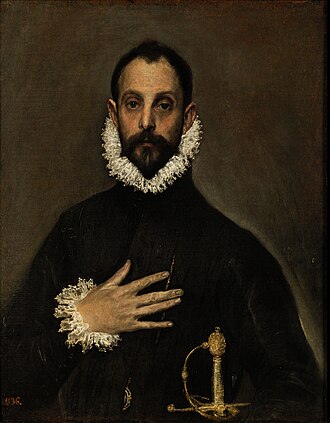 Le Gentilhomme à la main sur la poitrine - El Greco (1580)
%20-%20Laoco%C3%B6n%20-%20Google%20Art%20Project.jpg) Laocoon - El Greco (1610s)
Laocoon - El Greco (1610s)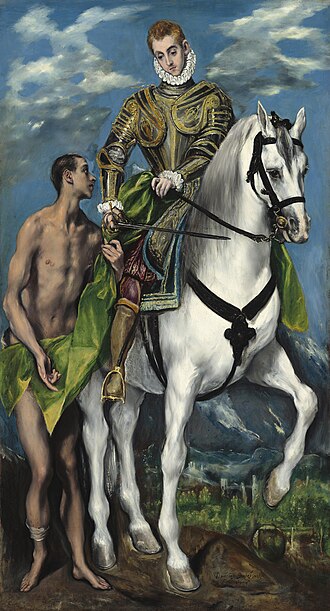 Saint Martin et le Mendiant - El Greco (1597)
.jpg) L'Adoration des bergers - El Greco (1612)
L'Adoration des bergers - El Greco (1612) Le Concert des anges - El Greco (1600s)
Œuvres d'artistes liés
.jpg) Vénus d'Urbin - Titian (1538)
Vénus d'Urbin - Titian (1538)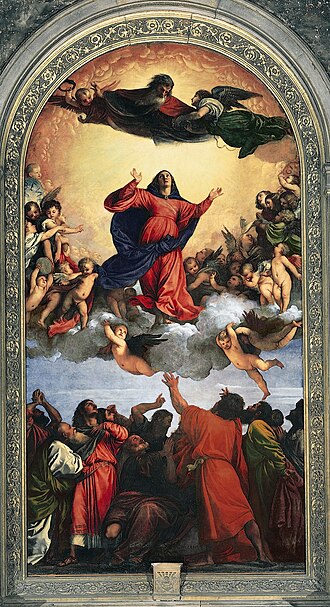 L'Assomption de la Vierge - Titian (1510s)
 Le Souper à Emmaüs - Caravaggio (1601)
 La Vocation de saint Matthieu - Caravaggio (1609)