Vue de Tolède
Le Greco · 1596
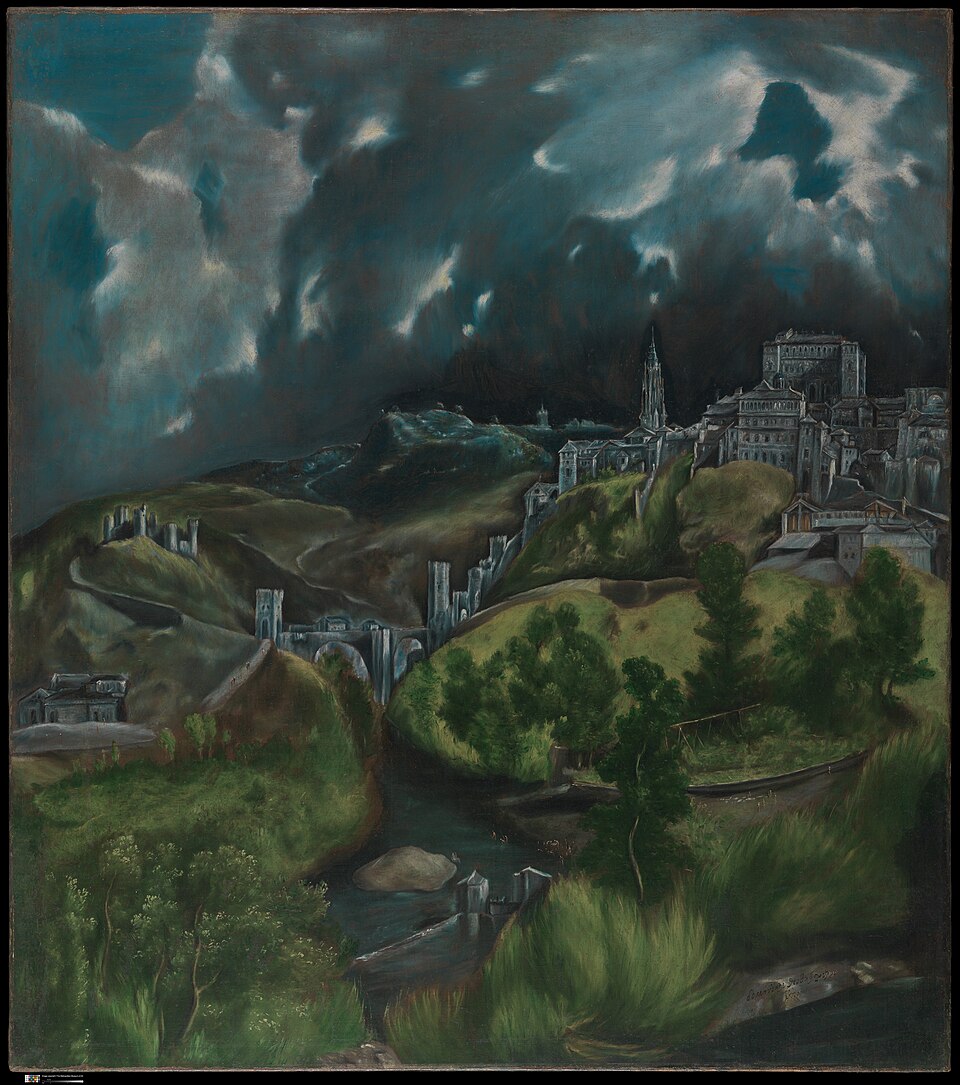
A storm-dark sky presses down on a grey city perched above vivid green hills. El Greco did not paint Toledo as it was, but as he imagined it could be.
The story behind the painting
View of Toledo is one of only two surviving landscapes by El Greco, the other being View and Plan of Toledo. Landscape painting was rare in Renaissance and Baroque Spain, so rare that some have wondered whether this canvas was cut from a larger work, though nothing has proved it. Its date is debated. Early literature placed it after 1600, shortly before the painter's death in 1614, while Harold Wethey argued for 1595-1600, pointing to similar backgrounds in Saint Joseph and the Christ Child of 1597-99. Wikidata gives 1596. Both Toledo paintings were found in the collection of Pedro Salazar de Mendoza after his death, and his passion for the city may have inspired them.
What to look for
Begin with the sky. It grows exceptionally dark near the city, a churning field of blue, black and white, and it is counted among the best known skies in Western art. Below, rolling hills burn a vivid green, and on their crest the city sits pale grey, catching light against the darkness. Find the Castle of San Servando on the left: it is accurately placed. Then look for the cathedral and the Alcázar, which El Greco moved from their true positions to compose his own Toledo. In the lower right corner is his signature, written in Greek letters with his real name, Domenikos Theotokopoulos, a quiet reminder of his Cretan roots.
Meaning and intent
Why rearrange a real city? Walter Liedtke suggests El Greco painted Toledo as a hope of what it might become, and stressed its greatness by setting it at the very top of the hill, as close to heaven as it could be without floating into the sky. The hills act almost as a pedestal. Jonathan Brown and Richard Kagan have also proposed that the artist shaped the city to fit his imagination. Following medieval tradition, he placed its landmarks to create what has been called "a city of the spirit". Some link the painting's enigmatic mood to the mysticism that filled Toledo at the time, and scholars have traced El Greco's style to Neoplatonic and Byzantine sources.
Legacy
Today the painting hangs in the Metropolitan Museum of Art in New York. Art historian Keith Christiansen counts it among El Greco's most ambitious masterpieces and one of the most celebrated landscapes in Western art. It is often named alongside Van Gogh's The Starry Night and the skies of Turner and Monet. Because of a perceived ban on landscape painting associated with the Council of Trent, some see it as perhaps the first Spanish landscape painting of its time. Compare it with View and Plan of Toledo, now in the El Greco Museum in Toledo: that later work is warm and brown, seen from the air, while this one remains all storm and vivid green.
Le saviez-vous ?
- It is one of only two surviving landscapes by El Greco.
- Its dating is disputed: some place it after 1600, Harold Wethey between 1595 and 1600.
- The Castle of San Servando is accurately placed, while the cathedral and Alcázar are moved.
- El Greco signed it in Greek letters as Domenikos Theotokopoulos.
À propos de l'artiste
Le Greco (1541-1614)
paysage · arbre · Metropolitan Museum of Art · nuage · pont
Autres œuvres de Le Greco
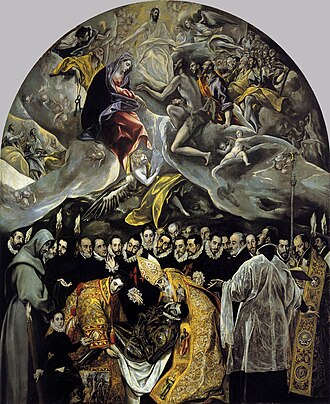 L'Enterrement du comte d'Orgaz - El Greco (1586)
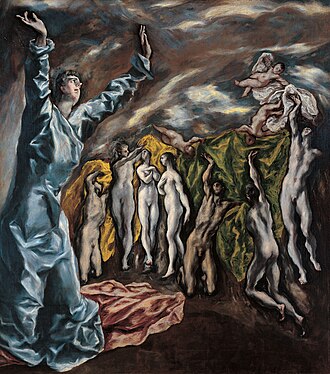 L'Ouverture du cinquième sceau - El Greco (1610)
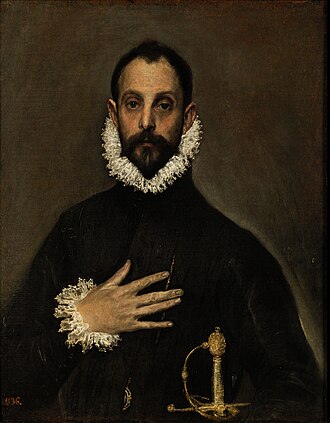 Le Gentilhomme à la main sur la poitrine - El Greco (1580)
%20-%20Laoco%C3%B6n%20-%20Google%20Art%20Project.jpg) Laocoon - El Greco (1610s)
Laocoon - El Greco (1610s)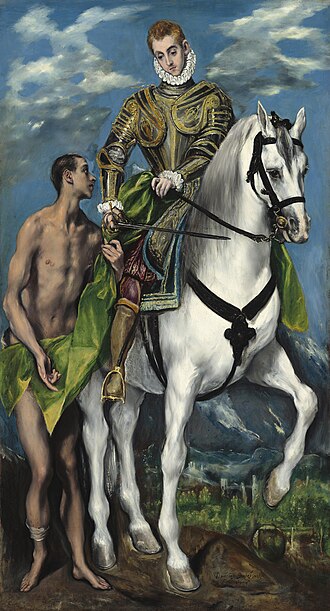 Saint Martin et le Mendiant - El Greco (1597)
.jpg) L'Adoration des bergers - El Greco (1612)
L'Adoration des bergers - El Greco (1612)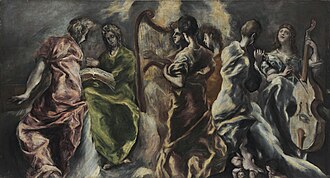 Le Concert des anges - El Greco (1600s)
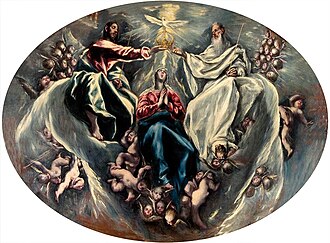 Le couronnement de la Vierge - El Greco (1597)
Œuvres d'artistes liés
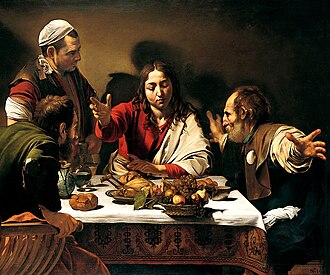 Le Souper à Emmaüs - Caravaggio (1601)
 La Vocation de saint Matthieu - Caravaggio (1609)