La Cène
Le Tintoret · 1563
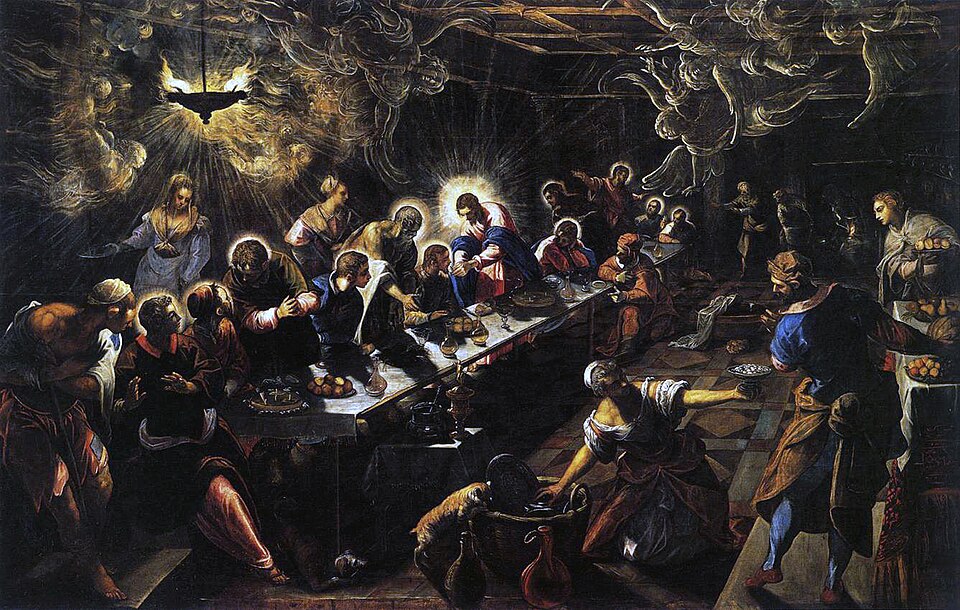
No calm row of apostles here: the table plunges diagonally into the dark, servants bustle, and angels made of light pour in above. This is Tintoretto's Last Supper in San Giorgio Maggiore.
The story behind the painting
Jacopo Tintoretto painted the Last Supper several times. This version hangs in the Church of San Giorgio Maggiore in Venice, on a huge canvas about 365 by 568 cm. Its date is a point of disagreement between the sources: Wikidata gives 1563, while the Wikipedia article describes it as a work of Tintoretto's final years, painted in 1592-1594. Earlier, for the churches of San Marcuola (1547) and San Felice (1559), he had painted the scene in the familiar way, with the figures seated frontally at a table parallel to the picture plane, the convention best known from Leonardo da Vinci's mural in Milan.
What to look for
Here that formula is overturned. The table with the apostles recedes into space on a steep diagonal. The centre of the picture is not taken by the apostles but by secondary characters: a woman carrying a dish, servants clearing plates from the table. The setting resembles a Venetian inn. Watch the light, which seems to come both from a lamp on the ceiling and from the halo around Jesus, cutting through the darkness. Above the scene a host of angels hovers, sketched in light and smoke.
Meaning and intent
The composition is complex and radically asymmetrical, using devices of Mannerism. Yet its dynamism and its attention to everyday life point forward to the Baroque. The sacred meal happens amid ordinary work, so that the holy moment and the busy household share the same room. As the source puts it, the dramatic power of the scene to engage viewers fitted the Counter-Reformation ideals of the Catholic Church, which believed in the teaching role of religious art.
Legacy
Set against Tintoretto's own earlier Last Suppers and against the long tradition of the frontal table, this canvas shows how far one painter could push a familiar subject. It still hangs in San Giorgio Maggiore, in the church for which it is recorded, where worshippers and visitors can stand before it at full scale. Its tilted table, glowing figures and crowd of servants and angels remain one of the boldest reimaginings of the scene.
Le saviez-vous ?
- Wikidata dates it 1563; Wikipedia gives 1592-1594.
- Church of San Giorgio Maggiore, Venice.
- Earlier versions: San Marcuola (1547) and San Felice (1559).
- Size: 365 x 568 cm (Wikidata).
À propos de l'artiste
Le Tintoret (1518-1594)
art religieux · femme · homme · Jésus-Christ · École vénitienne · maniérisme · ange · chien · lampe
Autres œuvres de Le Tintoret
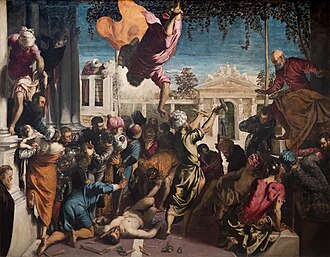 Miracle de l'esclave - Jacopo Tintoretto (1540s)
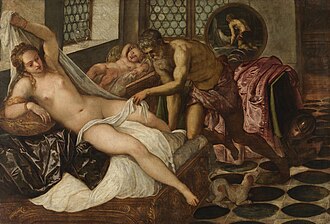 Vénus, Mars et Vulcain - Jacopo Tintoretto (1555)
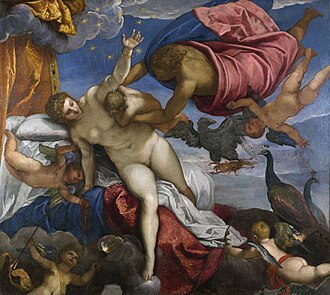 L'Origine de la Voie lactée - Jacopo Tintoretto (1575)
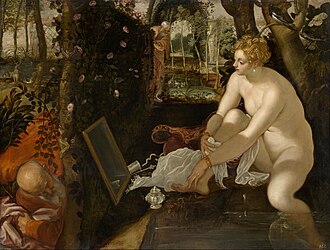 Suzanne et les Vieillards - Jacopo Tintoretto (1550s)
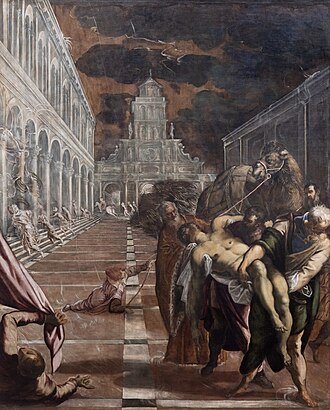 Le corps de saint Marc ramené à Venise - Jacopo Tintoretto (1560s)
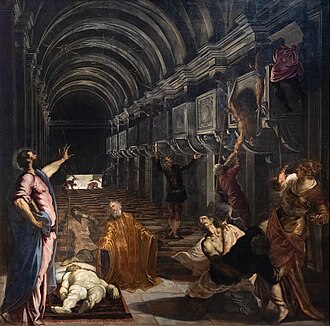 La Découverte du corps de saint Marc - Jacopo Tintoretto (1562)
%20Jacopo%20Tintoretto%20-%20Gloria%20del%20Paradiso%20-%20Sala%20del%20Maggior%20Consiglio.jpg) Le Paradis - Jacopo Tintoretto
Le Paradis - Jacopo Tintoretto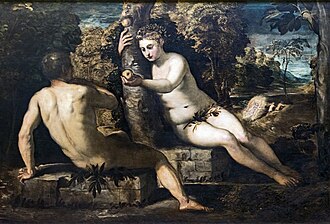 La Tentation d'Adam et Ève - Jacopo Tintoretto (1550s)
Œuvres d'artistes liés
.jpg) Vénus d'Urbin - Titian (1538)
Vénus d'Urbin - Titian (1538) L'Assomption de la Vierge - Titian (1510s)