Saint Joseph and the Christ Child
Le Greco · 1590s
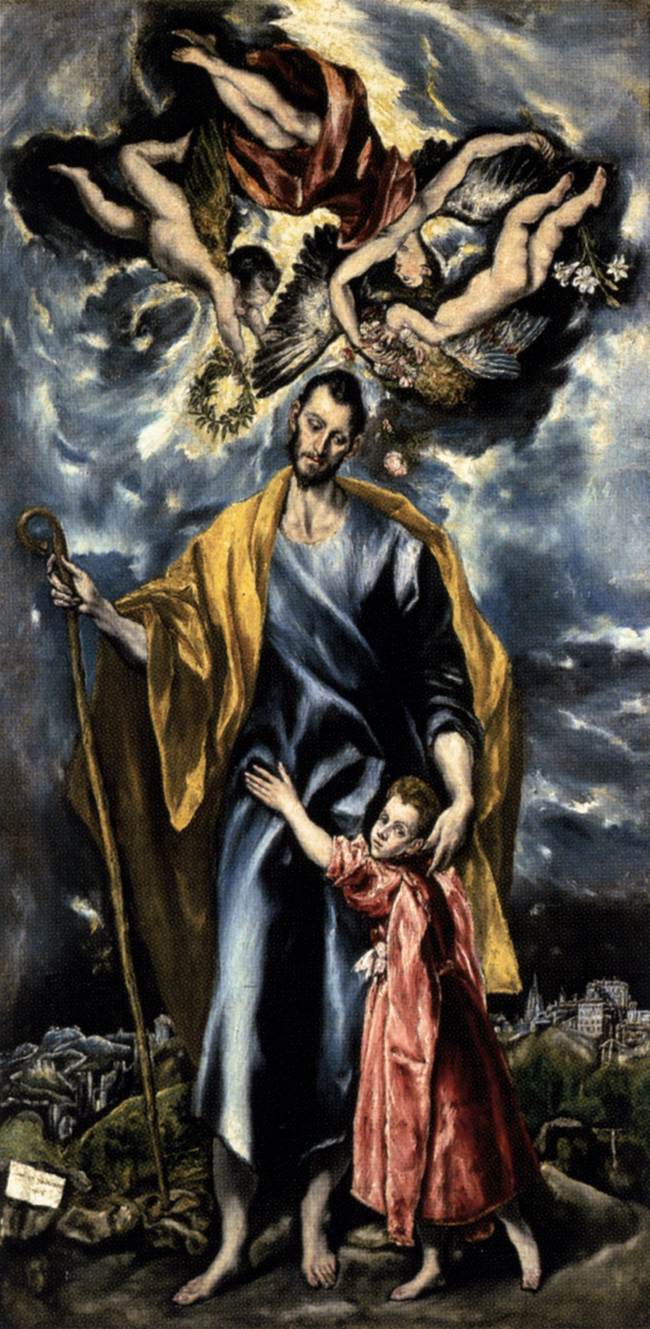
Saint Joseph walks toward us, young, tall and strong, staff in one hand, the Christ Child sheltered by the other, while angels bring him lilies, roses and a laurel crown. Behind them rises Toledo, its monuments rearranged by El Greco's imagination.
The story behind the painting
This is the most important canvas of the altarpieces in the Chapel of San José in Toledo, documented in 1597 to 1599, while Wikidata dates it simply to the 1590s. Before the sixteenth century, Joseph had been painted as an elderly craftsman and his cult was minor; El Greco himself had shown him as a secondary figure in works like the Adoration of the Magi. After the Council of Trent his importance grew. Johannes Molanus, a professor at Louvain, advised in 1570 that Joseph be shown young, strong and willing, able to protect the Virgin through his work, and Fray Alonso de Villegas offered a similar youthful image in 1580.
What to look for
The canvas is tall, 289 by 147 cm. Joseph, a man under forty, wears a blue tunic and a yellow cloak and carries a staff in his right hand, while with his left he shelters the Child in a pink dress, whose figure seems fully merged with his own. Above, angels in red, pink and pale blue twist in bold foreshortening; the central one offers lilies, another holds roses, a third brings a crown of laurel. In the background you can find Toledo: the castle of San Servando, the Alcántara bridge, the walls, the cathedral tower and the Alcázar without its spires, which had not yet been built.
Meaning and intent
According to José Álvarez Lopera, Joseph here is one of El Greco's finest creations: a traveller, a protector and a guide for the Child. The composition matches the Counter-Reformation idea of the saint and seems to follow Molanus's advice closely. El Greco places the Toledo monuments freely and with unlikely perspective to give the scene more character and meaning. At the bottom he paints only the smallest patch of ground needed for the figures to set their feet, because all he wants to stress are the two figures and the view behind them, a walk between heaven and a beloved city.
Legacy
The painting is signed in small cursive Greek letters on a paper at the lower left, and is number 15 in Harold Wethey's catalogue of El Greco. The tumbling group of angels has been compared, for its daring foreshortening, to the angel Tintoretto painted in Saint Mark Freeing the Slave. The canvas remains in the Chapel of San José in Toledo, the place it was made for, and it stands as a vivid image of how a once secondary saint became, around 1600, a young and heroic protector.
Le saviez-vous ?
- Main canvas of the altarpieces of the Chapel of San José, Toledo.
- Documented in 1597 to 1599; Wikidata says the 1590s.
- Measures 289 by 147 cm, signed in Greek.
- The background shows Toledo before the Alcázar had its spires.
À propos de l'artiste
Le Greco (1541-1614)
art religieux · Enfant Jésus · maniérisme · Joseph · bâton de marche
Autres œuvres de Le Greco
 L'Enterrement du comte d'Orgaz - El Greco (1586)
 Vue de Tolède - El Greco (1596)
 L'Ouverture du cinquième sceau - El Greco (1610)
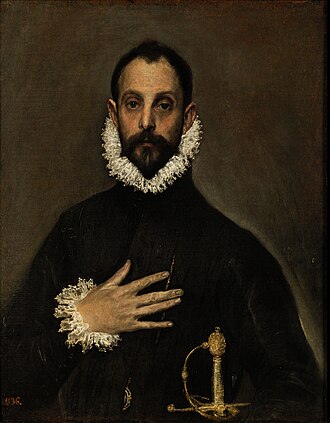 Le Gentilhomme à la main sur la poitrine - El Greco (1580)
%20-%20Laoco%C3%B6n%20-%20Google%20Art%20Project.jpg) Laocoon - El Greco (1610s)
Laocoon - El Greco (1610s)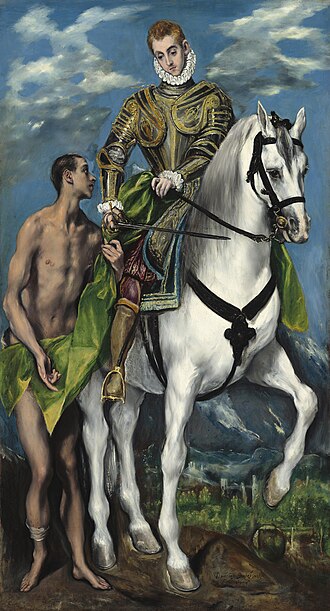 Saint Martin et le Mendiant - El Greco (1597)
.jpg) L'Adoration des bergers - El Greco (1612)
L'Adoration des bergers - El Greco (1612) Le Concert des anges - El Greco (1600s)
Œuvres d'artistes liés
.jpg) Vénus d'Urbin - Titian (1538)
Vénus d'Urbin - Titian (1538)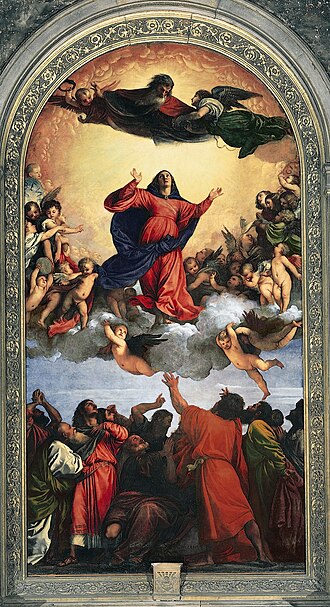 L'Assomption de la Vierge - Titian (1510s)
 Le Souper à Emmaüs - Caravaggio (1601)
 La Vocation de saint Matthieu - Caravaggio (1609)
 Les Ambassadeurs - Hans Holbein the Younger (1533)
 Le Christ mort - Hans Holbein the Younger (1520s)