Saint Barthélemy
Le Greco · 1610s
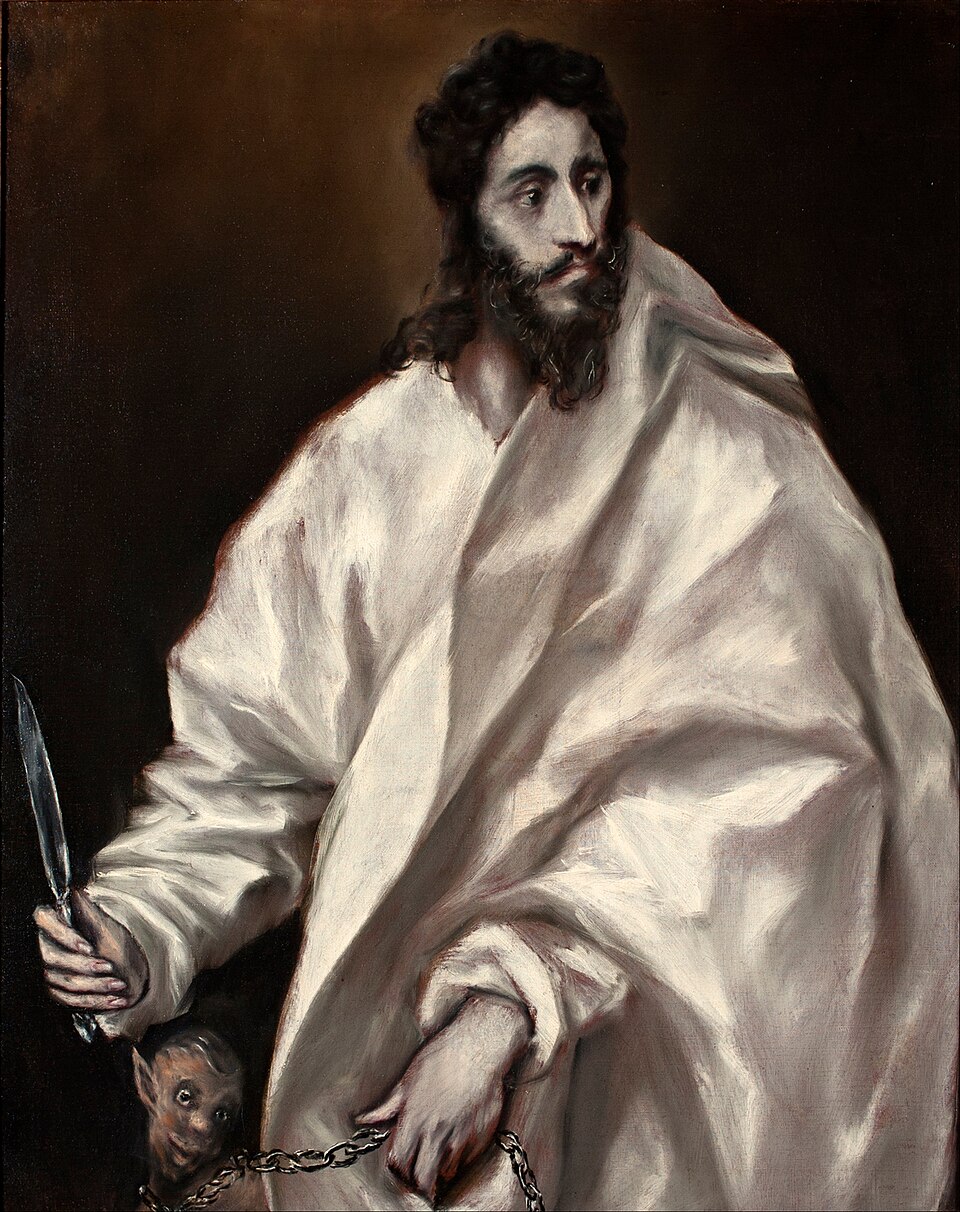
A pale young apostle in white holds a knife in one hand and, in the other, a chain leading to a small chained monkey. El Greco gave Saint Bartholomew a rare detail drawn from medieval legend, in one of his late series of apostles.
The story behind the painting
This portrait of the apostle Bartholomew belonged to a cycle called the Apostolado. El Greco painted the set of twelve apostles and the Saviour several times, but only two complete groups survive, one in the sacristy of Toledo Cathedral and one in the El Greco Museum in Toledo, where this canvas hangs. It is dated 1610 to 1614 and measures 97 by 77 cm. In the museum's series, Saint Matthew is replaced by Saint Paul. Six figures turn their heads to the right, six to the left, and the image of Christ the Saviour stood at the centre.
What to look for
The apostle wears a white tunic with a white cloak over his shoulder. He is still a young man, with a black beard and a pale, gaunt face. In his right hand he holds a knife, the attribute that recalls that he was flayed alive. In his other hand he holds a chain, a second attribute rarely shown, which makes this picture remarkable. At the end of it El Greco painted a monkey standing for a demon. He built the figure with a monochrome technique that gives a sculptural illusion, then modelled the features with light over a reddish ground.
Meaning and intent
The chain comes from the Golden Legend of Jacobus de Voragine, written in 1260 to 1270. Bartholomew was said to have preached as far as the Indies, where he confronted the false god Astaroth, and a demon named Berith declared that the god was bound in chains and could neither speak nor breathe once Bartholomew entered the temple. Guided by these words, El Greco placed a chain in the apostle's hands. Because missionaries of his time brought monkeys back from the Indies, he used that animal to show the demon, turning an old text into a vivid image.
Legacy
The history of the series is not fully clear. It was long thought to come from the Hospital of Santiago in Toledo after church property was confiscated, but documents found more recently show that the canvases belonged to the San Sebastián poorhouse, founded in 1834, and had been given by Marcelian Manuel Rodriguez, a priest of the Mozarabic church of Saint Luke. In 1909 they went to the museum founded on the initiative of the Marquis de la Vega Inclán. The painting has since travelled to Stockholm, Mexico City, Caracas, Madrid, Washington, Florence and Paris.
Le saviez-vous ?
- Part of El Greco's Apostolado series, dated 1610-1614.
- The knife recalls that Bartholomew was flayed alive.
- The chain and monkey come from the Golden Legend.
- In the El Greco Museum in Toledo since 1909.
À propos de l'artiste
Le Greco (1541-1614)
Autres œuvres de Le Greco
 L'Enterrement du comte d'Orgaz - El Greco (1586)
 Vue de Tolède - El Greco (1596)
 Le Dépouillement du Christ - El Greco (1570s)
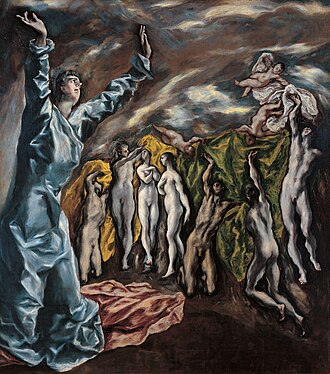 L'Ouverture du cinquième sceau - El Greco (1610)
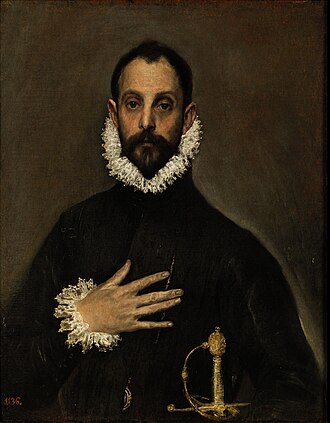 Le Gentilhomme à la main sur la poitrine - El Greco (1580)
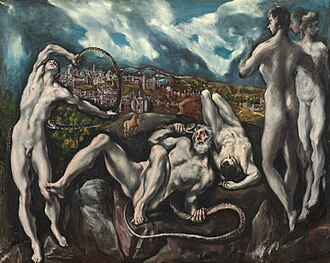 Laocoon - El Greco (1610s)
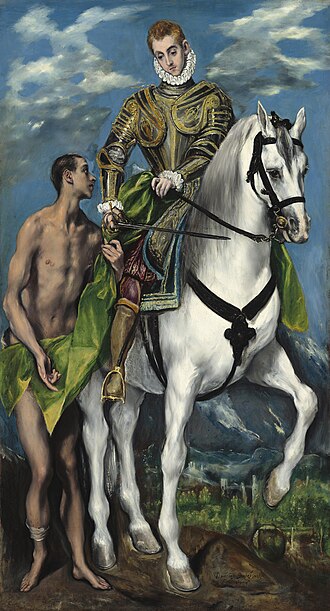 Saint Martin et le Mendiant - El Greco (1597)
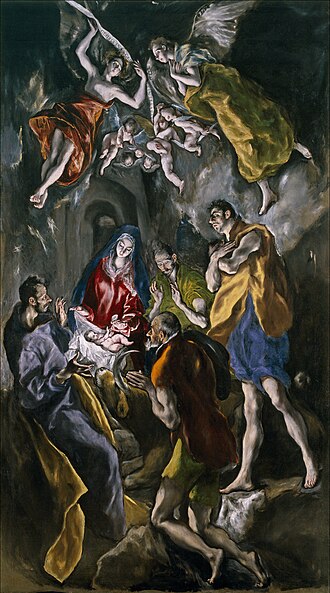 L'Adoration des bergers - El Greco (1612)
Œuvres d'artistes liés
 Les Noces de Cana - Paolo Veronese (1560s)
 Le Repas chez Levi - Paolo Veronese (1573)
 La Cène - Jacopo Tintoretto (1563)
 Miracle de l'esclave - Jacopo Tintoretto (1540s)
 Vénus d'Urbin - Titian (1538)
 L'Assomption de la Vierge - Titian (1510s)
 Le Souper à Emmaüs - Caravaggio (1601)
 La Vocation de saint Matthieu - Caravaggio (1609)
 Les Ambassadeurs - Hans Holbein the Younger (1533)
 Le Christ mort - Hans Holbein the Younger (1520s)