Jeune chanteuse
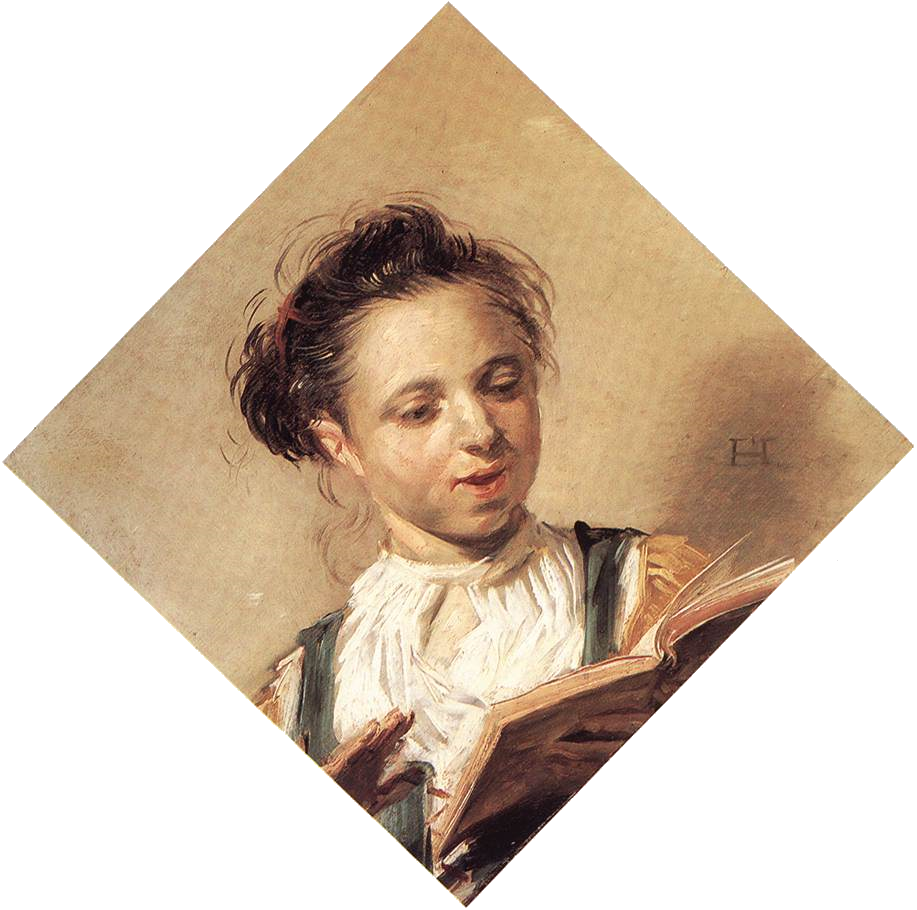
A girl sings from her book, lips parted, hair coming loose, keeping time with her hand. Frans Hals caught her on a tiny diamond-shaped panel, and some think she was his own daughter.
The story behind the painting
Hals painted Girl Singing in Haarlem, probably around 1628, as a pair with Boy Playing the Violin. The date is a guess based on comparison with other works, since the panel is not dated. Both are small square panels hung on one corner, in a lozenge format that is unusual for Hals, and both have a musical theme. A Haarlem resident told the writer Arnold Houbraken that Hals's many children were all keen musicians, and a 1644 inventory lists two square likenesses of Hals's children painted by him. Jaap van der Veen suggests these may be this pair. It has been conjectured that the girl is his daughter Sara, born in 1617.
What to look for
The light falls from the left, and in the girl's shadow on the plain warm brown background Hals placed his FH monogram. She turns her face slightly down to the book in her left hand, while her right hand keeps the rhythm. Because the painter looks up from a little below, we can see her eyes. The page she sings from flutters above the others. The lines of her brow, mouth, shoulders, fingertips and page almost echo the sides of the diamond. She wears a plain green bodice over a white chemise, her hair is in a loose bun spilling strands, and her chemise is coming apart a little at the collar.
Meaning and intent
No lace or finery marks her as a lady dressing up for a portrait, which helps the illusion that we have caught a passing moment. In strict Haarlem, loose hair and a loose chemise might have drawn a scolding, so the details suggest a home rather than a public place, and an enthusiastic singer simply busy with her song. The critic Ernst Wilhelm Moes said Hals's young singers really are singing to us, so that we can almost hear their voices. The Catholic Herald saw something nearly angelic in her face. Seymour Slive noted the same sparkling technique and blond tones as Hals's small portraits of the late 1620s.
Legacy
Hals never titled his pictures: Hofstede de Groot listed this one as A Girl Singing from a Book, and Slive as Singing Girl. Unless it was kept in the family, it can be seen as a tronie, an expressive face made for the open market rather than a paid portrait. If the model was Sara Hals, her later life was hard: after she twice had a child out of wedlock, her parents had her committed to the same workhouse and asylum where Malle Babbe lived. The panel is bookmatched with its partner, probably Baltic oak, and both now sit in elaborate tortoise-shell frames.
Le saviez-vous ?
- Pendant of Boy Playing the Violin, about 1628.
- Square panel hung as a diamond, each side about 18.5 cm.
- Signed with the FH monogram in the girl's shadow.
- The model may have been Hals's daughter Sara.
À propos de l'artiste
Frans Hals (1591-1666)
scène de genre · fille · Art Institute of Chicago
Autres œuvres de Frans Hals
 Le Joyeux Buveur - Frans Hals (1620s)
 Le Cavalier riant - Frans Hals (1624)
 La Bohémienne - Frans Hals (1628)
 Malle Babbe - Frans Hals (1640s)
 Portrait de Willem van Heythuysen - Frans Hals (1625)
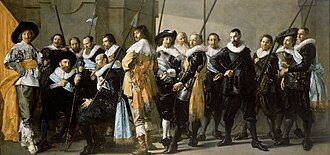 La Compagnie du capitaine Reinier Reael, dite ‘La Maigre Compagnie’ - Frans Hals (1630s)
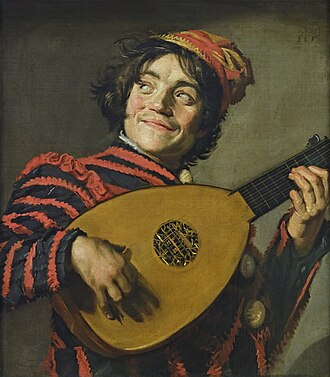 Le Bouffon au luth - Frans Hals (1623)
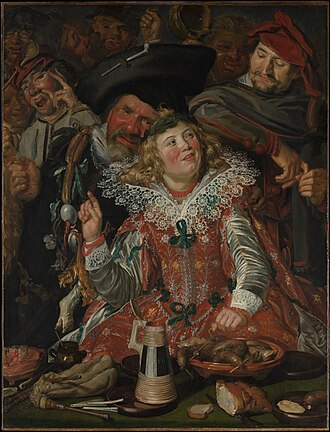 Fêtards du Mardi Gras - Frans Hals (1610s)
Œuvres d'artistes liés
 La Ronde de nuit - Rembrandt van Rijn (1642)
 Autoportrait - Rembrandt van Rijn (1659)
 La Jeune Fille à la perle - Johannes Vermeer (1665)
 La Laitière - Johannes Vermeer (c. 1658)
 La Fête de la Saint-Nicolas - Jan Steen (1660s)
 La Mangeuse d'huîtres - Jan Steen (1658)
 Le Moulin près de Wijk bij Duurstede - Jacob van Ruisdael (1670)
 Le Cimetière juif - Jacob van Ruisdael (1650s)
 La Cour d'une maison à Delft - Pieter de Hooch (1658)
 La Peleuse de pommes - Pieter de Hooch (1663)