Portrait de famille dans un paysage
Frans Hals · 1640s
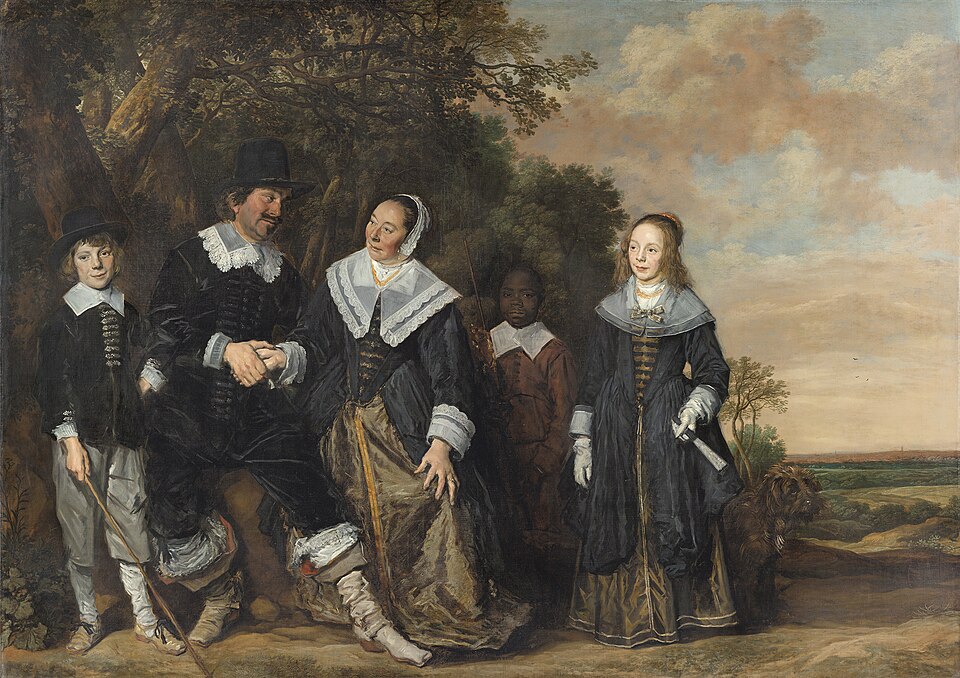
A Haarlem family poses in the open air, husband and wife hand in hand, children beside them, a poodle at their feet. Among them stands a Black boy, a rare figure in Hals' world and the reason this canvas still speaks today.
The story behind the painting
Frans Hals painted this large family portrait around 1645 to 1648; Wikidata dates it to the 1640s, and Hofstede de Groot's catalog of 1910 put it at about 1640. It is one of a handful of family pictures Hals made in the open air picnic style, and the only one that includes a Black boy, a rarity in Haarlem in his lifetime. At about 202 by 285 cm it is one of his largest works, the largest not devoted to the civic guards of Haarlem. Who the family were has long been unclear. In 2023 Ineke Mok and Dineke Stam argued they were Jacob Ruychaver, a former director general of the Gold Coast, his wife Maria Hendrixs and their children.
What to look for
On the left a man in a tall black hat, black velvet and high riding boots holds his wife's right hand, and they look at each other. She wears a greenish grey dress with a black bodice trimmed with yellow bows and a lace cap and collar. A smiling youth with a stick stands beside the man; a little boy and a daughter holding a closed fan stand to the right, and a poodle crouches beside her. Trees fill the left background and a town lies in the right distance. Hofstede de Groot found it all painted in neutral grey tones, relieved only by the red of the boots.
Meaning and intent
The family's flat collars and colored underskirt mark them as wealthy burghers who could afford the latest fashion. According to Mok and Stam, it was common for former directors general of the Gold Coast to commission a painting that included an African servant. The background landscape has been proposed as the work of Pieter de Molijn, first suggested by Neil MacLaren for Hals' family portrait in London and then applied to this canvas by Seymour Slive. Hals' quick, lively portraits catch people in the middle of a glance or a smile, as the youth on the left shows.
Legacy
The painting was shown at the Royal Academy in 1906 as Portraits of The Painter and his Family. It had belonged to the Warde family of Squerries Court, Kent, since about 1750, passed through the dealer Joseph Duveen in 1909, was bought by Otto Hermann Kahn and lent to the Metropolitan Museum of Art, and later entered the Thyssen-Bornemisza collection; it is now in Madrid. It was restored in 1966. In 2017 the artist Titus Kaphar made it the subject of a TED talk, painting out every figure but the Black boy to show how little is known about the Black people who appear in such pictures.
Le saviez-vous ?
- Painted around 1645 to 1648 (Wikidata: 1640s).
- One of Hals' largest paintings, about 202 by 285 cm.
- His only family portrait that includes a Black boy.
- Now in the Museo Thyssen-Bornemisza, Madrid.
À propos de l'artiste
Frans Hals (1591-1666)
paysage · musée Thyssen-Bornemisza · portrait de famille · famille · Sammlung Schloss Rohoncz
Autres œuvres de Frans Hals
 Le Joyeux Buveur - Frans Hals (1620s)
 Le Cavalier riant - Frans Hals (1624)
 La Bohémienne - Frans Hals (1628)
 Malle Babbe - Frans Hals (1640s)
 Portrait de Willem van Heythuysen - Frans Hals (1625)
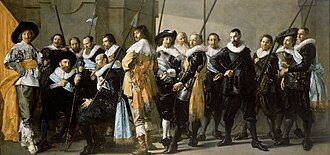 La Compagnie du capitaine Reinier Reael, dite ‘La Maigre Compagnie’ - Frans Hals (1630s)
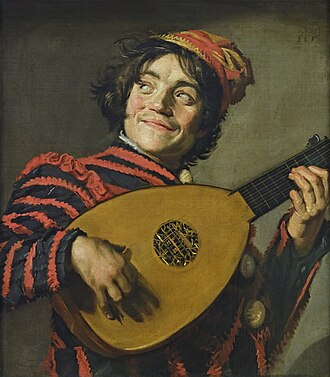 Le Bouffon au luth - Frans Hals (1623)
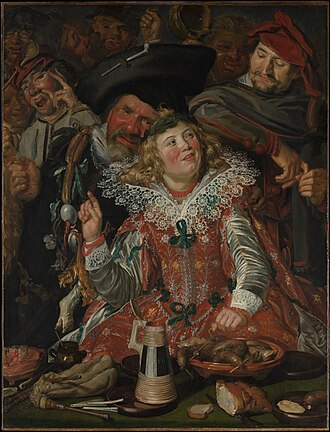 Fêtards du Mardi Gras - Frans Hals (1610s)
Œuvres d'artistes liés
 La Ronde de nuit - Rembrandt van Rijn (1642)
 Autoportrait - Rembrandt van Rijn (1659)
 La Jeune Fille à la perle - Johannes Vermeer (1665)
 La Laitière - Johannes Vermeer (c. 1658)
 La Fête de la Saint-Nicolas - Jan Steen (1660s)
 La Mangeuse d'huîtres - Jan Steen (1658)
 Le Moulin près de Wijk bij Duurstede - Jacob van Ruisdael (1670)
 Le Cimetière juif - Jacob van Ruisdael (1650s)
 La Cour d'une maison à Delft - Pieter de Hooch (1658)
 La Peleuse de pommes - Pieter de Hooch (1663)