La Lithotomie
Jérôme Bosch · 1500s
.jpg)
A doctor in a funnel hat bends over a patient's head and lifts out a stone that is really a flower bulb. Bosch's little panel laughs at folly, and perhaps at those who sell cures for it.
The story behind the painting
Cutting the Stone, also called The Extraction of the Stone of Madness or The Cure of Folly, is an oil painting on panel by Hieronymus Bosch, now in the Museo del Prado in Madrid. The source dates it to around 1494 or later, while Wikidata gives the 1500s. It is a small work, 48.5 by 34.5 centimetres. Its subject was the old idea that madness could be cured by removing a stone from the head. An inscription in gold Gothic letters runs around the scene, and it names Lubbert Das, a comical, foolish character from Dutch literature, which tells us at once that we are watching a satire.
What to look for
At the centre a surgeon wearing a funnel as a hat operates on a seated patient, cutting into his head by trepanation. Look at what he pulls out: not a stone, but a flower bulb. Bosch is playing on the Dutch word kei, which could mean both stone and bulb. Another flower lies on the table. Beside them stands an assistant, a monk holding a tankard. To one side a woman leans on the table with a closed book balanced on her head, looking on calmly. Each figure is a small riddle, and Bosch invites us to puzzle over them one by one.
Meaning and intent
The source offers several readings. The flower and the funnel hat may both hint that the doctor is a charlatan, a quack performing a sham operation on a gullible man. In that case the folly lies as much with the healer and his helpers as with the patient. The woman with the book is harder to explain. One scholar, Skemer, sees her as a satire on the Flemish custom of wearing amulets made from books and scripture, a picture of the word phylactery. Others think she simply represents folly itself. The painting leaves these questions open, letting each viewer decide who is truly foolish.
Legacy
The panel belongs to the allegories that Wikidata groups under Early Netherlandish painting, and it shows Bosch turning a popular joke into a sharp, careful image. Its alternative titles, The Cure of Folly and The Extraction of the Stone of Madness, show how its message has been read across time: a mockery of foolishness and of those who profit from it. The Lubbert Das inscription links it to a comic figure known to its first viewers. In the Prado today it remains a small but memorable picture, where wordplay, satire and quiet observation combine in a way that still rewards close looking.
Le saviez-vous ?
- Oil on panel, 48.5 x 34.5 cm, Museo del Prado
- The source dates it to about 1494 or later; Wikidata gives the 1500s
- The stone is shown as a flower bulb, a pun on the Dutch word kei
- The inscription names Lubbert Das, a foolish character in Dutch literature
À propos de l'artiste
Jérôme Bosch (1450-1516)
femme · homme · musée du Prado · position assise · station debout · allégorie
Autres œuvres de Jérôme Bosch
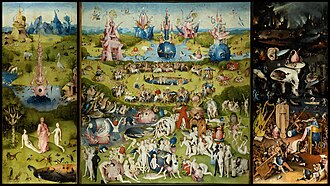 Le Jardin des délices - Hieronymus Bosch
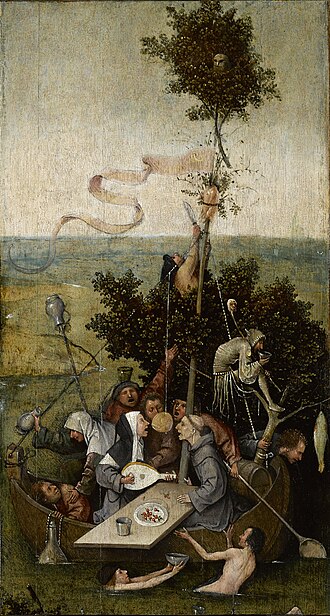 La Nef des fous - Hieronymus Bosch (1500s)
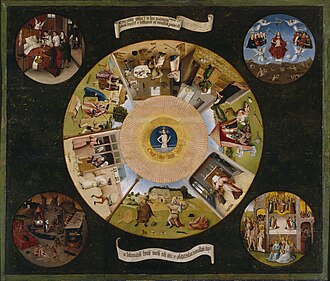 Les Sept Péchés capitaux et les Quatre Dernières Étapes humaines - Hieronymus Bosch (1500)
.jpg) Le Chariot de foin - Hieronymus Bosch (1510s)
Le Chariot de foin - Hieronymus Bosch (1510s)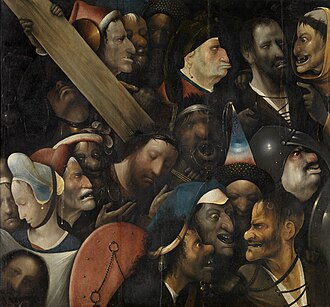 Le Portement de Croix - Hieronymus Bosch (1510s)
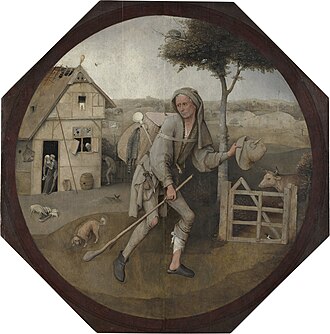 Le Vagabond - Hieronymus Bosch (1500)
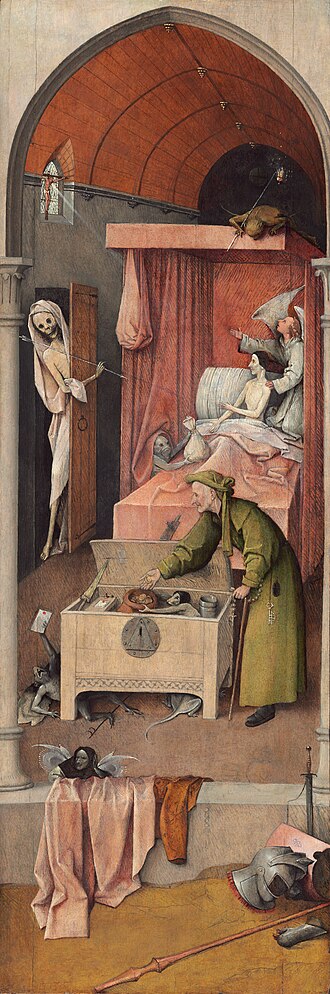 La Mort de l'avare - Hieronymus Bosch (1500s)
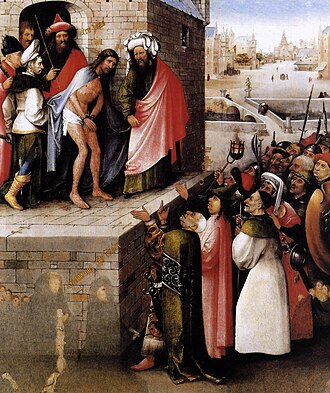 Ecce Homo - Hieronymus Bosch (1490s)
Œuvres d'artistes liés
 La Joconde - Leonardo da Vinci (1503-1519)
 La Dame à l'hermine - Leonardo da Vinci (1490)
.jpg) Vénus d'Urbin - Titian (1538)
Vénus d'Urbin - Titian (1538) L'Assomption de la Vierge - Titian (1510s)
 Autoportrait - Albrecht Dürer (1500)
 Adoration des mages - Albrecht Dürer (1504)
 La Naissance de Vénus - Sandro Botticelli (c. 1485)
 Le Printemps - Sandro Botticelli (1480s)
%20-%20Google%20Art%20Project.jpg) Les Chasseurs dans la neige - Pieter Bruegel the Elder (1565)
Les Chasseurs dans la neige - Pieter Bruegel the Elder (1565) Les Proverbes flamands - Pieter Bruegel the Elder (1551)