Les Sept Péchés capitaux et les Quatre Dernières Étapes humaines
Jérôme Bosch · 1500
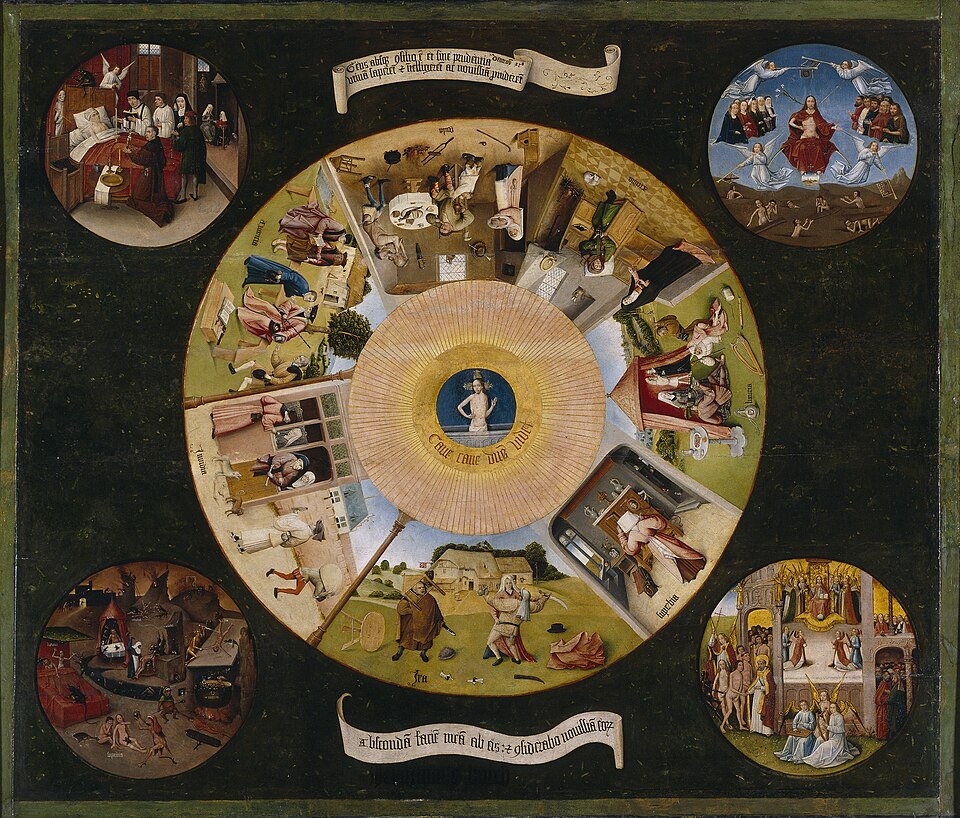
At the centre of this tabletop is a great eye, and in its pupil Christ rises from the tomb above two words of warning: Beware, beware, the Lord sees. Around it, ordinary people go on sinning.
The story behind the painting
The painting is attributed to Hieronymus Bosch or to a follower, and dated around 1500 or later. Philip II of Spain bought it before 1560 believing it an original, made it his favourite Bosch and hung it in his bedroom at El Escorial, then gave it to the monastery in 1574. Doubts began early: a passage by Felipe de Guevara in 1560 mentions a gifted pupil who signed his master's name. In 2015 the Bosch Research and Conservation Project assigned it to a follower, but the Prado, where it is displayed in a sealed case, still considers it authentic.
What to look for
The panel, about 120 by 140 cm, is built from circles. A large central wheel shows the seven sins as scenes from daily life, not allegories. A judge takes a bribe for greed. A drunkard and a fat man feast while a child pleads for gluttony. A man dozes by the fire, ignoring a nun who reminds him to pray. Couples picnic in a pink tent. A woman admires herself in a mirror held by a demon. Two drunken peasants fight while a woman tries to separate them. In the corners, four small circles show Death, Judgment, Heaven and Hell.
Meaning and intent
The design turns the whole picture into the eye of God watching the world. The Latin inscription Cave cave dominus videt, Beware, beware, the Lord sees, sits beneath the risen Christ. Above and below, lines from Deuteronomy lament a people void of counsel and wish they would consider their latter end. The four last things remind viewers where each sin leads: a deathbed with an angel and a demon at hand, Christ in glory waking the dead, Saint Peter at the gate of Heaven, and demons punishing sinners according to their sins.
Legacy
Debate over the work continues. Some scholars cite its awkward drawing, its poplar panel rather than oak, and its costumes; Ed Hoffman argued in 2005 it might be a copy. Others note that the underdrawing and brushwork are consistent with Bosch's later paintings, that the pentimenti show it is no simple reproduction, and that the signature is Bosch's own. Most historians now date the costumes to between 1505 and 1510, while Wikidata gives 1500. Whatever its authorship, its watchful eye remains one of the most memorable images in the Prado.
Le saviez-vous ?
- Owned by Philip II of Spain, who hung it in his bedroom.
- Attribution disputed; the Prado considers it authentic.
- Displayed at the Prado in a sealed case.
- Inscription: Cave cave dominus videt (Beware, beware, the Lord sees).
À propos de l'artiste
Jérôme Bosch (1450-1516)
art religieux · musée du Prado
Autres œuvres de Jérôme Bosch
 Le Jardin des délices - Hieronymus Bosch
 La Nef des fous - Hieronymus Bosch (1500s)
.jpg) Le Chariot de foin - Hieronymus Bosch (1510s)
Le Chariot de foin - Hieronymus Bosch (1510s) Le Portement de Croix - Hieronymus Bosch (1510s)
 Le Vagabond - Hieronymus Bosch (1500)
 La Mort de l'avare - Hieronymus Bosch (1500s)
 Ecce Homo - Hieronymus Bosch (1490s)
.jpg) La Lithotomie - Hieronymus Bosch (1500s)
La Lithotomie - Hieronymus Bosch (1500s)
Œuvres d'artistes liés
 La Joconde - Leonardo da Vinci (1503-1519)
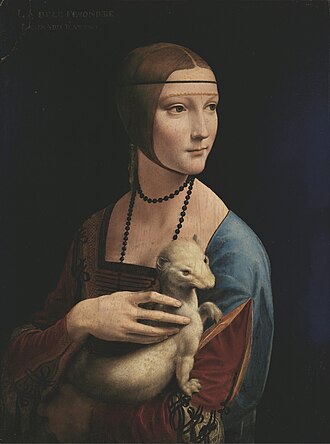 La Dame à l'hermine - Leonardo da Vinci (1490)
.jpg) Vénus d'Urbin - Titian (1538)
Vénus d'Urbin - Titian (1538)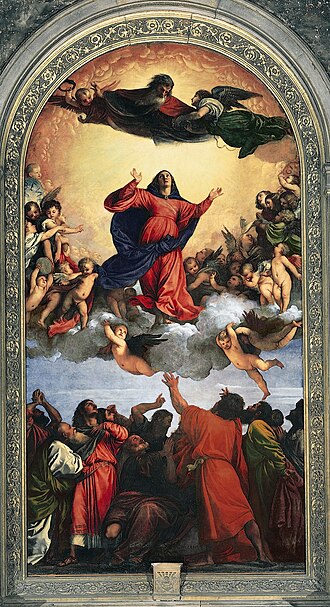 L'Assomption de la Vierge - Titian (1510s)
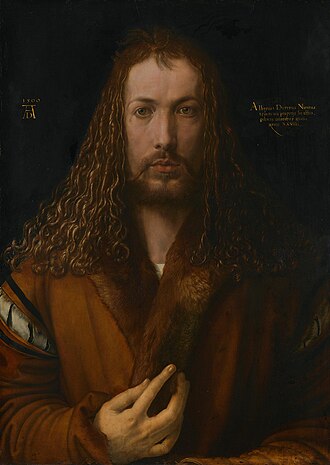 Autoportrait - Albrecht Dürer (1500)
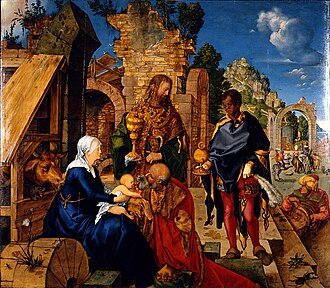 Adoration des mages - Albrecht Dürer (1504)
 La Naissance de Vénus - Sandro Botticelli (c. 1485)
 Le Printemps - Sandro Botticelli (1480s)
%20-%20Google%20Art%20Project.jpg) Les Chasseurs dans la neige - Pieter Bruegel the Elder (1565)
Les Chasseurs dans la neige - Pieter Bruegel the Elder (1565) Les Proverbes flamands - Pieter Bruegel the Elder (1551)