La Mort de l'avare
Jérôme Bosch · 1500s
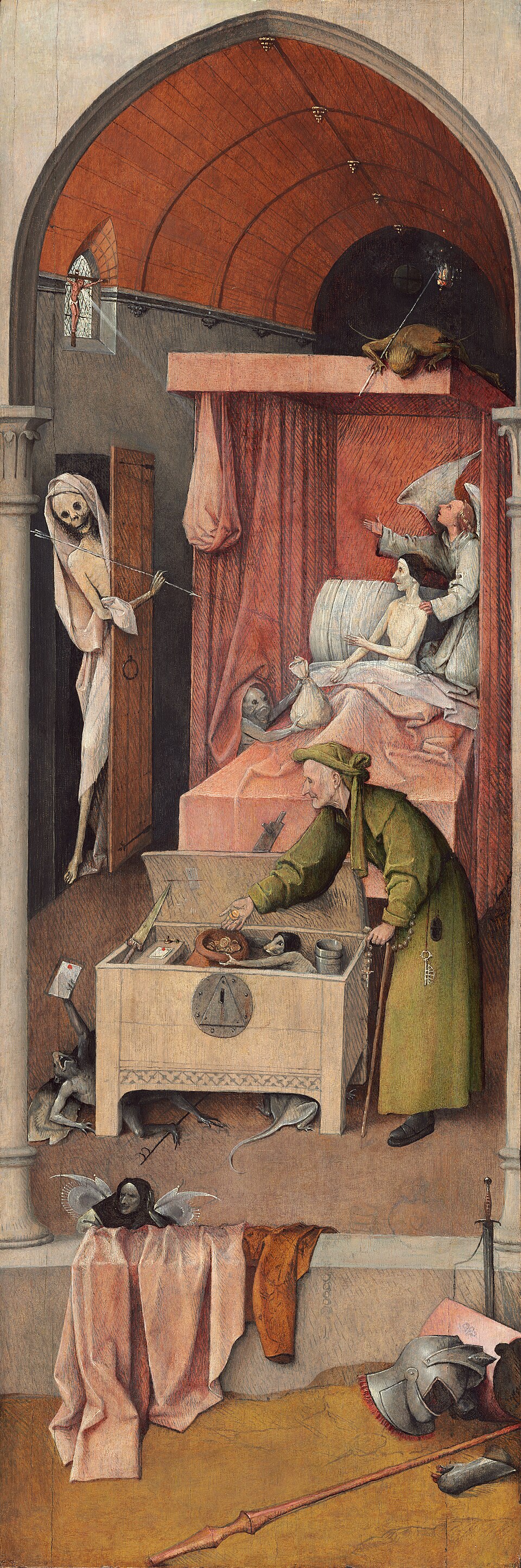
Death slips through a door with an arrow, an angel points to a crucifix in the window, and a demon offers a bag of gold. The dying man must choose, and Bosch does not tell us what he does.
The story behind the painting
Death and the Miser, also called Death of the Usurer, was painted by Hieronymus Bosch between 1490 and 1516; Wikidata gives the 1500s. It was originally part of a triptych whose centre is now missing. The tall, narrow panel measures 93 by 31 centimetres and belongs to the National Gallery of Art in Washington, D.C., through the Samuel H. Kress Collection. It is a memento mori, an image meant to remind viewers that death is certain and that the pursuit of wealth is futile. Bosch drew on the Ars moriendi, popular fifteenth-century handbooks with text and woodcuts that taught Christians how to die well.
What to look for
We look through a pointed arch into a narrow vaulted room. A thin, sickly man lies in bed. On the left, skeletal Death emerges from a doorway, an arrow aimed at him. An angel rests a hand on his shoulder and gestures toward a ray of light from the window, where a small crucifix hangs. From the bed canopy a creature peers down with a lantern, while a devil offers the man a large sack of coins. In the foreground an old man in green, clutching a cane and rosary, drops coins into a demon's sack inside a chest filled with money, armour, a knife and letters.
Meaning and intent
The painting folds different moments into one scene. The old man in green is widely seen as the miser in better health, storing gold while clinging to his rosary, torn between piety and wealth. Usury, lending money at interest, was then condemned as a grave sin. In the Ars moriendi the angel succeeds in turning the dying man to Christ. Here, as Death looms, the miser's gaze and hand still reach down toward the demon's gold. Whether he will turn to salvation is left uncertain. The source suggests this places the decision in his own hands rather than in a battle between angels and demons.
Legacy
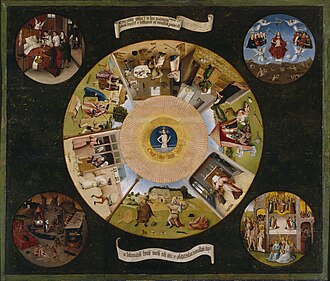
Bosch's familiarity with the Ars moriendi also appears in a roundel showing the death of a sinner in The Seven Deadly Sins and the Four Last Things, which shares the figure of Death and the angel and devil at the bedside. Death and the Miser may have been Bosch's image of avarice within a similar scheme. Another reading suggests the man is offering his wealth to Death as a ransom. Debate continues over the exact symbolism of the figures and objects. Today in Washington, the panel still asks the question at its heart, quietly and without answering it: what will we hold on to at the end?
Le saviez-vous ?
- Painted between 1490 and 1516; Wikidata gives the 1500s
- Originally part of a triptych whose centre panel is lost
- 93 x 31 cm, National Gallery of Art, Washington, Samuel H. Kress Collection
- Draws on the Ars moriendi handbooks on dying well
À propos de l'artiste
Jérôme Bosch (1450-1516)
National Gallery of Art · allégorie · lit
Autres œuvres de Jérôme Bosch
 Le Jardin des délices - Hieronymus Bosch
 La Nef des fous - Hieronymus Bosch (1500s)
 Les Sept Péchés capitaux et les Quatre Dernières Étapes humaines - Hieronymus Bosch (1500)
.jpg) Le Chariot de foin - Hieronymus Bosch (1510s)
Le Chariot de foin - Hieronymus Bosch (1510s)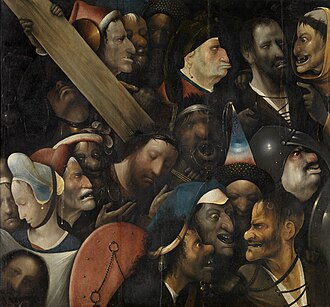 Le Portement de Croix - Hieronymus Bosch (1510s)
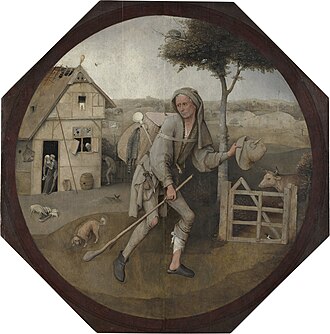 Le Vagabond - Hieronymus Bosch (1500)
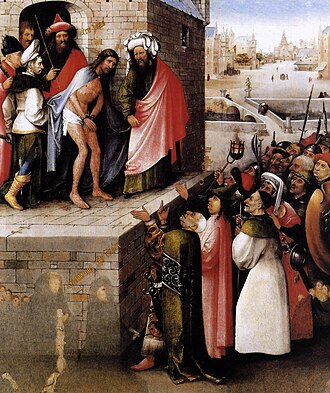 Ecce Homo - Hieronymus Bosch (1490s)
.jpg) La Lithotomie - Hieronymus Bosch (1500s)
La Lithotomie - Hieronymus Bosch (1500s)
Œuvres d'artistes liés
 La Joconde - Leonardo da Vinci (1503-1519)
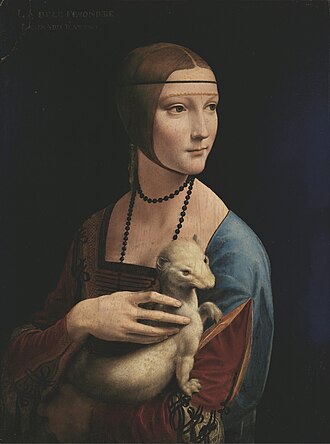 La Dame à l'hermine - Leonardo da Vinci (1490)
.jpg) Vénus d'Urbin - Titian (1538)
Vénus d'Urbin - Titian (1538)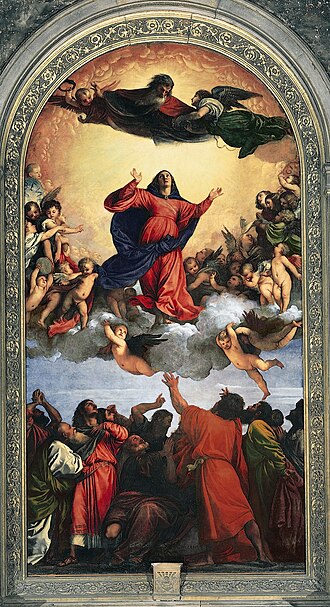 L'Assomption de la Vierge - Titian (1510s)
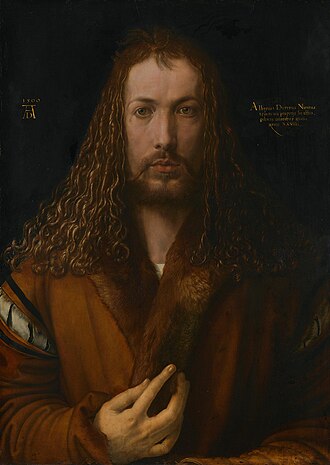 Autoportrait - Albrecht Dürer (1500)
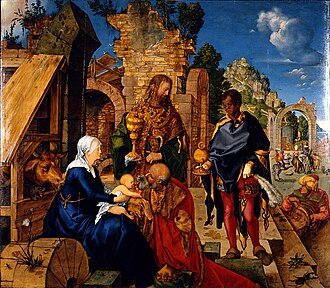 Adoration des mages - Albrecht Dürer (1504)
 La Naissance de Vénus - Sandro Botticelli (c. 1485)
 Le Printemps - Sandro Botticelli (1480s)
%20-%20Google%20Art%20Project.jpg) Les Chasseurs dans la neige - Pieter Bruegel the Elder (1565)
Les Chasseurs dans la neige - Pieter Bruegel the Elder (1565) Les Proverbes flamands - Pieter Bruegel the Elder (1551)