Le Vagabond
Jérôme Bosch · 1500
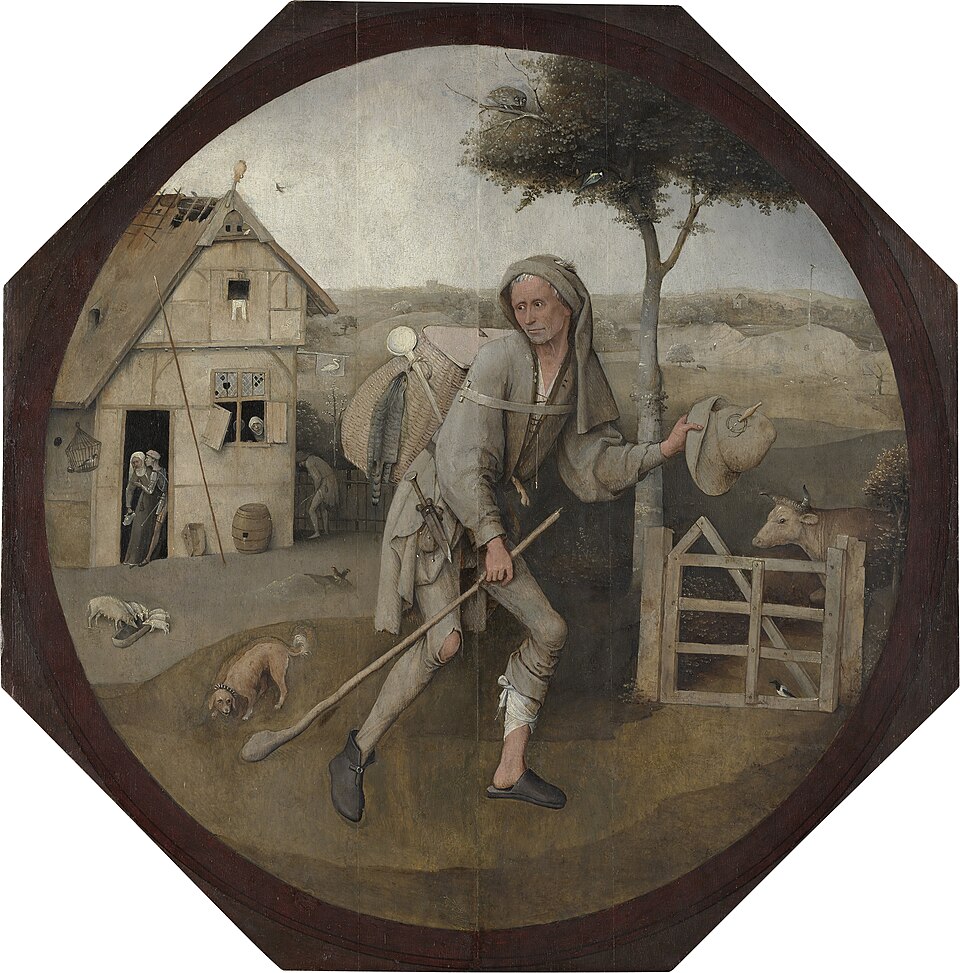
A lone pedlar walks through a landscape, with a house on one side and a gate on the other. Hieronymus Bosch leaves us to decide which way his story turns.
The story behind the painting
Hieronymus Bosch, born Jheronimus van Aken around 1450, spent his whole life in the Brabant town of 's-Hertogenbosch and died in 1516. The Wayfarer, also called The Pedlar, was painted in oil on panel around 1500. It is not a complete work but a fragment: it once belonged to a triptych or diptych that is now partly lost. Other surviving pieces of the same ensemble are the Allegory of Gluttony and Lust, the Ship of Fools, and Death and the Miser, now scattered among different collections.
What to look for
The painting is round, about 71.5 cm across, a shape that frames the traveller like a scene seen through a lens. A lone man, the pedlar of the alternative title, walks through the landscape with his load. Behind him on the left stands a house associated with debauchery; to the right is a gate. The figure closely resembles the wanderer Bosch painted in The Path of Life on the outside of The Haywain Triptych, so the two images can be read as relatives in Bosch's thinking.
Meaning and intent
What is the traveller doing? Interpretations differ. One reading sees him choosing between the path of virtue, marked by the gate on the right, and the path of debauchery in the house on the left. Another sees him as the prodigal son of the parable, returning home from the world. Both readings make the picture a meditation on choice and on the road of a human life, with the viewer invited to stand at the same crossroads and ask which way they would go.
Legacy
The panel is now in the Museum Boijmans Van Beuningen in Rotterdam, which also holds Bosch's drawing The Owl's Nest; Wikidata also records it in the Jacques Goudstikker collection. Wikidata gives the size as 71 by 70.6 cm, close to the 71.5 cm diameter in Wikipedia. The figure has continued to inspire: the Australian painter Tim Storrier's self-portrait The Histrionic Wayfarer (after Bosch) won the Archibald Prize in 2012, five centuries after Bosch set his traveller on the road.
Le saviez-vous ?
- Oil on panel, c. 1500; round, about 71.5 cm across.
- A fragment of a partly lost triptych or diptych.
- Museum Boijmans Van Beuningen, Rotterdam.
- Inspired Tim Storrier's 2012 Archibald Prize winner.
Wikipedia · Wikipedia · Wikidata
À propos de l'artiste
Jérôme Bosch (1450-1516)
Autres œuvres de Jérôme Bosch
 Le Jardin des délices - Hieronymus Bosch
 La Nef des fous - Hieronymus Bosch (1500s)
 Les Sept Péchés capitaux et les Quatre Dernières Étapes humaines - Hieronymus Bosch (1500)
.jpg) Le Chariot de foin - Hieronymus Bosch (1510s)
Le Chariot de foin - Hieronymus Bosch (1510s)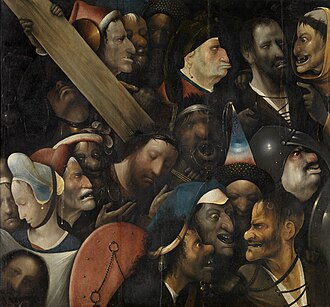 Le Portement de Croix - Hieronymus Bosch (1510s)
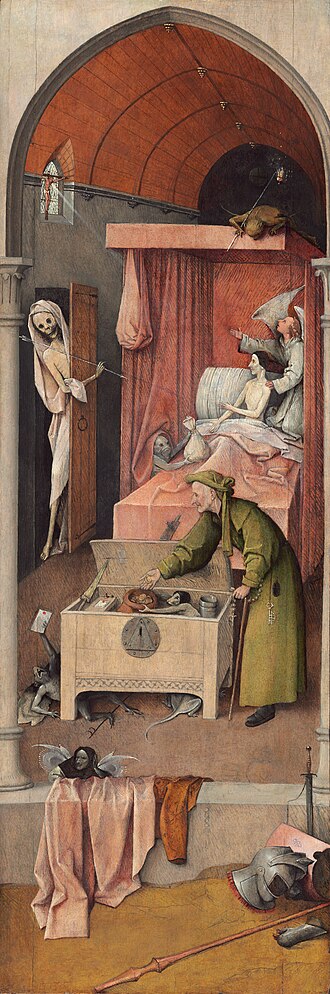 La Mort de l'avare - Hieronymus Bosch (1500s)
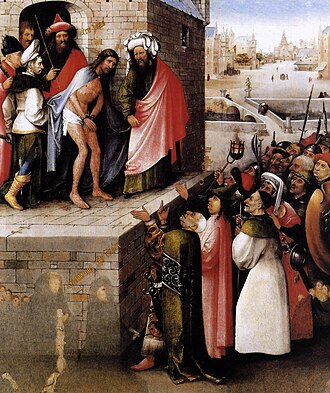 Ecce Homo - Hieronymus Bosch (1490s)
.jpg) La Lithotomie - Hieronymus Bosch (1500s)
La Lithotomie - Hieronymus Bosch (1500s)
Œuvres d'artistes liés
 La Joconde - Leonardo da Vinci (1503-1519)
 La Dame à l'hermine - Leonardo da Vinci (1490)
.jpg) Vénus d'Urbin - Titian (1538)
Vénus d'Urbin - Titian (1538) L'Assomption de la Vierge - Titian (1510s)
 Autoportrait - Albrecht Dürer (1500)
 Adoration des mages - Albrecht Dürer (1504)
 La Naissance de Vénus - Sandro Botticelli (c. 1485)
 Le Printemps - Sandro Botticelli (1480s)
%20-%20Google%20Art%20Project.jpg) Les Chasseurs dans la neige - Pieter Bruegel the Elder (1565)
Les Chasseurs dans la neige - Pieter Bruegel the Elder (1565) Les Proverbes flamands - Pieter Bruegel the Elder (1551)