Banquet des officiers du corps des archers de Saint-George, Haarlem 1627
Frans Hals · 1627
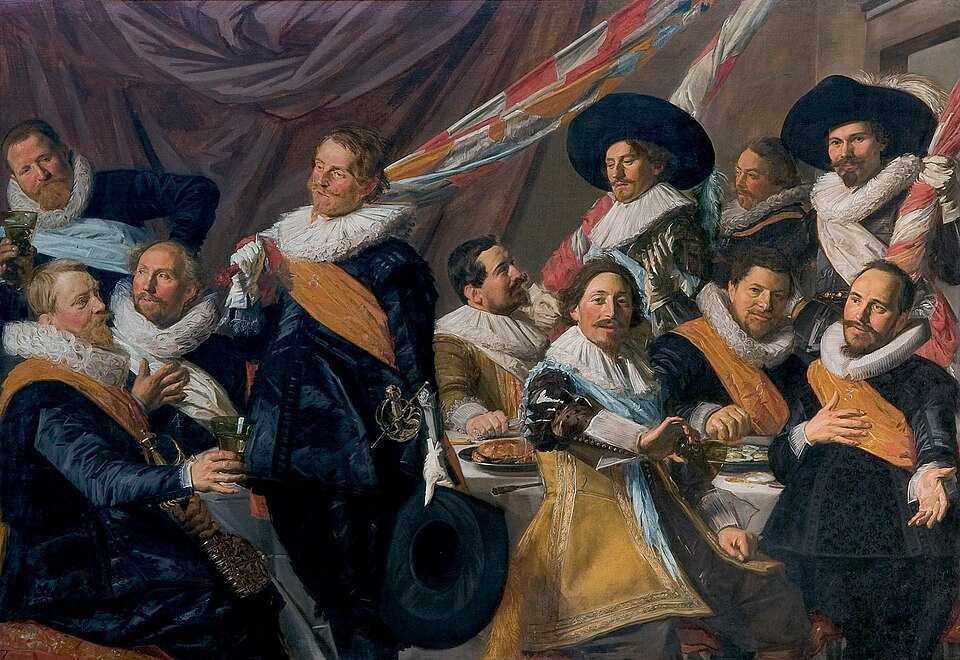
Glasses raised, sashes flashing orange, white and blue, the officers of a Haarlem militia company turn as if someone just walked into the room. Frans Hals made a staged dinner feel like a moment caught alive.
The story behind the painting
Haarlem had civic militias since at least 1374. After Spanish occupation ended in 1580, new officers led new companies, including the St George Guild. Officers had to pay for their service and their own uniforms, so they came from wealthy citizens, such as Captain Michiel de Wael, a popular tavern keeper. The officers commissioned this group portrait in 1626 to 1627 to mark the end of their three years of service. Each member paid a share, and according to the source some paid more to improve their place on the canvas, while those who could not pay had a smaller role.
What to look for
On a canvas of about 179 by 257.5 cm, the officers sit around a long table in the banquet hall of the St Jorisdoelen. At the head of the table, Colonel Aart Jansz Druyvesteyn in an orange sash holds a glass of wine and looks at Captain Michiel de Wael, whose glass is empty. Find the flag bearer Boudewijn van Offenberg, whose orange contrasts with the deep darks of his uniform, and the servant Arent Jacobsz Koets in the background. Up close the brushstrokes are loose and quick; from a distance the details come together.
Meaning and intent
Hals cared more about how the men interact than about symbols; ceremonial meaning is minor. He grouped the officers in small conversations, varied their heights for depth, and turned some of them toward the viewer, as if they are looking at someone outside the frame. Art historian Ann Sutherland Harris calls this seeming realism. It is an illusion: Hals did not paint during a real banquet. He invented the composition and then had each officer pose for him in his studio. The result sits between group portrait and genre scene.
Legacy
Between 1616 and 1639 Hals painted five such militia group portraits for Haarlem companies. This one hung with others in the main hall of the old St Jorisdoelen, today the Proveniershuis on the Grote Houtstraat, which for years served as an inn where the militia paintings were a tourist attraction. All of them were later moved to the Frans Hals Museum, where this banquet is now one of the main attractions.
Le saviez-vous ?
- Painted 1626-1627 for the St George militia of Haarlem.
- Marked the end of the officers' three years of service.
- Officers posed one by one in Hals's studio.
- One of the main attractions of the Frans Hals Museum.
À propos de l'artiste
Frans Hals (1591-1666)
schutterstuk · musée Frans-Hals
Autres œuvres de Frans Hals
 Le Joyeux Buveur - Frans Hals (1620s)
 Le Cavalier riant - Frans Hals (1624)
 La Bohémienne - Frans Hals (1628)
 Malle Babbe - Frans Hals (1640s)
 Portrait de Willem van Heythuysen - Frans Hals (1625)
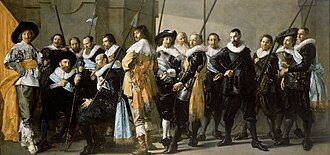 La Compagnie du capitaine Reinier Reael, dite ‘La Maigre Compagnie’ - Frans Hals (1630s)
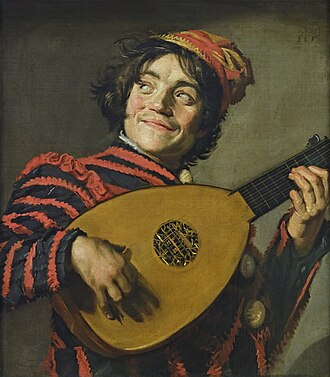 Le Bouffon au luth - Frans Hals (1623)
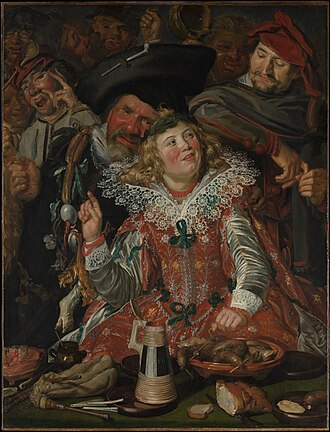 Fêtards du Mardi Gras - Frans Hals (1610s)
Œuvres d'artistes liés
 La Ronde de nuit - Rembrandt van Rijn (1642)
 Autoportrait - Rembrandt van Rijn (1659)
 La Jeune Fille à la perle - Johannes Vermeer (1665)
 La Laitière - Johannes Vermeer (c. 1658)
 La Fête de la Saint-Nicolas - Jan Steen (1660s)
 La Mangeuse d'huîtres - Jan Steen (1658)
 Le Moulin près de Wijk bij Duurstede - Jacob van Ruisdael (1670)
 Le Cimetière juif - Jacob van Ruisdael (1650s)
 La Cour d'une maison à Delft - Pieter de Hooch (1658)
 La Peleuse de pommes - Pieter de Hooch (1663)