À la Mie
Henri de Toulouse-Lautrec · 1891
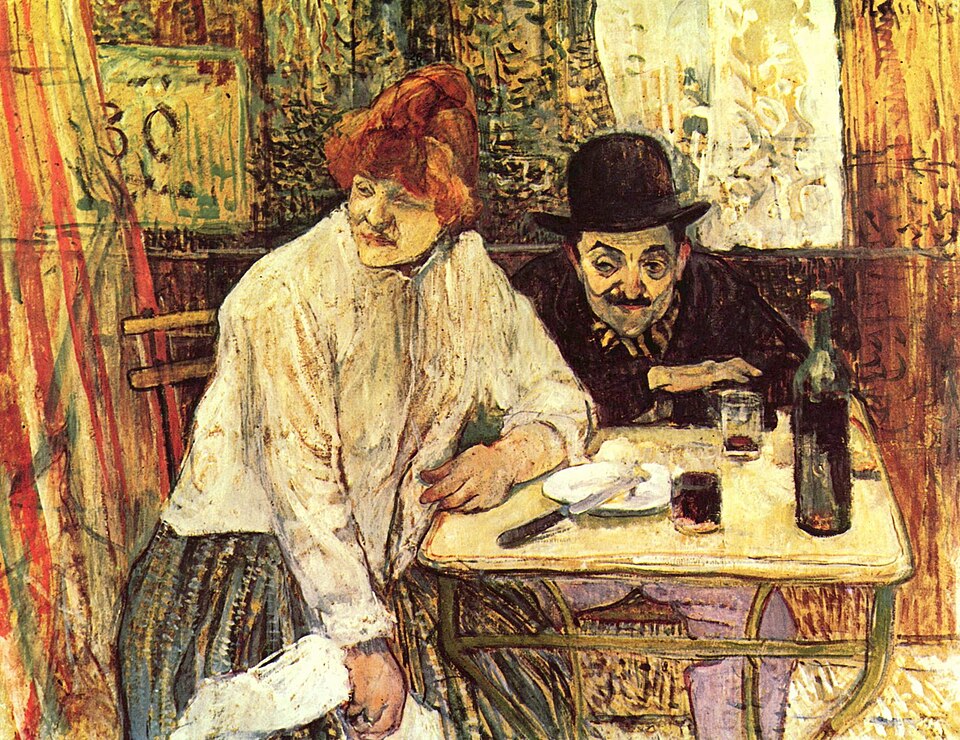
A man and a woman sit at a marble table after lunch in a humble Paris cafe, waiting for nothing in particular. It looks like a snapshot, and in a way it was: Toulouse-Lautrec staged the scene and had it photographed first.
The story behind the painting
At La Mie, a modest cafe-restaurant whose name means the crumb, is an oil on cardboard of about 53.5 by 68 cm, dated to 1891 and now in the Museum of Fine Arts, Boston. Toulouse-Lautrec showed it at the Salon des Independants that same year. The man at the table is a good friend of the painter, Maurice Guibert, a champagne merchant. The woman with him, of doubtful reputation according to the source, was probably his mistress Mariette Berthau.
What to look for
The two customers have just finished lunch in the corner of a humble cafe, at a table of marble and wrought iron. What strikes you first is how bare the setting is and the waiting look in both faces. Guibert, a jovial and kind man in life, appears here as a decadent bourgeois; the painter always drew him as something of a caricature. Colour sets the mood of the two figures so strongly that the Spanish source calls it almost an expressionist reading.
Meaning and intent
On the surface the picture records a moment of working-class life, but the source argues that it hides much of Toulouse-Lautrec's naturalism. The work seems influenced by The Absinthe Drinkers by Jean-Francois Raffaelli, shown at the Impressionist exhibition of 1881 and at his solo show in 1884. Above all, it shows how the painter worked: after arranging Guibert and the woman, he had a photograph taken as a reminder and used it later while painting.
Legacy
That photograph was published in 1931 in issue 4 of the magazine L'Amour de l'Art. Its survival changed how the picture is read. According to the source, it explains how often works by Toulouse-Lautrec that seem to have been made at one go, spontaneously, are in fact the result of careful preparatory study. The casual cafe scene in Boston is therefore a lesson in how much planning can lie behind a picture that looks caught in a single glance.
Le saviez-vous ?
- Oil on cardboard, about 53.5 by 68 cm, dated 1891.
- Shown at the Salon des Independants of 1891.
- The man is Maurice Guibert, a champagne merchant and friend of the painter.
- Painted with the help of a staged photograph, published in 1931.
À propos de l'artiste
Henri de Toulouse-Lautrec (1864-1901)
femme · homme · scène de genre · table · musée des Beaux-Arts de Boston · vin · tasse
Autres œuvres de Henri de Toulouse-Lautrec
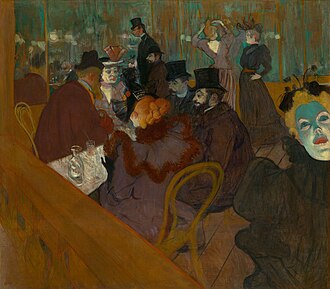 Au Moulin-Rouge - Henri de Toulouse-Lautrec (1892)
%20Rousse%20(La%20Toilette)%20-%201889%20-%20Henri%20de%20Toulouse-Lautrec%20-%20Mus%C3%A9e%20d'Orsay%2C%20Paris.jpg) La Toilette - Henri de Toulouse-Lautrec (1896)
La Toilette - Henri de Toulouse-Lautrec (1896)%2C%201887-1889%20color%20corrected.jpg) Gueule de bois - Henri de Toulouse-Lautrec (1889)
Gueule de bois - Henri de Toulouse-Lautrec (1889)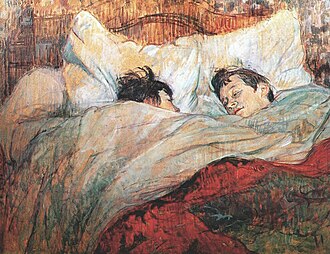 Le Lit - Henri de Toulouse-Lautrec (1890s)
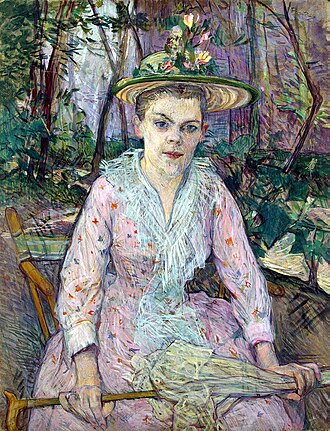 Femme à l'ombrelle, dite Berthe la Sourde, assise dans le jardin de M. Forest - Henri de Toulouse-Lautrec (1889)
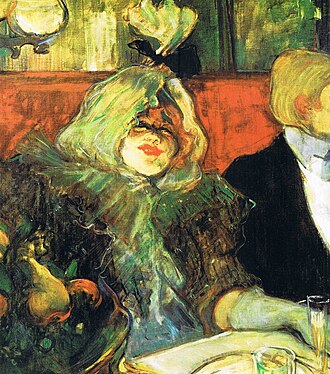 Le Salon privé - Henri de Toulouse-Lautrec (1899)
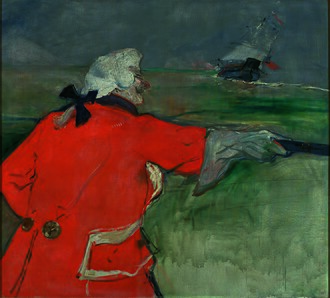 Paul Viaud en costume d'amiral du XVIIIe siècle - Henri de Toulouse-Lautrec (1901)
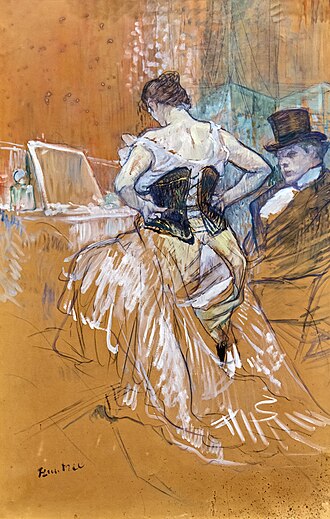 Conquête de passage - Henri de Toulouse-Lautrec (1896)
Œuvres d'artistes liés
 La Nuit étoilée - Vincent van Gogh (1889)
.jpg) Terrasse du café le soir - Vincent van Gogh (1888)
Terrasse du café le soir - Vincent van Gogh (1888) D'où venons-nous ? Que sommes-nous ? Où allons-nous ? - Paul Gauguin (1897-1898)
%201889.jpg) Le Christ jaune - Paul Gauguin (1889)
Le Christ jaune - Paul Gauguin (1889) Bal du moulin de la Galette - Pierre-Auguste Renoir (1876)
 Le Déjeuner des canotiers - Pierre-Auguste Renoir (1881)