Gueule de bois
Henri de Toulouse-Lautrec · 1889
%2C%201887-1889%20color%20corrected.jpg)
A young woman sits alone in a Montmartre club, a glass and a bottle before her, her gaze somewhere far away. Toulouse-Lautrec painted her just before his own success, and the model was the future painter Suzanne Valadon.
The story behind the painting
The Hangover, also called The Drinker, was painted in the late 1880s. Its model, Suzanne Valadon, had begun posing for artists after falling from a circus trapeze at 15. Lautrec hired her on the advice of his friend Federico Zandomeneghi, and the two mingled at Le Mirliton, the cabaret Aristide Bruant opened in 1885. Lautrec was the first to buy her art and suggested she change her name from Marie to Suzanne. She went on to become the first woman painter admitted to the Société Nationale des Beaux-Arts.
What to look for
Look at the loose, broken brushwork: Wikipedia notes it recalls both the colour theory of Neo-Impressionism and the technique of Lautrec's art school friend Vincent van Gogh. The woman sits alone, a glass in front of her, in a club of the kind where Lautrec and Valadon spent their nights. The canvas measures about 47 by 55 cm. Several preparatory studies came first, followed by a drawing in ink and chalk published in Le Courrier français in 1889.
Meaning and intent
The theme of women drinking alone in cafes runs through Bruant's songs about poor working women, and Lautrec painted it in other works such as Waiting and A la Bastille. Whether this picture was based on a specific song, or titled by Bruant, is debated: the historian Gale B. Murray thinks it had no direct link to any lyric, though its mood matched the songs. The subject also touched Lautrec himself, who drank heavily to cope with the pain of his disability and died at 36.
Legacy
The painting hung permanently at Le Mirliton in the late 1880s and early 1890s, as one of ten works shown at Bruant's club. It reached the United States at the Armory Show in 1913 and is now in the Fogg Museum at Harvard, while the study and the drawing are in the Musée Toulouse-Lautrec. It is one of several works by Lautrec featuring Valadon, alongside Rice Powder in the Van Gogh Museum. Wikipedia dates it to the late 1880s, Wikidata to 1889.
Le saviez-vous ?
- Also known as The Drinker (La Buveuse).
- The model was the painter Suzanne Valadon.
- Shown at the Armory Show in New York in 1913.
- Now in the Fogg Museum, Harvard Art Museums.
À propos de l'artiste
Henri de Toulouse-Lautrec (1864-1901)
Autres œuvres de Henri de Toulouse-Lautrec
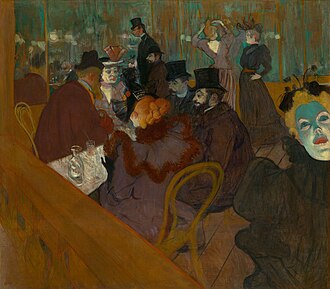 Au Moulin-Rouge - Henri de Toulouse-Lautrec (1892)
%20Rousse%20(La%20Toilette)%20-%201889%20-%20Henri%20de%20Toulouse-Lautrec%20-%20Mus%C3%A9e%20d'Orsay%2C%20Paris.jpg) La Toilette - Henri de Toulouse-Lautrec (1896)
La Toilette - Henri de Toulouse-Lautrec (1896)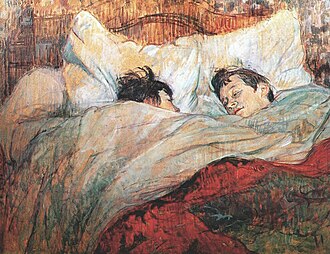 Le Lit - Henri de Toulouse-Lautrec (1890s)
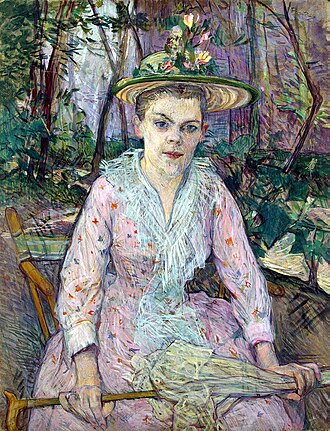 Femme à l'ombrelle, dite Berthe la Sourde, assise dans le jardin de M. Forest - Henri de Toulouse-Lautrec (1889)
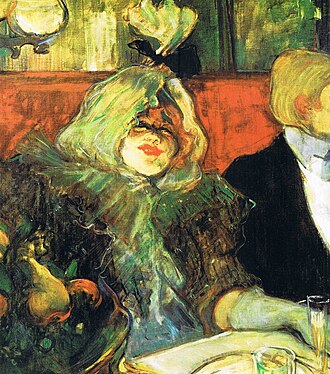 Le Salon privé - Henri de Toulouse-Lautrec (1899)
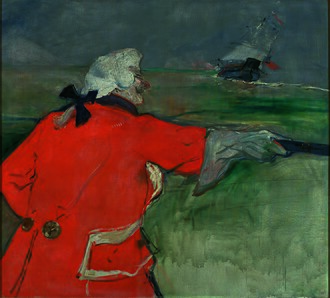 Paul Viaud en costume d'amiral du XVIIIe siècle - Henri de Toulouse-Lautrec (1901)
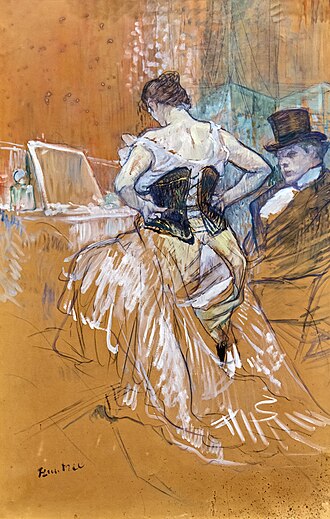 Conquête de passage - Henri de Toulouse-Lautrec (1896)
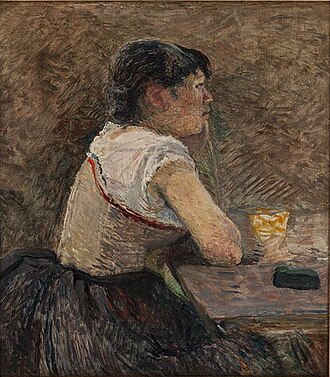 À Grenelle, buveuse d'absinthe - Henri de Toulouse-Lautrec (1886)
Œuvres d'artistes liés
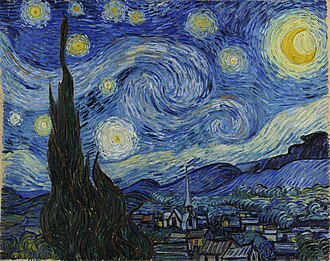 La Nuit étoilée - Vincent van Gogh (1889)
.jpg) Terrasse du café le soir - Vincent van Gogh (1888)
Terrasse du café le soir - Vincent van Gogh (1888) D'où venons-nous ? Que sommes-nous ? Où allons-nous ? - Paul Gauguin (1897-1898)
%201889.jpg) Le Christ jaune - Paul Gauguin (1889)
Le Christ jaune - Paul Gauguin (1889) Bal du moulin de la Galette - Pierre-Auguste Renoir (1876)
 Le Déjeuner des canotiers - Pierre-Auguste Renoir (1881)