Raphaël
1483-1520
Raphael was orphaned at eleven and dead at thirty-seven, yet in between he painted The School of Athens and became, with Leonardo and Michelangelo, one of the three great masters of the High Renaissance. His art is loved for its clarity, grace and calm.
Origins
Raphael was born in 1483 in Urbino, a small but highly cultured city; sources give his birthday as either 28 March or 6 April. His father, Giovanni Santi, was court painter to the Duke of Urbino and also a poet who wrote a rhymed chronicle of Duke Federico's life. Growing up around this court gave Raphael the excellent manners and social skills that Vasari stressed. His mother Màgia died in 1491, when he was eight, and his father on 1 August 1494, so he was orphaned at eleven. According to Vasari he had been a great help to his father, and a teenage self-portrait drawing shows his precocity. He seems to have helped manage the family workshop from a very early age.
Life and turning points
Vasari says his father placed him with Pietro Perugino "despite the tears of his mother", but this account has been disputed, and another theory says he trained partly with Timoteo Viti. Most historians agree he worked as Perugino's assistant from around 1500, and in December 1500 he was described as a master. His first documented work was the Baronci Altarpiece, commissioned in 1500. From about 1504 he spent much time in Florence, though perhaps never as a continuous resident. In 1508 he moved to Rome at the invitation of Pope Julius II and stayed for the rest of his life, working for two popes, Julius and Leo X, painting the Vatican rooms and working as an architect. He died on 6 April 1520, still at the height of his powers.
Style and technique
Raphael's work is admired for its clarity of form, ease of composition and visual achievement of the Neoplatonic ideal of human grandeur. Vasari described three phases: his early years in Umbria, about four years absorbing the art of Florence, and twelve hectic, triumphant years in Rome. Early on he absorbed Perugino so fully that Wölfflin wrote no pupil of genius ever took in so much of his master's teaching. In Florence the strongest influence was Leonardo: his figures took more dynamic poses, he adopted the pyramidal composition and developed his own version of sfumato, while keeping Perugino's soft, clear light. In Rome he ran an unusually large workshop, and much of his later work was carried out by assistants from his drawings.
Stories and anecdotes
A letter of recommendation from October 1504, written by the mother of the next Duke of Urbino, described him as a sensible and well-mannered young man whom she loved for his father's sake. In 1502 his fellow Perugino pupil Pinturicchio invited him to Siena to help with the cartoons for the frescoes of the Piccolomini Library, knowing him to be a draughtsman of the highest quality. Michelangelo, only eight years older, came to dislike him even more than he disliked Leonardo, blaming him for conspiracies against him. In Rome Julius II commissioned Raphael at once to fresco the room meant to be his private library, while other painters' work was painted over. Raphael became good friends with Baldassare Castiglione, author of The Book of the Courtier.
Legacy
The Stanza della Segnatura, with The School of Athens, The Parnassus and the Disputation of the Holy Sacrament, made a stunning impact on Roman art and is still generally regarded as his greatest masterpiece. Raphael was very influential in his lifetime, though outside Rome his work was known mostly through prints. After his death Michelangelo's influence outweighed his until the 18th and 19th centuries, when Raphael's serene, harmonious qualities were again held up as the highest model. Through Johann Joachim Winckelmann he shaped Neoclassical painting, and the Pre-Raphaelite Brotherhood later rejected his methods by name, which shows how central he remained. For many viewers his Madonnas are still the very picture of grace.
Le saviez-vous ?
- Raphael also worked as an architect in Rome.
- His father wrote a rhymed chronicle of the life of Duke Federico da Montefeltro.
- After his death his workshop completed a fourth Vatican room.
- His Deposition of Christ was later forcibly removed from Perugia by the Borghese.
Artistes liés
Titien · Leonardo da Vinci · Michel-Ange Buronarroti · Albrecht Dürer · Sandro Botticelli · Jérôme Bosch
Œuvres de Raphaël
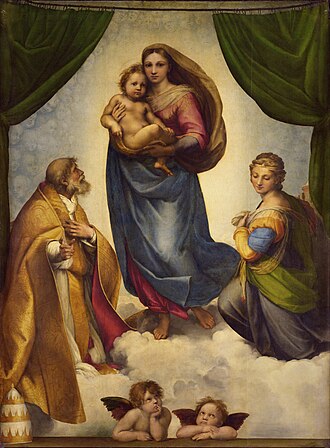 La Madone Sixtine - Raphael (1510s)
.jpg) La Fornarina - Raphael
La Fornarina - Raphael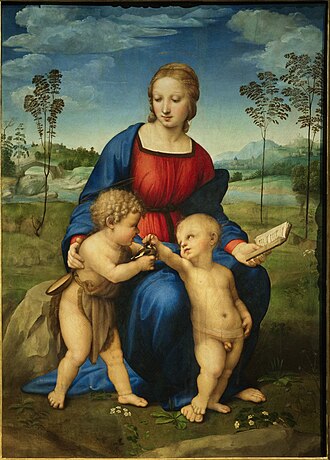 La Vierge au chardonneret - Raphael (1500s)
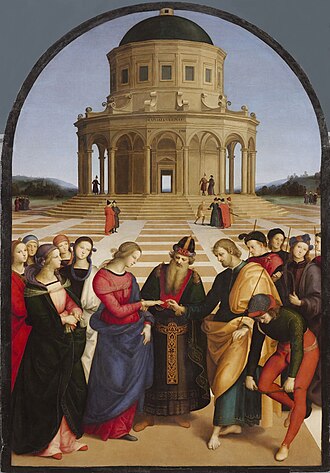 Le Mariage de la Vierge - Raphael (1504)
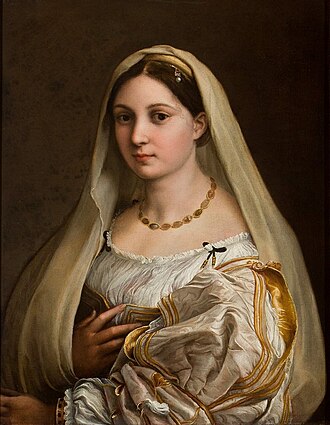 La donna velata - Raphael (1510s)
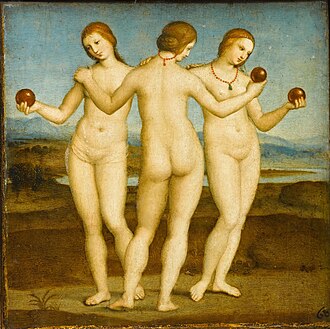 Les Trois Grâces - Raphael (1504)
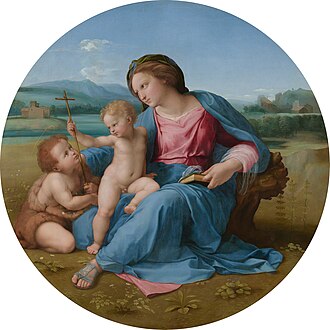 La Madone d'Alba - Raphael (1510)
%20-%20La%20Madonna%20del%20Granduca%20-%20178%20-%20Galleria%20Palatina.jpg) La Madone du Grand-Duc - Raphael (1500s)
La Madone du Grand-Duc - Raphael (1500s)%20September%202015-1a.jpg) La Transfiguration - Raphael
La Transfiguration - Raphael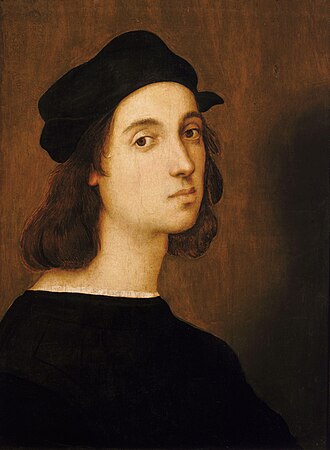 Autoportrait - Raphael (1500s)