Haute Renaissance
The High Renaissance is the short, dazzling stretch when Leonardo da Vinci, Michelangelo and Raphael were all at work in Italy.
Leonardo da Vinci · Titian · Albrecht Dürer · Sandro Botticelli
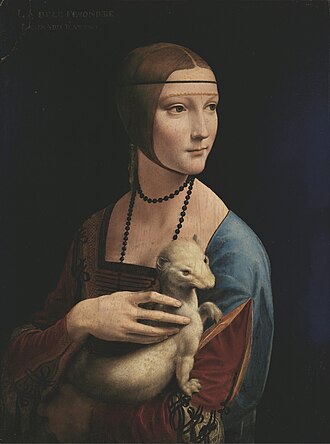 La Dame à l'hermine - Leonardo da Vinci (1490)
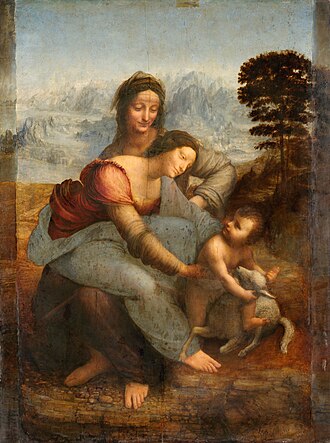 La Vierge, l'Enfant Jésus et sainte Anne - Leonardo da Vinci
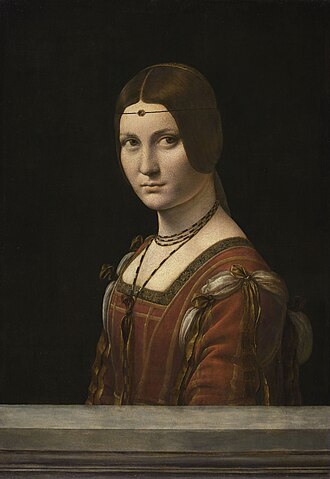 La Belle Ferronnière - Leonardo da Vinci (1495)
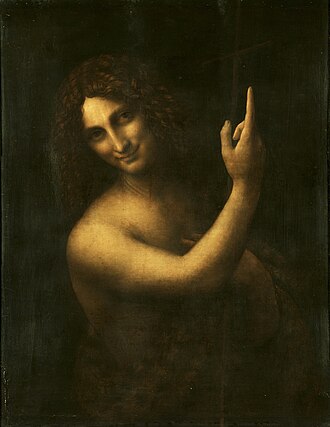 Saint Jean-Baptiste - Leonardo da Vinci (1510s)
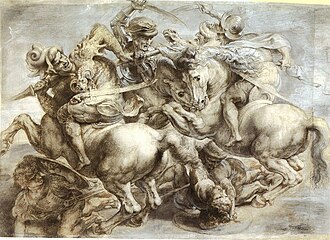 La Bataille d'Anghiari - Leonardo da Vinci (1503)
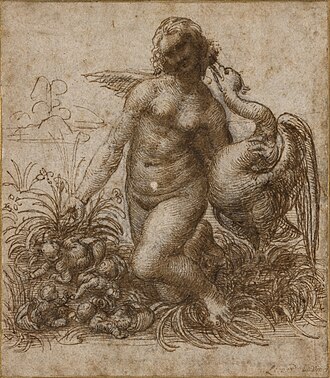 Léda et le Cygne - Leonardo da Vinci (1510)
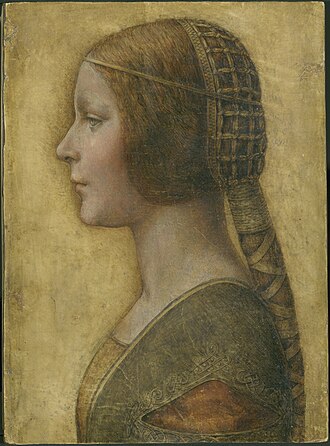 La Belle Princesse - Leonardo da Vinci (1495)
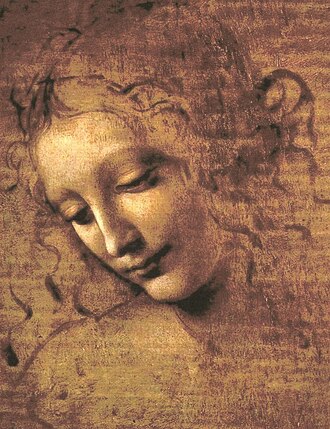 La Scapigliata - Leonardo da Vinci (1500s)
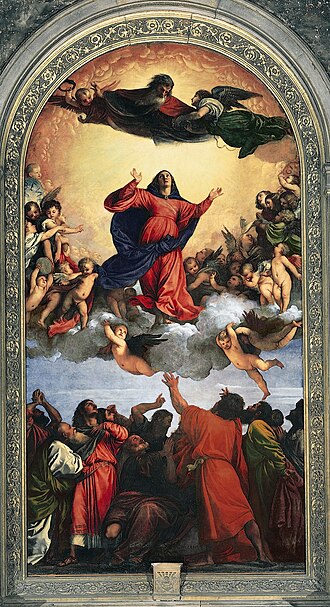 L'Assomption de la Vierge - Titian (1510s)
.jpg) La Vierge de la fête du rosaire - Albrecht Dürer (1506)
La Vierge de la fête du rosaire - Albrecht Dürer (1506)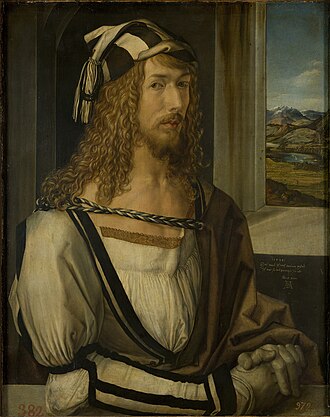 Autoportrait à 26 ans - Albrecht Dürer (1498)
FXD.jpg) Amour sacré et Amour profane - Titian (1510s)
Amour sacré et Amour profane - Titian (1510s)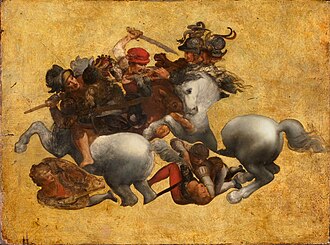 Tavola Doria - Leonardo da Vinci (1503)
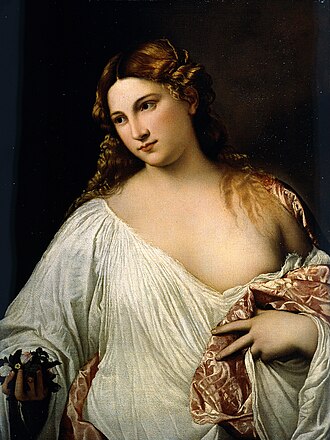 Flore - Titian (1517)
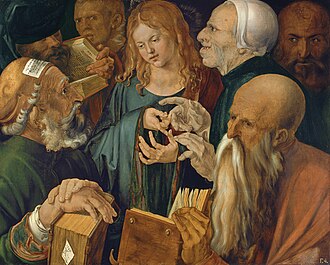 Jésus parmi les docteurs - Albrecht Dürer (1506)
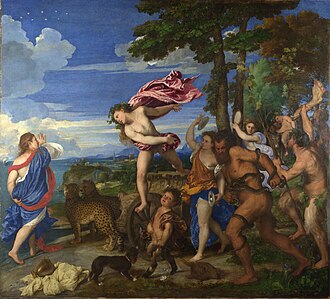 Bacchus et Ariane - Titian (1520s)
%20nave%20left%20-%20Altar%20of%20Madona%20di%20Ca'Pesaro.jpg) Madonna di Ca' Pesaro - Titian
Madonna di Ca' Pesaro - Titian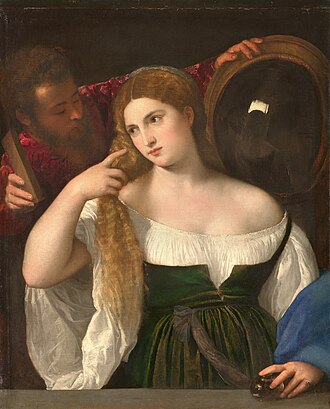 La Femme au miroir - Titian (1515)
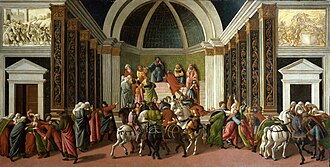 Histoire de Virginie Romana - Sandro Botticelli (1505)
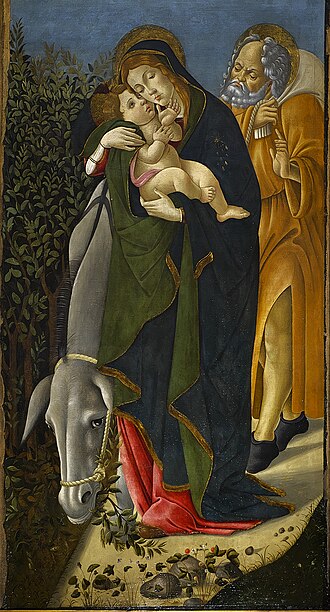 La Fuite en Égypte - Sandro Botticelli (1510)
Envie d'en savoir plus sur Haute Renaissance ?
The High Renaissance is the short, dazzling stretch when Leonardo da Vinci, Michelangelo and Raphael were all at work in Italy. It is often called the peak of Western painting, and it gave us some of the most famous images in the world, from the Mona Lisa to the Sistine Chapel ceiling.
What is the High Renaissance, in simple words?
It was a short period of truly exceptional art in Italy, especially in Rome and Florence. Painters pulled together all the advances of earlier generations, such as linear perspective, realistic bodies and feelings, and clever use of light and shadow, into one unified style. The goal was a picture where every part fits the whole in perfect order, balance and harmony. It is often described as the high point of Western painting.
Why is it called the High Renaissance?
The term was first coined in German, as Hochrenaissance, by the historian Jacob Burckhardt in 1855. It grew out of the idea of a "High Style" in painting and sculpture of the early 16th century, described by Johann Joachim Winckelmann in 1764. The word "High" signals that this was seen as the summit of the Renaissance, building on the earlier experiments of the Early Renaissance.
When and where did it happen?
Most art historians say it began between 1490 and 1500 and ended in 1520 with the death of Raphael. Others put the end around 1525, in 1527 with the Sack of Rome by the army of Charles V, or about 1530. The main centres were Rome, capital of the Papal States, and Florence, with Venice developing its own version. Some scholars place its peak between 1505 and 1513.
Who were the main artists?
The three giants were Leonardo da Vinci, Michelangelo and Raphael, with the architect Bramante also central. In Venice the leaders were Giovanni Bellini in his later works, Giorgione and the young Titian. Correggio and Andrea del Sarto were other important painters, and even lesser-known artists such as Fra Bartolomeo and Mariotto Albertinelli are still praised for the harmony of their designs.
How can I recognise a High Renaissance painting?
Look for a calm, balanced composition where everything feels in its right place. Figures are closely observed and lifelike, perspective is masterful, and light is handled with techniques like sfumato, the soft blending between colours, and chiaroscuro, the contrast of light and dark. These paintings reconcile opposites: real and ideal, movement and rest, space and flat surface. Venetian works add a serene mood and glowing colour.
How is it different from the Early Renaissance and from Mannerism?
The Early Renaissance experimented with perspective, light and anatomy; the High Renaissance perfected them and fused them into one harmonious style. Leonardo's The Last Supper is often said to make a complete break with the Early Renaissance. After about 1520, the elongated bodies and exaggerated poses seen in late works by Michelangelo, Andrea del Sarto and Correggio pointed toward Mannerism, which replaced High Renaissance balance with tension.
Who paid for this art?
Patrons were wealthy and powerful. Cardinals, rulers, bankers and very rich families commissioned works, and Pope Julius II supported many artists, including Michelangelo, whom he commissioned to paint the Sistine Chapel ceiling. Sculpture was often commissioned by the public and the state, partly because it was so expensive. Subjects were mostly religious, but classical figures from the ancient world also appeared often.
Which famous works should I see first?
Start with Leonardo's The Last Supper, painted 1495-1498, and his Mona Lisa. Then Michelangelo's Sistine Chapel ceiling and his sculptures the Pietà and David. From Raphael, see The School of Athens, a masterpiece of perspective and composition, and the Sistine Madonna. For Venice, look at Giorgione's mysterious The Tempest and Titian's Assumption of the Virgin.
Where can I see these works today?
The Sistine Chapel ceiling and Raphael's frescoes, including The School of Athens, are in the Vatican. Michelangelo's Pietà is in St. Peter's Basilica in Vatican City. Bramante's Tempietto, the building that starts High Renaissance architecture, stands at San Pietro in Montorio in Rome. Titian's Assumption of the Virgin is on the altar of the Frari church in Venice, and Raphael's La Belle Jardinière is in the Louvre.
Why does it still matter?
The High Renaissance has long been seen as a great explosion of creative genius, a view that goes back to the Florentine writer Giorgio Vasari. Michelangelo's Sistine ceiling affected every later generation of European artists, and Leonardo's Last Supper set the benchmark for religious painting. Recently some historians have criticised the term for focusing on only a few iconic works, which is a good reminder to look beyond the famous names too.