La Crucifixion Mond
Raphaël · 1500s
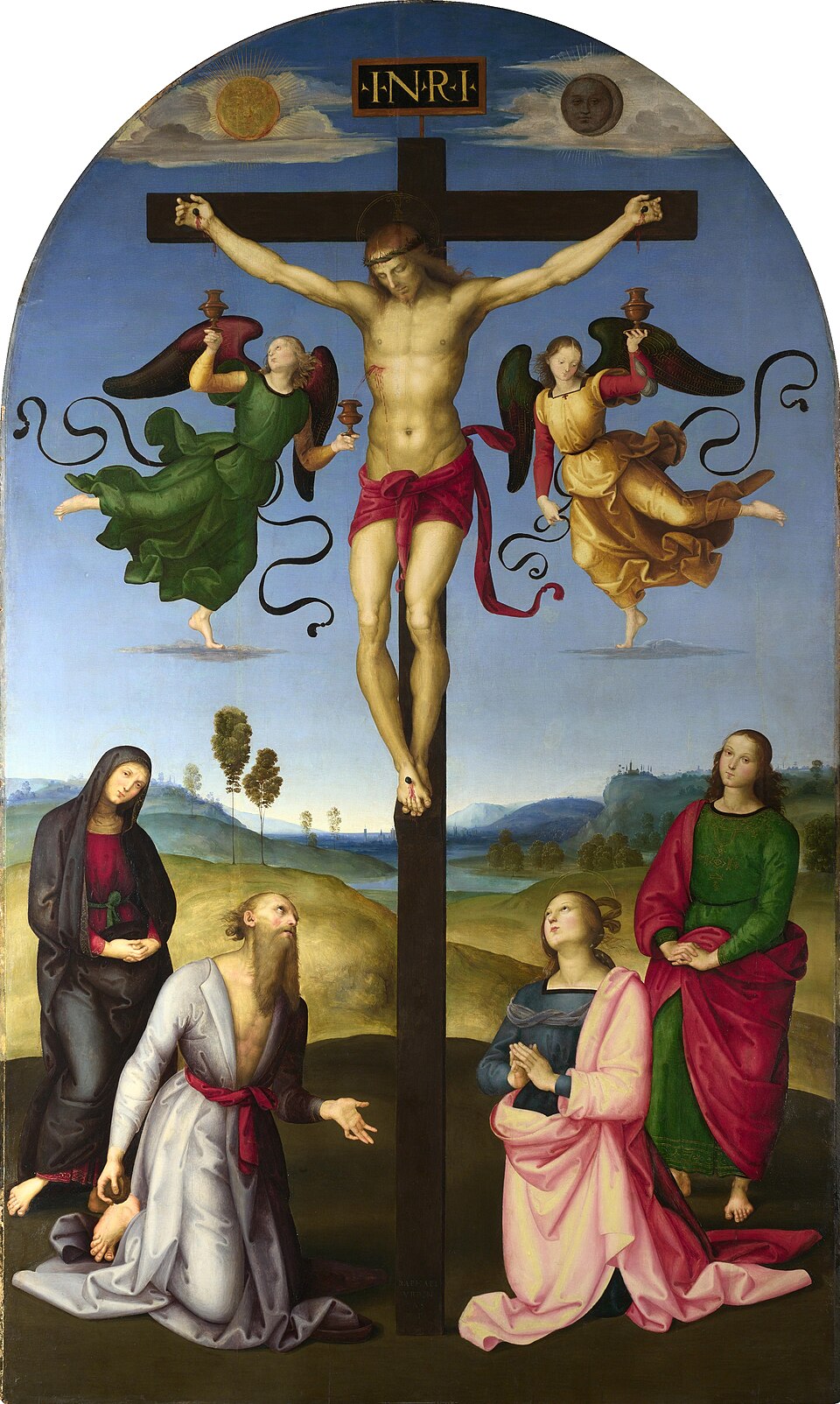
Two angels catch the blood of Christ in golden chalices while a gold sun and a silver moon hang side by side in the sky. At the foot of the cross a young painter signed his name, Raphael of Urbino, on one of his earliest works.
The story behind the painting
The wool merchant Domenico Gavari commissioned this altarpiece for his burial chapel in the church of San Domenico in Citta di Castello, in Umbria, near Raphael's home town of Urbino. The chapel was dedicated to Saint Jerome, and most of its original stone frame survives, carved with the date 1503. Gavari's first son, Girolamo, that is Jerome, had died young. Wikipedia dates the panel 1502 to 1503, making it perhaps Raphael's second work after the Baronci Altarpiece, made for Gavari's associate Andrea Baronci. Wikidata gives only the 1500s.
What to look for
Christ hangs peacefully on the cross, crowned with thorns, in a loincloth of unusual red, against Umbrian hills with Citta di Castello in the distance. On one side Mary Magdalene kneels with John the Evangelist standing behind her; on the other, the Virgin stands behind the kneeling Saint Jerome, who holds a stone to beat his chest. The kneeling pair gaze at Christ, while the standing pair wring their hands and look out at us. At the foot of the cross, silver letters read RAPHAEL VRBIN AS P. The light comes from the left, as did the chapel's windows.
Meaning and intent
The picture owes much to Perugino, whom Raphael knew in Perugia, and closely resembles his Monteripido Altarpiece of about 1502, with similar angels and ribbons. Vasari later said that no one would have believed it was by Raphael rather than Perugino if he had not signed it. Yet the young painter also smeared and softened wet paint with his fingers, leaving fingerprints that can still be detected. Saint Jerome lived centuries after the Crucifixion, but he is here as patron of the chapel, kneeling where a father who had lost a son named Jerome would pray.
Legacy
The altarpiece once had a three-panel predella; two panels survive, in Lisbon and in Raleigh, North Carolina, telling miracles of Saint Jerome. Cardinal Fesch bought the main panel in 1808 and left a copy in the chapel. It passed to Lord Ward, later Earl of Dudley, and in 1892 to Ludwig Mond, after whom it is named; it entered the National Gallery in London in 1924. Analysis there identified natural ultramarine, lead-tin yellow, verdigris, vermilion and ochres. The panel measures 283.3 by 167.3 cm.
Le saviez-vous ?
- Oil on poplar panel, dated 1502-1503 by Wikipedia.
- Painted for Domenico Gavari's chapel in Citta di Castello.
- Signed at the foot of the cross: RAPHAEL VRBIN AS P.
- In the National Gallery, London, since 1924.
À propos de l'artiste
Raphaël (1483-1520)
art religieux · femme · homme · Haute Renaissance · Marie · National Gallery · Jésus-Christ · cheveux longs · Marie de Magdala · Jérôme de Stridon · Jean l'Évangéliste
Autres œuvres de Raphaël
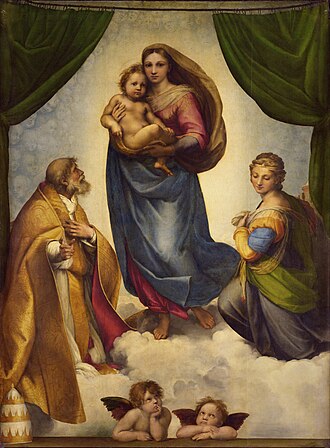 La Madone Sixtine - Raphael (1510s)
.jpg) La Fornarina - Raphael
La Fornarina - Raphael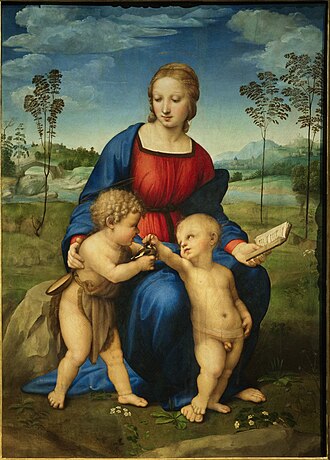 La Vierge au chardonneret - Raphael (1500s)
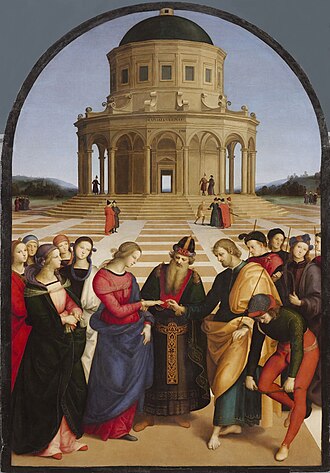 Le Mariage de la Vierge - Raphael (1504)
 La donna velata - Raphael (1510s)
 Les Trois Grâces - Raphael (1504)
 La Madone d'Alba - Raphael (1510)
%20-%20La%20Madonna%20del%20Granduca%20-%20178%20-%20Galleria%20Palatina.jpg) La Madone du Grand-Duc - Raphael (1500s)
La Madone du Grand-Duc - Raphael (1500s)
Œuvres d'artistes liés
.jpg) Vénus d'Urbin - Titian (1538)
Vénus d'Urbin - Titian (1538) L'Assomption de la Vierge - Titian (1510s)
 Tondo Doni - Michelangelo (1500s)
 Le Tourment de saint Antoine - Michelangelo (1487)
 La Joconde - Leonardo da Vinci (1503-1519)
 La Dame à l'hermine - Leonardo da Vinci (1490)
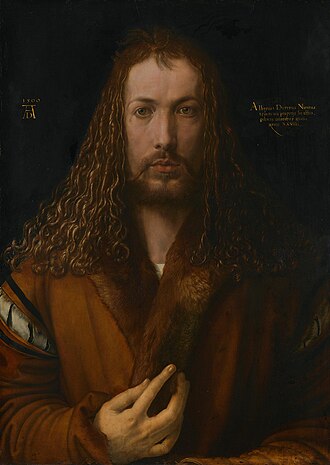 Autoportrait - Albrecht Dürer (1500)
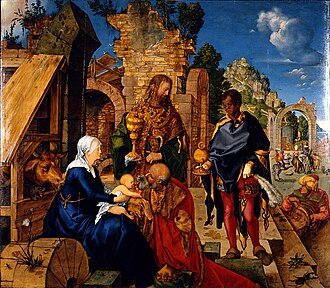 Adoration des mages - Albrecht Dürer (1504)
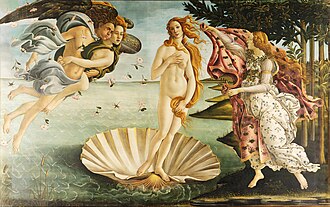 La Naissance de Vénus - Sandro Botticelli (c. 1485)
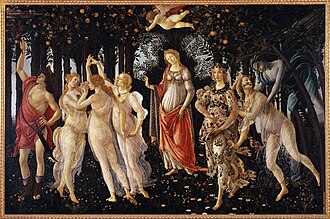 Le Printemps - Sandro Botticelli (1480s)
 Le Jardin des délices - Hieronymus Bosch
 La Nef des fous - Hieronymus Bosch (1500s)