Jacques-Louis David
1748-1825
Jacques-Louis David turned French painting from Rococo charm to classical severity, and lived through six political regimes, painting for the Revolution and then for Napoleon. The Death of Marat and Napoleon Crossing the Alps are among the images he gave to history.
Origins
David was born into a prosperous family in Paris on 30 August 1748. When he was about nine his father was killed in a duel, and his mother left him with his well-off uncles, who were architects. He was educated at the College des Quatre-Nations but was never a good student: a facial tumour hampered his speech, and he was always drawing, once saying he hid behind the teacher's chair to draw through the class. His family wanted him to be an architect, but he insisted on painting. Francois Boucher, a distant relative, sent him to Joseph-Marie Vien, a painter who embraced the classical reaction to Rococo.
Life and turning points
David tried three times for the Prix de Rome; after his second loss in 1772 he went on a hunger strike for two and a half days. He finally won in 1774 and travelled to Italy in 1775, filling twelve sketchbooks he used for the rest of his life. Back in Paris in 1780 he became a member of the Royal Academy and married Marguerite Charlotte Pecoul. Saying only in Rome could he paint Romans, he returned there and painted The Oath of the Horatii in 1784. During the Revolution he befriended Robespierre, joined the Jacobins and voted for the execution of Louis XVI. Jailed after Robespierre's fall, he later served Napoleon. After the Bourbons returned, he went into exile in Brussels and died there on 29 December 1825.
Style and technique
In the 1780s his history painting moved taste away from Rococo frivolity toward classical austerity and heightened feeling. In Italy he studied Poussin, Caravaggio and the Carracci, and Raphael left a lasting mark on him. Raphael Mengs introduced him to the rigorous study of classical sources and to Winckelmann's writings, and a visit to Pompeii in 1779 deepened his belief in classical culture. Under Napoleon he developed his Empire style, notable for warm Venetian colour.
Stories and anecdotes
When The Death of Socrates appeared at the Salon of 1787, one critic called it perfect in every sense, and Diderot said it looked copied from an ancient relief. In 1789, as the Revolution began, the authorities blocked The Lictors Bring to Brutus the Bodies of His Sons; when newspapers reported it, public outrage forced them to hang it, guarded by art students. His portrait of the Lavoisiers was also kept out of that Salon. His Tennis Court Oath was never finished.
Legacy
David had many pupils, around 50 in his early years alone, which made him the strongest influence on French art in the early 19th century, especially academic Salon painting. He is considered the leading painter of his era. His pictures of civic virtue and sacrifice, from the Horatii to Brutus, still show how much he believed painting could speak to a nation. Famous images such as The Death of Marat, Napoleon Crossing the Alps and The Coronation of Napoleon have entered the collective imagination.
Le saviez-vous ?
- The Prix de Rome he won in 1774 was for Erasistratus Discovering the Cause of Antiochus' Disease, a subject set by the judges.
- The King granted him lodging in the Louvre after the Salon of 1781.
- He had four children with Marguerite Charlotte Pecoul.
- In 1787 he was refused the directorship of the French Academy in Rome as too young.
Artistes liés
Jean-Auguste-Dominique Ingres · Francisco Goya
Œuvres de Jacques-Louis David
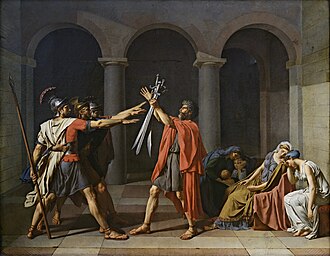 Le Serment des Horaces - Jacques-Louis David (1784)
.jpg) Les Sabines - Jacques-Louis David (1799)
Les Sabines - Jacques-Louis David (1799)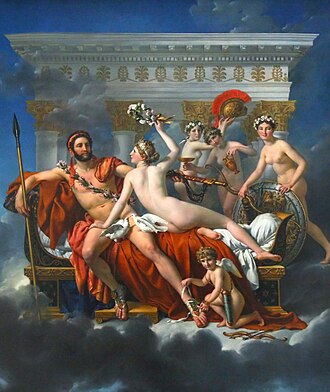 Mars désarmé par Vénus - Jacques-Louis David (1824)
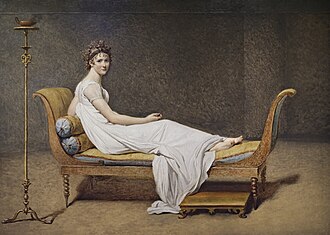 Madame Récamier - Jacques-Louis David (1800)
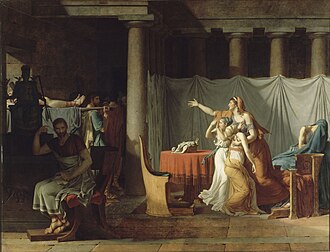 Les licteurs rapportant à Brutus les corps de ses fils - Jacques-Louis David (1789)
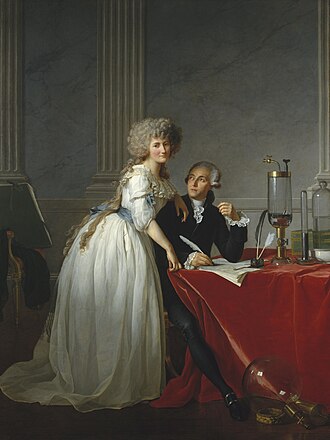 Portrait d'Antoine-Laurent Lavoisier et de sa femme - Jacques-Louis David (1788)
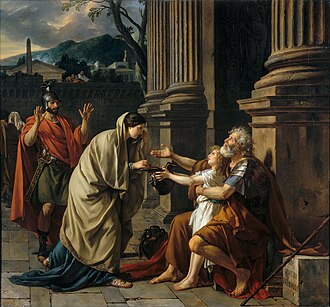 Bélisaire demandant l'aumône - Jacques-Louis David (1781)
L'Amour et Psyché - Jacques-Louis David (1817)
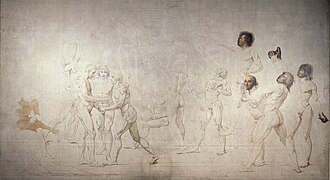 Le Serment du jeu de paume - Jacques-Louis David (1791)
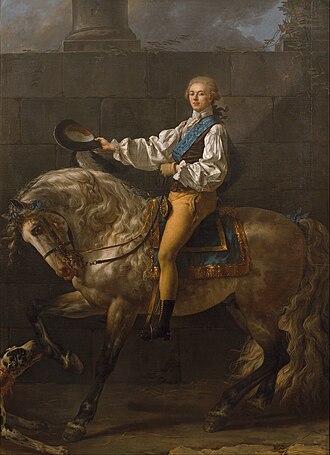 Portrait du comte Stanislas Potocki - Jacques-Louis David (1780)
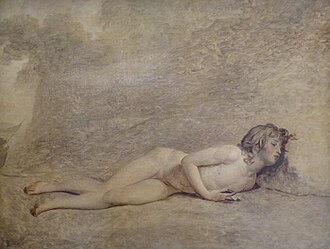 La Mort du jeune Bara - Jacques-Louis David (1794)
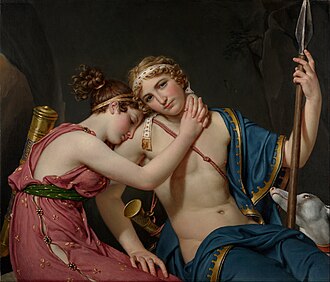 Les Adieux de Télémaque et d'Eucharis - Jacques-Louis David (1818)
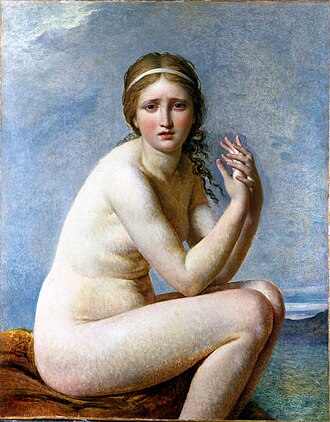 Psyché abandonnée - Jacques-Louis David (1795)
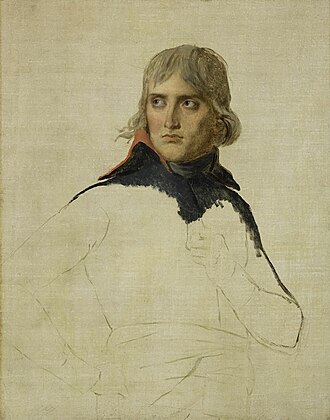 portrait inachevé de Bonaparte - Jacques-Louis David (1790s)
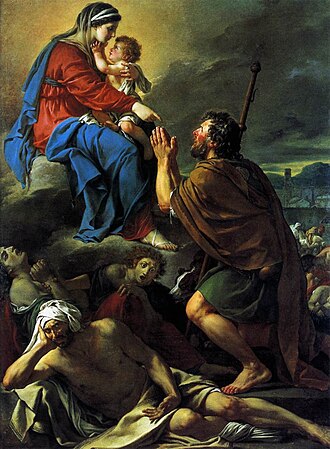 Saint Roch intercédant auprès de la Vierge - Jacques-Louis David (1780)