Saint Roch intercédant auprès de la Vierge
Jacques-Louis David · 1780
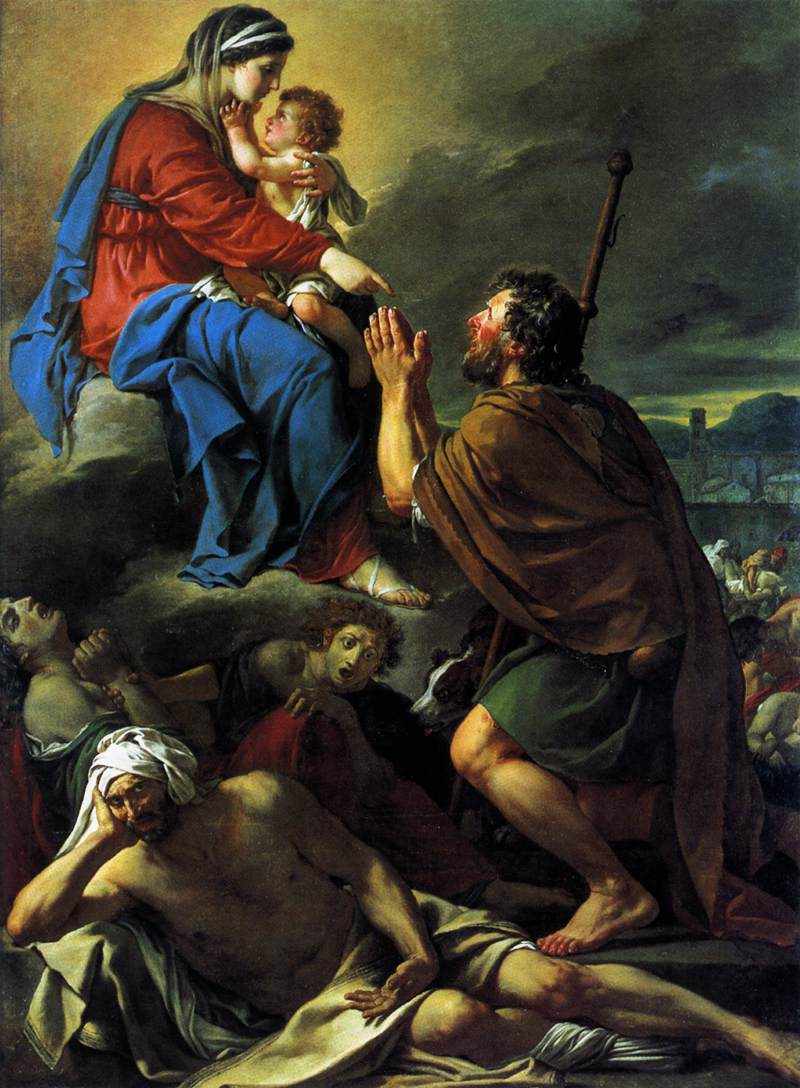
A pilgrim saint pleads upward with the Virgin while plague victims sink into despair below him. The young David painted it in Rome, and its sufferers look less like people awaiting a miracle than people who have stopped hoping.
The story behind the painting
Jacques-Louis David painted this altarpiece-sized canvas in 1780 at the Villa Medici in Rome, where he lived after winning first prize in painting in the Prix de Rome. It came before his Portrait of Count Stanislas Potocki. In Rome he was much influenced by Caravaggio, Poussin, Guercino and Lebrun, though he declared that the Antique would not seduce him because it lacked animation. He still filled twelve sketchbooks with drawings there, which he and his studio used as models for the rest of his life. On his return to France he exhibited the painting at the Salon of 1781 at the Louvre.
What to look for
Saint Roch stands right of centre, gazing up at the Virgin Mary and the Christ Child at top left. You can recognise him by his pilgrim's clothes, the plague sore on his leg and the dog behind him, which recalls the dog that brought him bread and licked his wounds when he was ill. At lower left a tight group of sufferers sits and lies on the ground in sombre browns and greys. Mary, in bright blue and red, plays with the Child. In the middle distance on the right, victims lie in a stupor and are carried away in a cart. The canvas measures 260 by 195 cm.
Meaning and intent
Saint Roch, who recovered from the plague himself, is the patron of invalids and is invoked against the disease. The picture is often compared with a 1623 to 1626 altarpiece by Rubens on the same theme, which may have influenced it. In Rubens the victims look up with hope. David's victims are apathetic and seem to see themselves as doomed: one gazes at the viewer in silent reproach, another makes a frantic, aimless movement, a third looks up with closed eyes. Even Roch and Mary seem apart, as if divided by glass. Their hands do not touch, and she seems unaware of him.
Legacy
The painting belongs to David's early Roman years, made before his Portrait of Count Stanislas Potocki and shown at the Salon of 1781 when he came back to France. The Roman period left a lasting mark: the twelve sketchbooks he filled there served him and his studio as models for the rest of his life. Comparisons with the Rubens altarpiece keep returning to the same point, that David chose apathy and despair where Rubens painted hope. The canvas is now in the Musée des Beaux-Arts in Marseille, France.
Le saviez-vous ?
- Painted in 1780 at the Villa Medici in Rome.
- Exhibited at the Salon of 1781 at the Louvre.
- About 260 by 195 cm, oil on canvas.
- Now in the Musée des Beaux-Arts in Marseille.
À propos de l'artiste
Jacques-Louis David (1748-1825)
art religieux · néo-classicisme · Vierge à l'Enfant
Autres œuvres de Jacques-Louis David
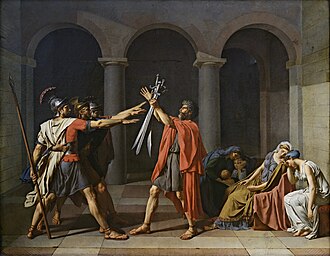 Le Serment des Horaces - Jacques-Louis David (1784)
.jpg) Les Sabines - Jacques-Louis David (1799)
Les Sabines - Jacques-Louis David (1799)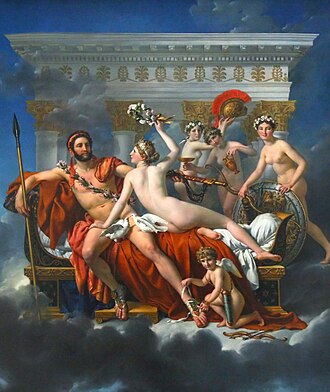 Mars désarmé par Vénus - Jacques-Louis David (1824)
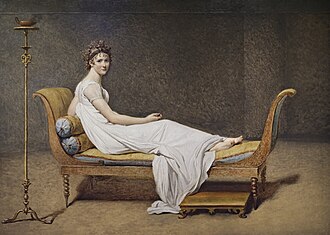 Madame Récamier - Jacques-Louis David (1800)
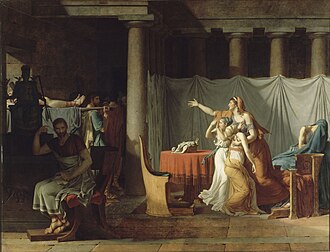 Les licteurs rapportant à Brutus les corps de ses fils - Jacques-Louis David (1789)
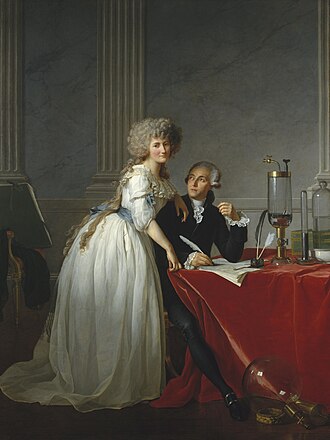 Portrait d'Antoine-Laurent Lavoisier et de sa femme - Jacques-Louis David (1788)
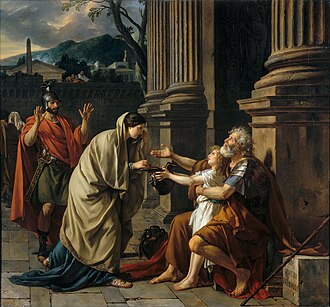 Bélisaire demandant l'aumône - Jacques-Louis David (1781)
L'Amour et Psyché - Jacques-Louis David (1817)
Œuvres d'artistes liés
 La Source - Jean-Auguste-Dominique Ingres (1856)
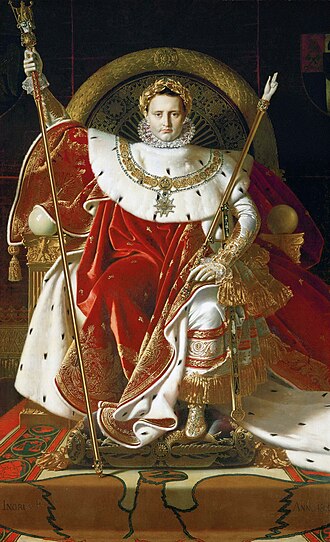 Napoléon Ier sur le trône impérial - Jean-Auguste-Dominique Ingres (1806)
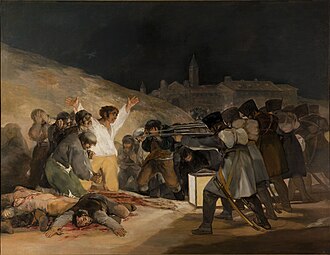 Tres de Mayo - Francisco Goya (1814)
.jpg) La Maja nue - Francisco Goya (1800)
La Maja nue - Francisco Goya (1800)