Mars désarmé par Vénus
Jacques-Louis David · 1824
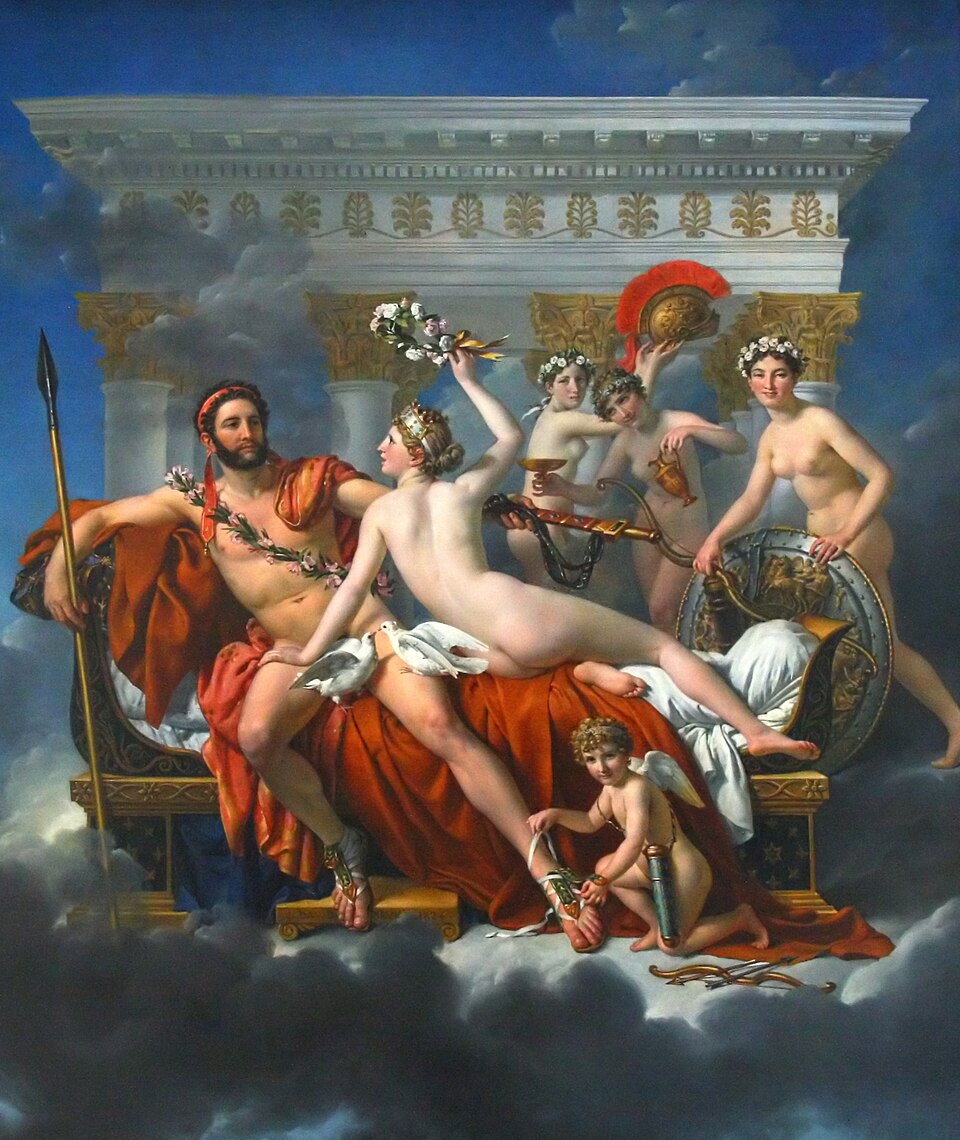
The god of war sits back and lets love take away his sword, helmet and shield. This was the last painting of Jacques-Louis David, made in exile in Brussels, the old master of heroic virtue ending his career with surrender.
The story behind the painting
David began the painting in 1822, aged 73, while living in political exile in Brussels. Wikipedia says he finished it three years later, before dying in an accident in 1825, yet it also says he sent it to Paris for the Salon of 1824; Wikidata dates it 1824. Most of his models came from the Théâtre de la Monnaie: the actress Marie Lesueur posed for Venus, Lucien Petipa for Cupid, a theatre subscriber for Mars, and the Prince of Orange's mistress for one of the Graces.
What to look for
At over 3 metres high, about 308 by 265 cm, it is an imposing canvas. Before a temple floating in the clouds, Venus, the three Graces and Cupid take away the weapons, helmet, shield and armour of Mars, who lets himself be disarmed and gives in to her charms. Look for the mix of manners: idealised mythological bodies painted with a realist attention to detail, and exaggerated poses, especially in the three Graces. The painting has no single style; David borrows from different traditions at once.
Meaning and intent
Art historians often read it as femininity conquering masculinity: love, emotion and pleasure overcoming strength and determination. That is a turn for the painter of the Oath of the Horatii, whose mid career works glorified male heroism, often in the service of the state. Satish Padiyar argues that through Mars and Venus David pulls his once authoritative language apart, shatters and disarms it. Philippe Bordes sees him embracing a past that was more than the ideal and a present that was more than realism.
Legacy
In Paris, where Romanticism was rising, the painting first received a muted response. Critics focused on technique and said little about politics, and they were cautious about the artist's exile, though that silence may have drawn more attention to it. Over time its reputation has grown. It is now in the Oldmasters Museum, part of the Royal Museums of Fine Arts of Belgium in Brussels, the city where David spent his last years.
Le saviez-vous ?
- David's last painting, begun in 1822 in exile in Brussels.
- Models came from the Théâtre de la Monnaie.
- Over 3 metres high.
- In the Royal Museums of Fine Arts of Belgium.
À propos de l'artiste
Jacques-Louis David (1748-1825)
femme · peinture mythologique · position assise · nu · néo-classicisme · nudité · nombril · Vénus · musées royaux des Beaux-Arts de Belgique · dos · homme vêtu, femme nue
Autres œuvres de Jacques-Louis David
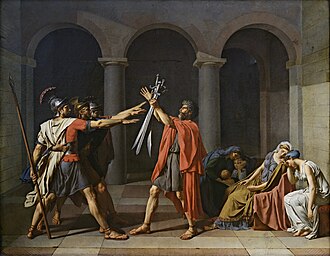 Le Serment des Horaces - Jacques-Louis David (1784)
.jpg) Les Sabines - Jacques-Louis David (1799)
Les Sabines - Jacques-Louis David (1799)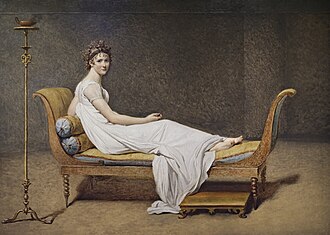 Madame Récamier - Jacques-Louis David (1800)
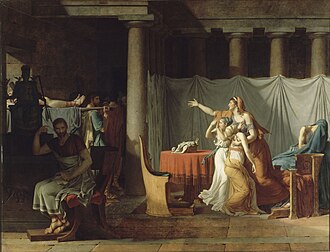 Les licteurs rapportant à Brutus les corps de ses fils - Jacques-Louis David (1789)
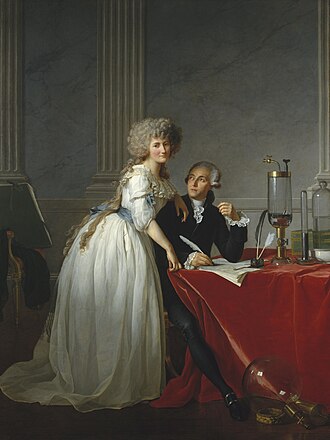 Portrait d'Antoine-Laurent Lavoisier et de sa femme - Jacques-Louis David (1788)
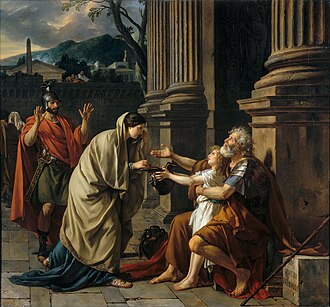 Bélisaire demandant l'aumône - Jacques-Louis David (1781)
L'Amour et Psyché - Jacques-Louis David (1817)
 Le Serment du jeu de paume - Jacques-Louis David (1791)
Œuvres d'artistes liés
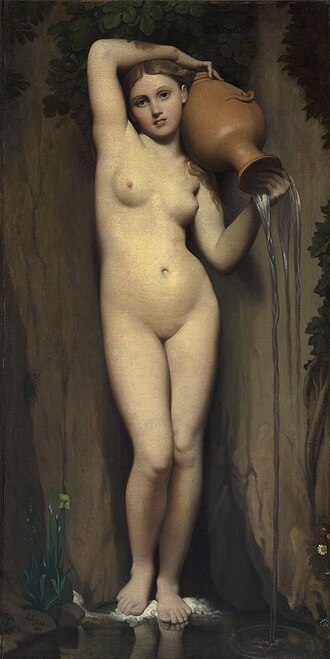 La Source - Jean-Auguste-Dominique Ingres (1856)
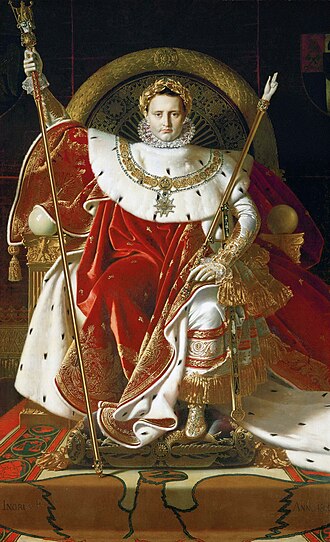 Napoléon Ier sur le trône impérial - Jean-Auguste-Dominique Ingres (1806)
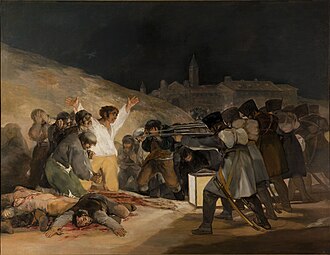 Tres de Mayo - Francisco Goya (1814)
.jpg) La Maja nue - Francisco Goya (1800)
La Maja nue - Francisco Goya (1800)