The Holy Family With a Palm Tree
Rafael Sanzio · 1506
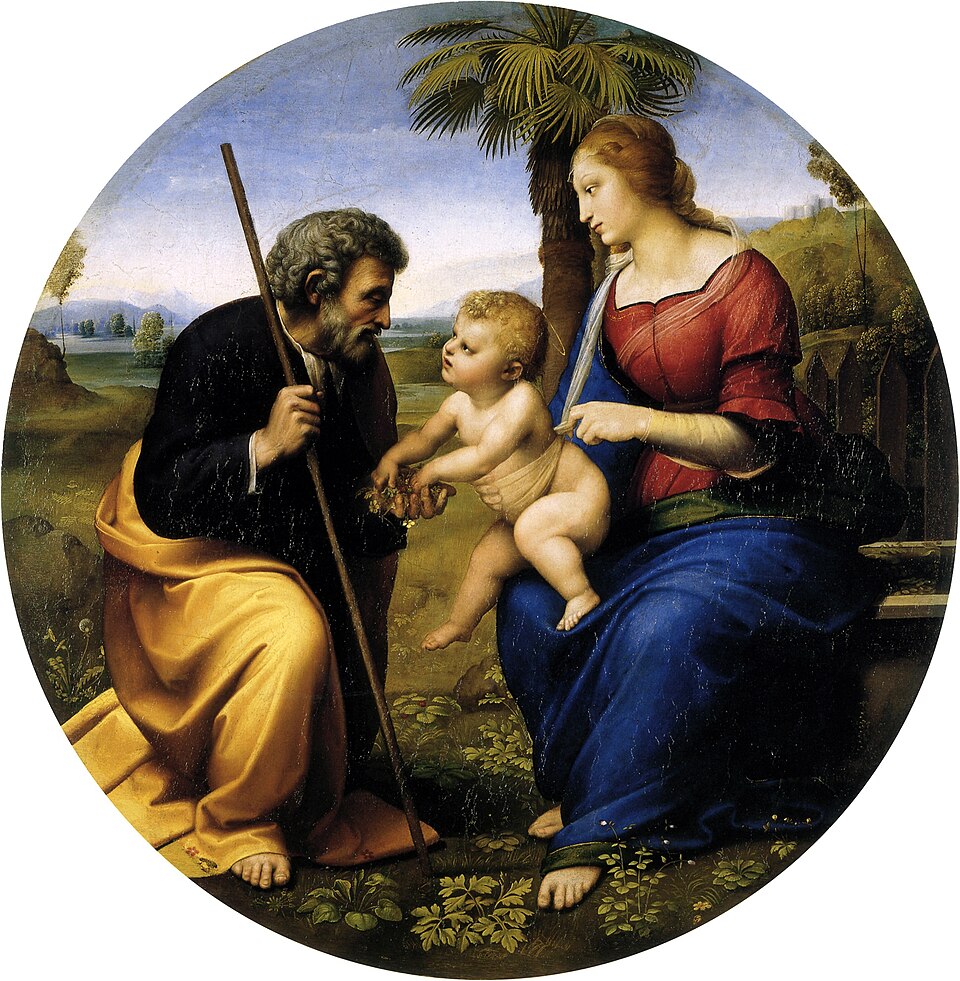
Joseph kneels and offers flowers, the Child reaches for them, and a palm tree rises between mother and son. In a round painting, Raphael gathered a family, a journey and a quiet foreshadowing.
The story behind the painting
The Holy Family with a Palm Tree is a religious painting by Raphael, now in the National Gallery of Scotland in Edinburgh. It is probably the second of two works Vasari says Raphael painted in Florence for Taddeo Taddei, the other likely being the Madonna of the Meadow. The first certain record dates from the 17th century, in the collection of the Countess of Chiverni in Paris. It then passed to the Duke of Orleans and was sold in 1792, when the duke took the name Philippe Egalite. It joined the Ellesmere collection in London and reached Edinburgh in 1945. Wikidata dates it 1506.
What to look for
The painting is a tondo, about 101.5 cm across according to Wikidata. Joseph kneels on the left, holding a staff in his right hand and offering flowers with the other to Jesus, who takes them. The Child sits on his mother's leg, held by her arms and by a sash tied around his waist and passed around her neck. Mary sits on the edge of a basin, a fence behind her, dressed as usual in red and blue. A palm trunk fills the space between mother and son, its fronds spread across the top. A distant lake, light trees, flowers and a dandelion at the far left edge complete the scene.
Meaning and intent
The scene probably takes place during the Flight into Egypt. The composition was carefully planned around the Christ Child at its centre, with the palm tree as his support. The palm is one of the signs of his entry into Jerusalem and so a symbol of his coming martyrdom. The figures interact vividly: Joseph looks at Jesus, who returns a firm, questioning look, while Mary unusually looks at Joseph rather than her son. The flowers in the foreground evoke ideas linked to the Virgin or the Passion, and the fence recalls the enclosed garden, a symbol of her virginity.
Legacy
The lively exchange of looks, the grasses in the foreground and the landscape backdrop recall Leonardo da Vinci, while the slender tree trunks recall Perugino, Raphael's first master. The colour already has the density and richness typical of his mature works. The botanical detail of the palm, its trunk and fronds, is described as extraordinarily faithful given how rare the plant was in Italy at the time. In the past the painting was restored to cover two deep vertical splits in its surface.
¿Sabías que…?
- A tondo, about 101.5 cm across.
- Probably painted in Florence for Taddeo Taddei.
- Reached the National Gallery of Scotland in 1945.
- The palm foreshadows Christ's entry into Jerusalem.
Sobre el artista
Rafael Sanzio (1483-1520)
arte religioso · mujer · Alto Renacimiento · Virgen María · Niño Jesús · niño · Galerías nacionales de Escocia
Más obras de Rafael Sanzio
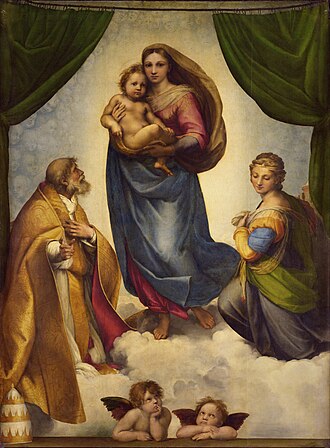 Madonna Sixtina - Raphael (1510s)
.jpg) La Fornarina - Raphael
La Fornarina - Raphael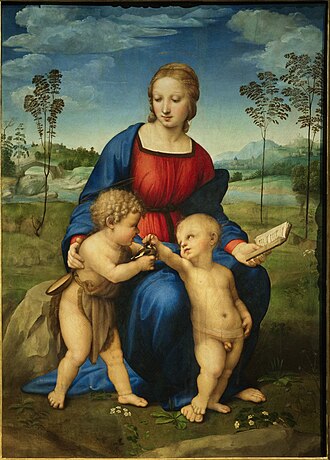 Virgen del jilguero - Raphael (1500s)
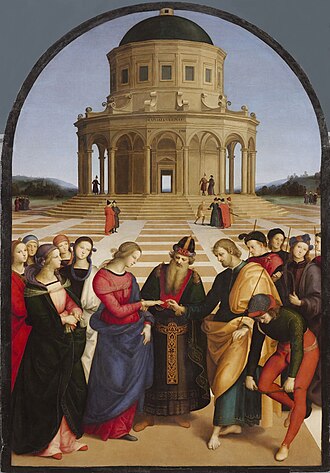 Los desposorios de la Virgen - Raphael (1504)
 La velada - Raphael (1510s)
 Las Gracias - Raphael (1504)
 Virgen de la Casa de Alba - Raphael (1510)
%20-%20La%20Madonna%20del%20Granduca%20-%20178%20-%20Galleria%20Palatina.jpg) Madona del gran duque - Raphael (1500s)
Madona del gran duque - Raphael (1500s)
Obras de artistas relacionados
.jpg) Venus de Urbino - Titian (1538)
Venus de Urbino - Titian (1538) La Asunción de la Virgen - Titian (1510s)
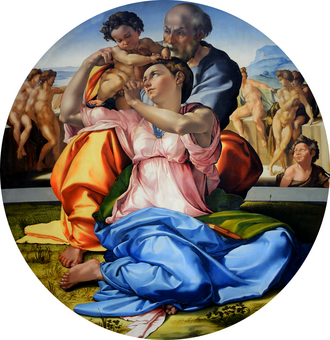 Tondo Doni - Michelangelo (1500s)
 Los tormentos de San Antonio - Michelangelo (1487)
 La Gioconda - Leonardo da Vinci (1503-1519)
 La dama del armiño - Leonardo da Vinci (1490)
 Autorretrato de Durero - Albrecht Dürer (1500)
 Adoración de los Magos - Albrecht Dürer (1504)
 El nacimiento de Venus - Sandro Botticelli (c. 1485)
 La primavera - Sandro Botticelli (1480s)
 El jardín de las delicias - Hieronymus Bosch
 La nave de los locos - Hieronymus Bosch (1500s)