El Damrak en Amsterdam
Jacob Ruysdael · 1670
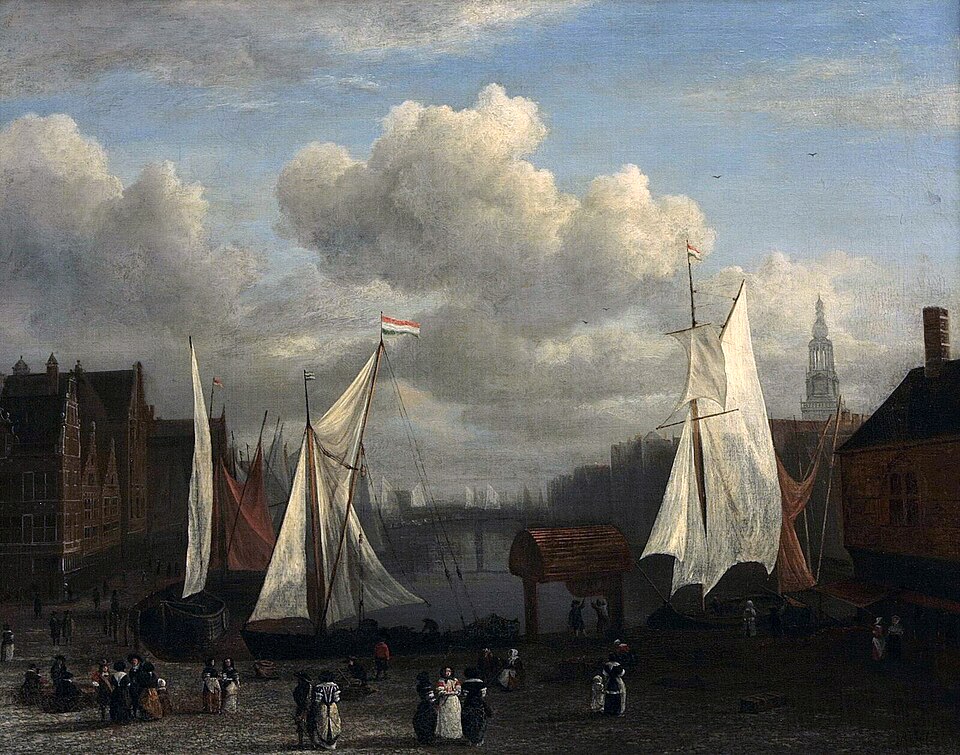
People and goods crowd the Dam, ships lie along the Damrak quay and sails hang to dry over a bridge railing. Ruisdael, a master of wild landscapes, rarely painted cities, yet here he painted the heart of his own Amsterdam.
The story behind the painting
Cityscapes are rare in Ruisdael's work, but he painted this view three times: this version in Rotterdam, one in the Frick Collection in New York, and one belonging to the Mauritshuis, on long-term loan to the Amsterdam Historical Museum since 1999. Seymour Slive dates this undated canvas to about 1675, while Wikidata gives 1670. Ruisdael then lived on the Dam itself, but could not have painted this from his studio window, which faced the other way.
What to look for
In the foreground, on the north side of the Dam, groups of people stand among merchandise on display. Beyond, the Damrak runs between rows of houses, with cargo ships moored at the quay. To the right rises the tower of the Oude Kerk. Mid-canal is the Papenbrug, with sails drying over its railings, and on the quay two men work a winch. The house to the left is called the Bishop, and the inn to the right Under the Sail. Wikipedia gives the size as 53.3 by 67.2 cm, Wikidata 54 by 68 cm.
Meaning and intent
Whether the figures are by Ruisdael or by a specialist figure painter is uncertain; such collaborations were common, and this could be one. The painting's poor condition is revealing in its own way: on the right, where the paint has worn thin, you can see that Ruisdael painted the buildings in full first, then painted the sails over them. For a painter known for landscapes, this busy square of trade, ships and drying sails is a rare portrait of daily city life.
Legacy
Signed lower right, the painting has been in the Museum Boijmans Van Beuningen in Rotterdam since 1866, as inventory number 1744 under the title The Damrak in Amsterdam. It is number 8 in Slive's 2001 catalogue raisonné of Ruisdael, and may be number 13 or 13f in Hofstede de Groot's 1911 catalogue. Its two sister versions, in New York and on loan in Amsterdam, let viewers compare how Ruisdael returned to the same busy place.
¿Sabías que…?
- One of three versions of this view by Ruisdael.
- Dated about 1675 by Slive; Wikidata gives 1670.
- Worn paint shows the sails were painted over finished buildings.
- In the Museum Boijmans Van Beuningen since 1866.
Sobre el artista
Jacob Ruysdael (1628-1682)
paisaje urbano · embarcación de vela · Museo Boymans Van Beuningen
Más obras de Jacob Ruysdael
 El molino de Wijk bij Duurstede - Jacob van Ruisdael (1670)
 El cementerio judío - Jacob van Ruisdael (1650s)
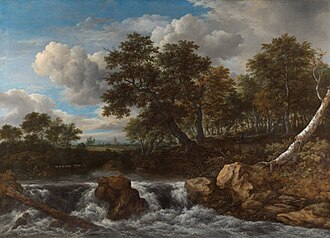 Paisaje con cascada - Jacob van Ruisdael (1668)
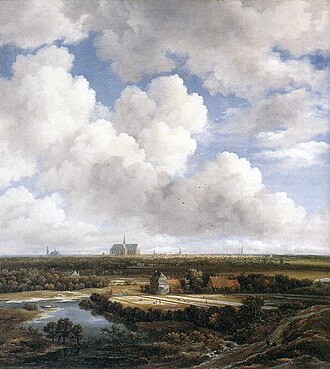 Vista de Haarlem con campos de blanqueo - Jacob van Ruisdael (1670)
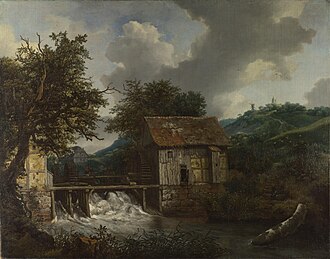 Dos molinos y una compuerta abierta cerca de Singraven - Jacob van Ruisdael (1650)
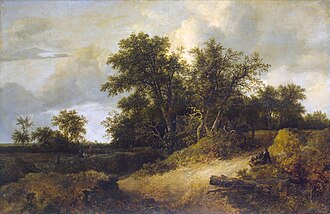 Duna paisaje - Jacob van Ruisdael (1646)
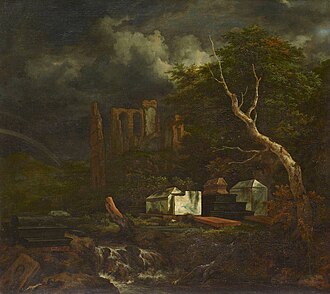 El cementerio judío, - Jacob van Ruisdael (1653)
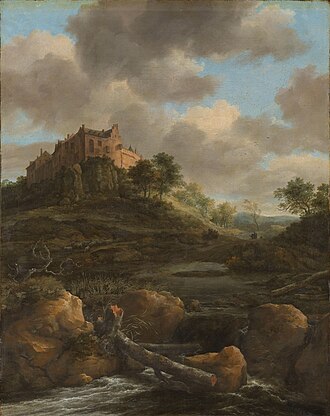 Castillo Bentheim - Jacob van Ruisdael (1650s)
Obras de artistas relacionados
 La ronda de noche - Rembrandt van Rijn (1642)
 Autorretrato - Rembrandt van Rijn (1659)
 La joven de la perla - Johannes Vermeer (1665)
 La lechera - Johannes Vermeer (c. 1658)
 La fiesta de San Nicolás - Jan Steen (1660s)
 Joven comiendo ostras - Jan Steen (1658)
 El alegre bebedor - Frans Hals (1620s)
 Caballero sonriente - Frans Hals (1624)
 Patio de una casa de Delft - Pieter de Hooch (1658)
 Mujer pelando manzanas - Pieter de Hooch (1663)