Standard of the Holy Trinity
Rafael Sanzio · 1499
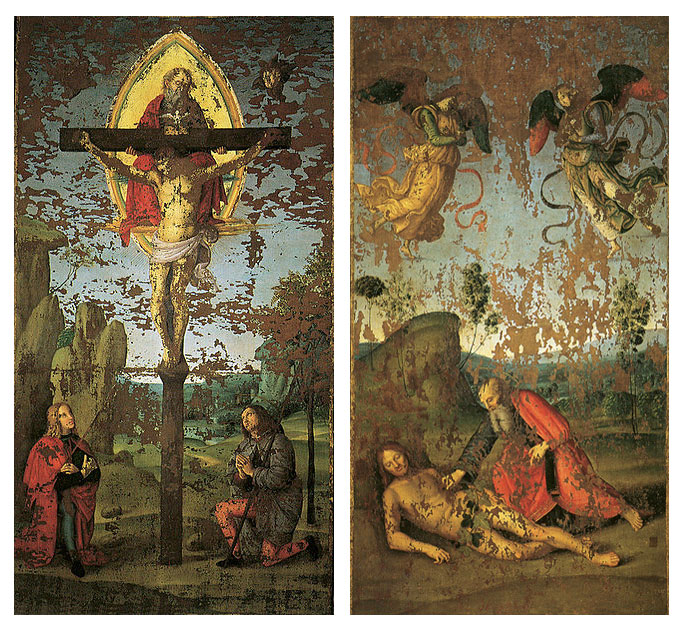
A processional banner once carried through the streets of a small Umbrian town in a time of plague. It is considered one of the very first works of the young Raphael, painted on both sides.
The story behind the painting
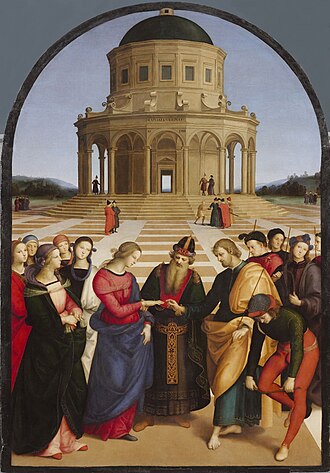
This banner, a gonfalon carried in processions, is attributed to Raphael and dated around 1499 to 1504. Wikidata gives 1499. It was painted for the church of the Trinity in Citta di Castello, where the young painter had gone to take the place of his father, Giovanni Santi, who had died in 1494 and kept a workshop in the town. After Luca Signorelli left, talented painters were scarce there, so the young artist, still under Perugino's influence, received many commissions, including the Saint Nicholas of Tolentino altarpiece, the Mond Crucifixion now in the National Gallery, and the Marriage of the Virgin in the Brera.
What to look for
The banner was painted on both faces; the two sides were later separated and are shown together. On the front is the Crucifixion, topped by a Throne of Grace, with Saints Roch and Sebastian. On the back is the Creation of Eve. The source sees Perugino in the soft landscapes and the symmetrical angels among floating ribbons, and Luca Signorelli in the firm sense of volume. Yet the placement of figures in space is much more coherent than in the work of his masters. Wikidata gives a size of about 167 by 94 cm, and the work is kept in the Pinacoteca Comunale of Citta di Castello.
Meaning and intent
Banners like this are generally linked with the plague epidemic of 1499, as the presence of Roch and Sebastian, protectors against plague, suggests. That is why some historians date it to that year or just after, though not beyond 1503 or 1504. Imagine it carried through the streets by a frightened community, the crucified Christ on one side and the first woman's creation on the other: death and the beginning of life on the same cloth. It is considered the first work of the painter, already showing an order and clarity that would grow into the art of the mature Raphael.
Legacy
The banner was already in poor condition in 1638. In 1867 it was entrusted to Count Della Porta, who had it restored, removing crusts and retouching the saints' heads. A more recent restoration after the Second World War brought back the original surface, where the glazes are still intact. The work was shown in the Raphael exhibition at the National Gallery in London in 2004 to 2005. A new restoration, a collaboration between the Metropolitan Museum, the town's Pinacoteca and the Istituto centrale per il restauro in Rome, made it a key work of the Met exhibition Raphael: Sublime Poetry, from 23 March to 28 June 2026.
¿Sabías que…?
- Painted around 1499 to 1504 for the church of the Trinity in Citta di Castello.
- Double-sided: Crucifixion on one face, Creation of Eve on the other.
- Probably linked to the plague of 1499.
- Shown at the Metropolitan Museum in 2026 after restoration.
Sobre el artista
Rafael Sanzio (1483-1520)
arte religioso · varón · Alto Renacimiento · Jesús de Nazaret
Más obras de Rafael Sanzio
 Madonna Sixtina - Raphael (1510s)
 La Fornarina - Raphael
 Virgen del jilguero - Raphael (1500s)
 Los desposorios de la Virgen - Raphael (1504)
 La velada - Raphael (1510s)
 Las Gracias - Raphael (1504)
 Virgen de la Casa de Alba - Raphael (1510)
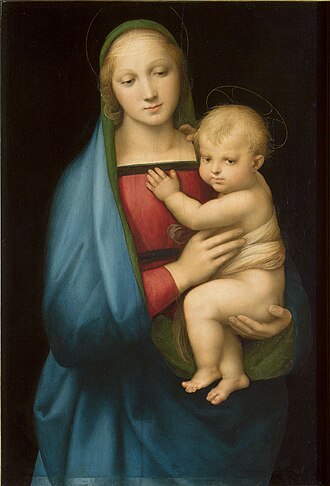 Madona del gran duque - Raphael (1500s)
Obras de artistas relacionados
 Venus de Urbino - Titian (1538)
 La Asunción de la Virgen - Titian (1510s)
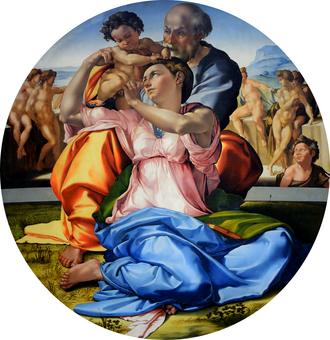 Tondo Doni - Michelangelo (1500s)
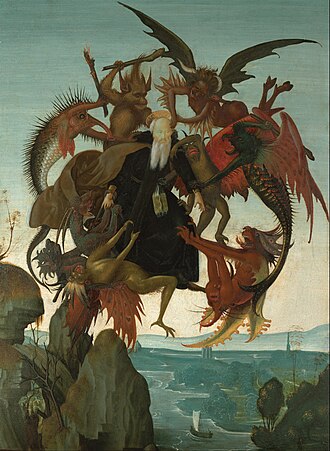 Los tormentos de San Antonio - Michelangelo (1487)
 La Gioconda - Leonardo da Vinci (1503-1519)
 La dama del armiño - Leonardo da Vinci (1490)
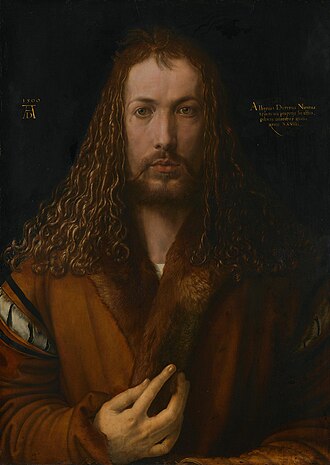 Autorretrato de Durero - Albrecht Dürer (1500)
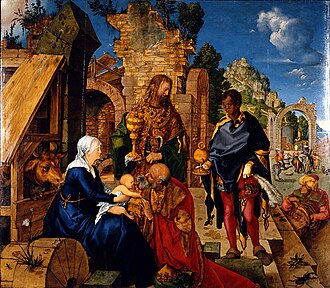 Adoración de los Magos - Albrecht Dürer (1504)
 El nacimiento de Venus - Sandro Botticelli (c. 1485)
 La primavera - Sandro Botticelli (1480s)
 El jardín de las delicias - Hieronymus Bosch
 La nave de los locos - Hieronymus Bosch (1500s)