Díptico de Felipe de Croÿ con la Virgen y el Niño
Rogier van der Weyden · 1460
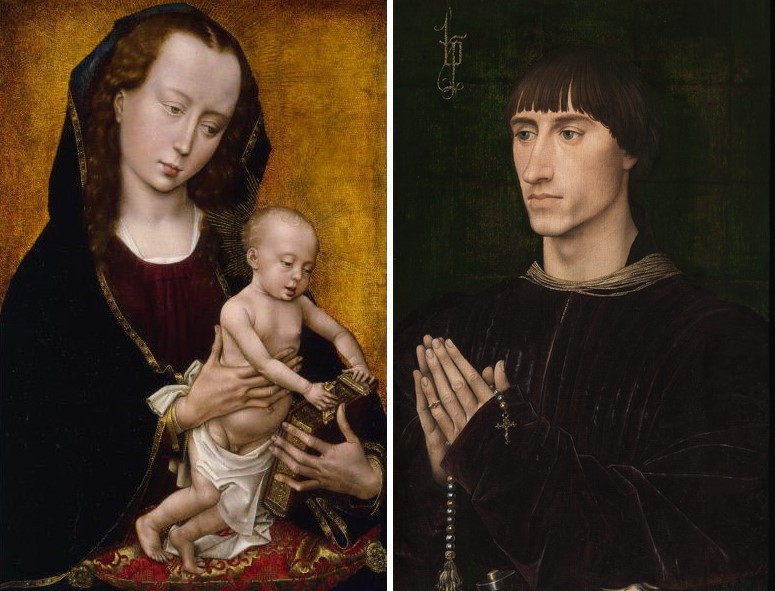
A young nobleman folds his hands in prayer, and across the hinge the Christ Child reaches toward him from a field of gold. The two small panels were made to be one, but today they live on two continents, in Antwerp and California.
The story behind the painting
Around 1460 Rogier van der Weyden painted two small oak panels: the Virgin and Child, and a portrait of Philip I de Croÿ, chamberlain to Philip the Good. It is believed but not proven that they were the wings of one devotional diptych, broken apart at some unknown time. A panel fitting the Mary wing appears in a 1629 inventory of Alexandre d'Arenberg, a descendant of de Croÿ. The reverse of the portrait carries the family crest and the title de Croÿ used from 1454 to 1461. He would have been about 25. By then van der Weyden, official painter of Brussels since 1436, was so sought after that he seems to have worked mainly on commissions.
What to look for
De Croÿ is seen half length in a high-necked dark purple doublet lined with fur, a pearled rosary between his fingers, ending in a gold tassel and a gilded crucifix. His backdrop is pleated green cloth laid in thin verdigris glazes over silver leaf, revealed only in a recent restoration; before, dirt made it look like a plain dark plane. His haircut, long in front and shaved at the sides, helps date the work. Opposite, Mary in a dark hooded cloak over a red dress stands against gold, while the restless child, on an embroidered cushion, toys with the clasps of a prayer book and stretches his hand toward the donor.
Meaning and intent
The gold behind Mary makes her an unearthly vision appearing to the praying man, set against his ordinary flat background. The child's outstretched hand, almost crossing the edge of his panel, links the human and the divine, and the art historian Martha Wolff suggests the gesture extends to us, the viewers praying before the diptych. The source notes that the lavish book may have been meant to flatter de Croÿ, a soldier, ambassador and noted collector of illuminated manuscripts. Van der Weyden also flattered him by softening his large nose and undershot jaw into the image of a refined, pious nobleman.
Legacy
Van der Weyden is widely credited as the first to use the diptych for donor portraits, pairing a half-length patron with a half-length holy figure, and these panels are among four confirmed examples. The conventions he set lasted until the mid sixteenth century and helped make devotional diptychs a lasting format of Early Netherlandish painting. His Marian panels echoed the Byzantine icons then prized in Italy. Today the portrait is in the Royal Museum of Fine Arts in Antwerp, while the Virgin panel, which surfaced in 1892 in Henry Willett's collection in Brighton and passed through the Kann collection in Paris, is at the Huntington in San Marino, California.
¿Sabías que…?
- Two oak panels painted around 1460, probably once a single diptych.
- The donor is Philip I de Croÿ, about 25 at the time.
- His hidden green and silver backdrop was revealed in a recent restoration.
- Now split between Antwerp and San Marino, California.
Sobre el artista
Rogier van der Weyden (1390s-1464)
arte religioso · retrato · Primitivo flamenco · Museo Real de Bellas Artes de Amberes
Más obras de Rogier van der Weyden
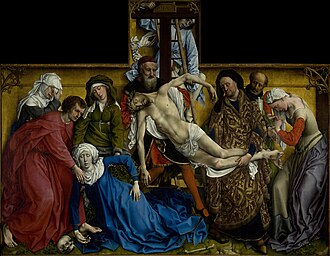 Descendimiento de la cruz - Rogier van der Weyden (1440s)
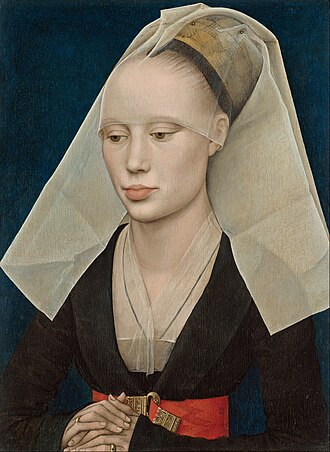 Retrato de una dama - Rogier van der Weyden (1460)
.jpg) Políptico del juicio final - Rogier van der Weyden (1443)
Políptico del juicio final - Rogier van der Weyden (1443)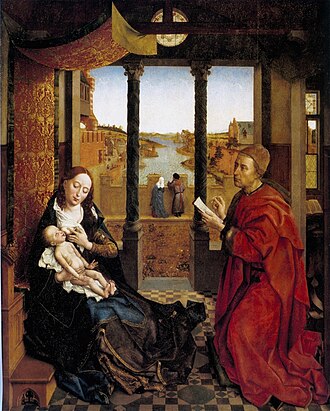 San Lucas dibujando a la Virgen - Rogier van der Weyden (1490)
 Tríptico del altar de Santa Columba - Rogier van der Weyden (1450s)
 La Magdalena leyendo - Rogier van der Weyden (1435)
 Tríptico Braque - Rogier van der Weyden (1452)
%20-%20Prado%20P02722.jpg) Madonna Durán - Rogier van der Weyden (1430s)
Madonna Durán - Rogier van der Weyden (1430s)
Obras de artistas relacionados
 El jardín de las delicias - Hieronymus Bosch
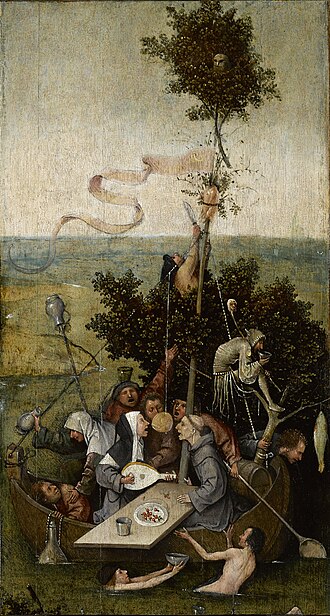 La nave de los locos - Hieronymus Bosch (1500s)
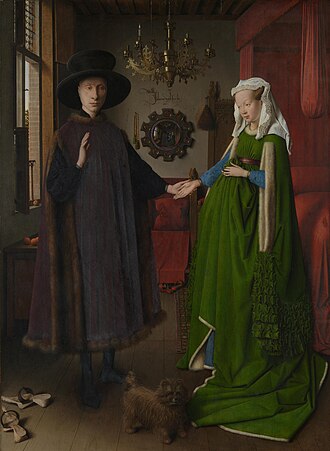 Retrato de Arnolfini y su esposa - Jan van Eyck (1434)
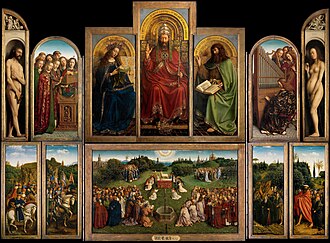 Políptico de Gante - Jan van Eyck (1432)
%20-%20Google%20Art%20Project.jpg) Cazadores en la nieve - Pieter Bruegel the Elder (1565)
Cazadores en la nieve - Pieter Bruegel the Elder (1565)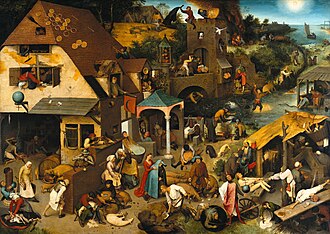 Los proverbios flamencos - Pieter Bruegel the Elder (1551)