Rogier van der Weyden
1390s-1464
Rogier van der Weyden painted grief so tenderly that his Descent from the Cross is still called his masterpiece. Famous across Europe in his lifetime, then almost forgotten, he is now seen as the most influential Northern painter of the 15th century.
Origins
Because archives were lost in 1695 and again in 1940, few certain facts of his life survive. He was born Rogelet de le Pasture, Roger of the Pasture, in Tournai in 1399 or 1400, to Henri de le Pasture, a knife maker, and Agnes de Wattrélos. In 1426 he married Elisabeth, daughter of a Brussels shoemaker, and they had four children: Cornelius, who became a Carthusian monk, Margaretha, Pieter, who became a painter, and Jan, a goldsmith. Little is known of his training. In 1427 the painters' guild records a Rogelet de le Pasture entering the workshop of Robert Campin, together with Jacques Daret, and on 1 August 1432 he became a master painter. Why he started so late is unclear.
Life and turning points
By 21 October 1435 the family had settled in Brussels, where he began using the Flemish form of his name, Rogier van der Weyden. From 1436 he held the title of painter to the town of Brussels, a post created for him and meant to lapse at his death, linked to a huge commission for four justice scenes in the Golden Chamber of the Town Hall. He grew prosperous, painted the Burgundian dukes and their court, gave generously to the poor and helped run a charitable foundation from 1455 to 1457. According to some sources he went to Italy in 1449 and possibly to Rome in the holy year 1450. Patrons included Philip the Good, the Este and the Medici. He died in Brussels on 18 June 1464.
Style and technique
Van der Weyden worked from life models and observed details closely, yet he often idealised their features, especially in his triptychs. His forms are rendered with rich, warm colour and a sympathetic expression, and he is known for expressive pathos and naturalism. He used an unusually broad range of colours and tones; in his finest work no tone is repeated elsewhere in the picture, so even the whites vary. His portraits tend to be half length and half profile. From Campin he took strong diagonal lines through headdresses or folds of cloth, dark flat backgrounds and strong light from the near left. His Italian experiences, if they happened, had no influence on his style.
Stories and anecdotes
The Descent from the Cross, now in the Prado, once hung in a church in Leuven before it was sent to the King of Spain. The ship carrying it sank, but the painting floated, and careful packing meant it was scarcely damaged; a copy by Michel Coxcie was given to Leuven in its place. On 17 November 1426 Tournai offered eight pitchers of wine in honour of a Maistre Rogier de le Pasture, which some take as a sign he had an academic title before he became a painter. His identity confused historians for centuries: Vasari placed him in Bruges, Van Mander thought there were two painters, and only in 1953 did Erwin Panofsky establish that one painter had two names.
Legacy
By the latter half of the 15th century Van der Weyden had eclipsed Jan van Eyck in popularity, and his paintings were exported to Italy and Spain. Humanists such as Nicolas Cusanus, Filarete and Bartolomeo Facio called him the greatest and most noble of painters. His fame lasted until the 17th century, but by the mid-18th century he was almost totally forgotten, and his reputation was rebuilt slowly over the next two hundred years. Many of his works were lost, including the four great justice panels destroyed in the French bombardment of Brussels in 1695. Today, with Robert Campin and Van Eyck, he is one of the three great Early Netherlandish painters, and his grieving figures still move those who stand before them.
¿Sabías que…?
- He left no self-portrait, though one may be hidden in his lost justice panels, copied in the Bern tapestry.
- The Duchess of Milan sent her court painter Zanetto Bugatto to train in his workshop.
- The Magdalen Reading in London is a fragment of a larger altarpiece cut up before 1811.
- He was buried in St. Catherine's Chapel of the Cathedral of St. Michael and St. Gudula in Brussels.
Artistas relacionados
Jerónimo Bosch · Jan van Eyck · Pieter Bruegel the Elder
Obras de Rogier van der Weyden
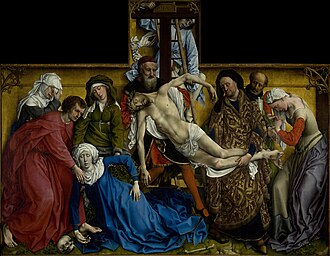 Descendimiento de la cruz - Rogier van der Weyden (1440s)
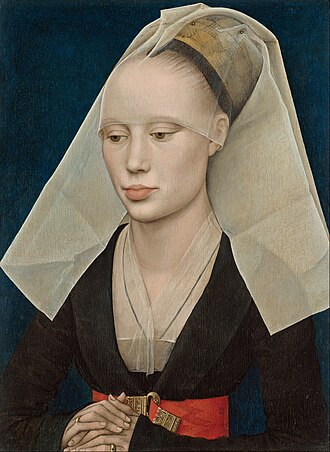 Retrato de una dama - Rogier van der Weyden (1460)
.jpg) Políptico del juicio final - Rogier van der Weyden (1443)
Políptico del juicio final - Rogier van der Weyden (1443)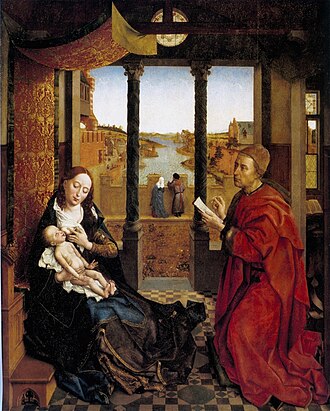 San Lucas dibujando a la Virgen - Rogier van der Weyden (1490)
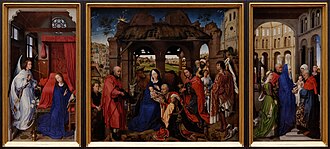 Tríptico del altar de Santa Columba - Rogier van der Weyden (1450s)
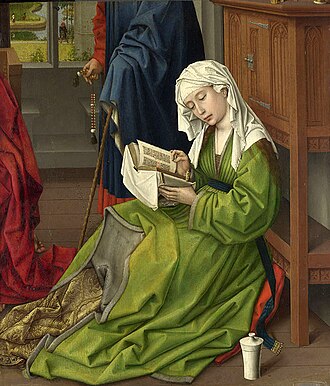 La Magdalena leyendo - Rogier van der Weyden (1435)
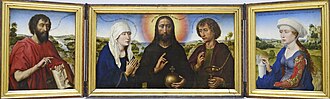 Tríptico Braque - Rogier van der Weyden (1452)
%20-%20Prado%20P02722.jpg) Madonna Durán - Rogier van der Weyden (1430s)
Madonna Durán - Rogier van der Weyden (1430s)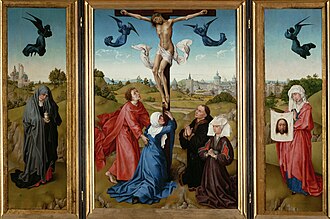 Cristo en la Cruz con María y San Juan - Rogier van der Weyden (1440s)
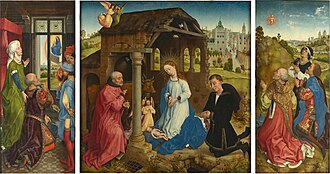 Retablo Bladelin - Rogier van der Weyden (1440s)
%20-%20The%20Crucifixion%2C%20with%20the%20Virgin%20and%20Saint%20John%20the%20Evangelist%20Mourning%20-%20Google%20Art%20Project.jpg) Calvario - Rogier van der Weyden (1460)
Calvario - Rogier van der Weyden (1460)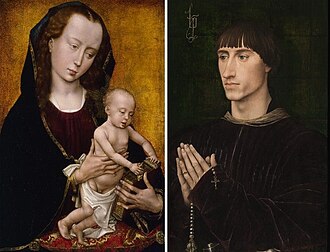 Díptico de Felipe de Croÿ con la Virgen y el Niño - Rogier van der Weyden (1460)