Diomedes devorado por sus caballos
Gustave Moreau · 1865
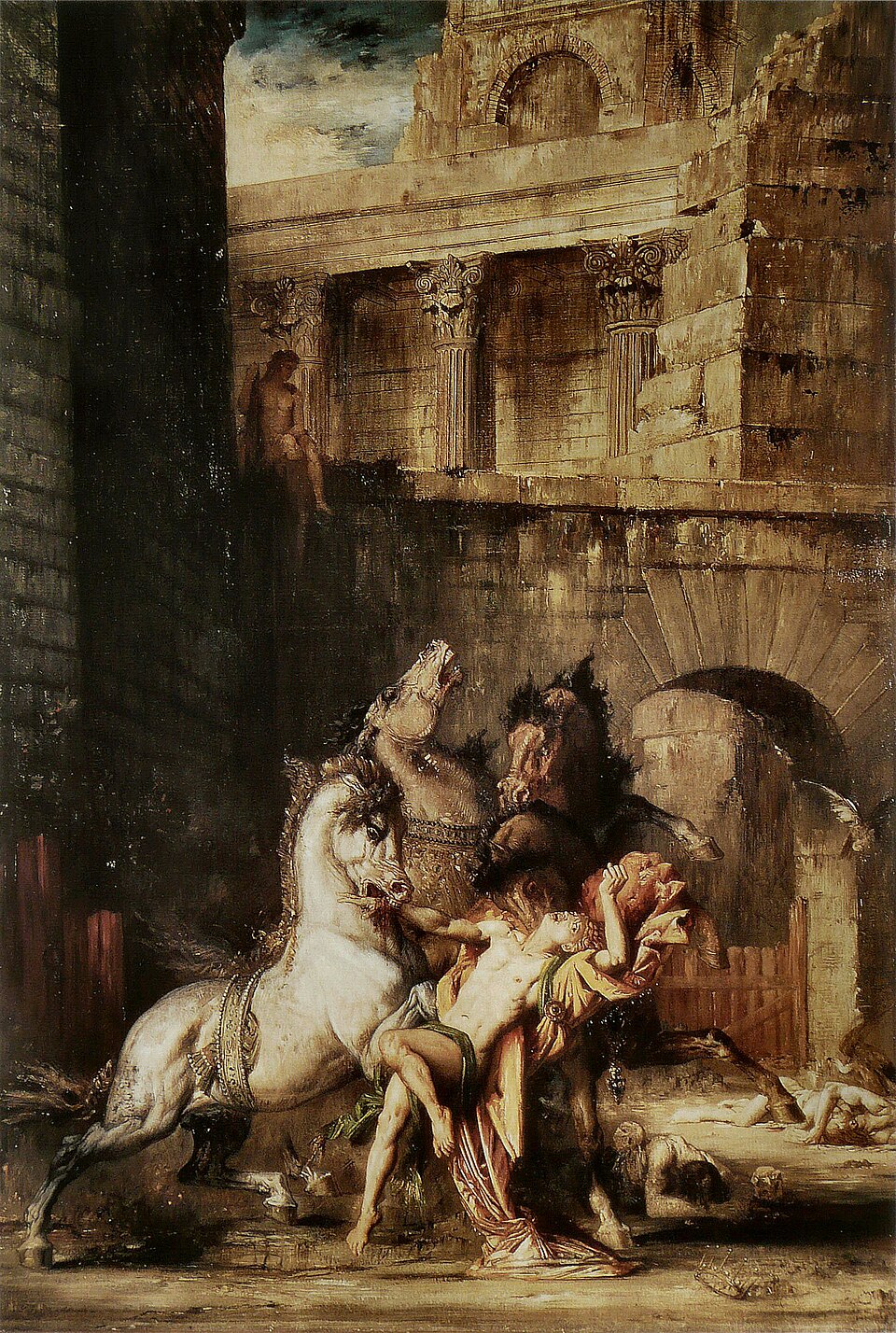
A king is torn apart by his own horses in a walled stable, while Hercules simply sits and watches. Gustave Moreau painted this savage scene in 1865, and later said he wished he had done better.
The story behind the painting
Diomede Devoured by His Horses is the title of three works by Gustave Moreau, and this is the first, an oil on canvas painted in 1865 for the Musée des Beaux-Arts in Rouen. A watercolour followed the next year and another oil in 1870. Moreau prepared it with many small, highly finished drawings, including a study of skulls and a study of a horse in profile. He was not pleased with the result. To the curator in Rouen he wrote that he would have liked to answer the request in a more satisfying way, with a larger and more successful canvas.
What to look for
The writer Maxime Du Camp described the stable as a kind of circus enclosed by a high wall from which strong columns rise, giving the whole an imposing severity. In the foreground the horses have rushed at their master, seizing him by the arm and neck and holding him in the air; here and there corpses white as ivory feed hoary vultures. The horses are exaggerated, as befits fabulous animals, with huge necks and flared nostrils. Diomede's pale face shows a grimacing terror. In the background Hercules sits on the wall among Corinthian columns and does not act.
Meaning and intent
The scene comes from the Greek myth of the mares of Diomede, one of the twelve labours of Hercules. Moreau chose the moment of the king's punishment rather than the hero's action, and set Hercules apart as a silent witness. Du Camp praised the shadowy background, both transparent and powerful, which makes the skilful whites of the foreground stand out, from the pearl grey of the first horse to the pallid corpses, balanced by Diomede's flesh tones and the white feathers of the vultures. Like all of Moreau's work, the paintings are Symbolist and have drawn many readings, including psychoanalytic ones.
Legacy
The 1865 canvas was shown at the Salon of painting and sculpture in 1866 and remains in the Musée des Beaux-Arts in Rouen, the museum for which it was made. Moreau returned to the subject twice. In the 1870 version, the art scholar Cécile Croce describes a grave, brown, sordid and damp stable, strewn with human remains trampled by the furious horses, and Diomede trapped in a complex red drapery that makes him look like an open, screaming wound. The first, smaller Rouen picture stands at the start of that obsession.
¿Sabías que…?
- Painted by Gustave Moreau in 1865 for the museum in Rouen.
- Shown at the Salon of 1866.
- Moreau painted two more versions, in 1866 and 1870.
- Based on one of the twelve labours of Hercules.
Sobre el artista
Gustave Moreau (1826-1898)
pintura mitológica · caballo · cadáver · pared
Más obras de Gustave Moreau
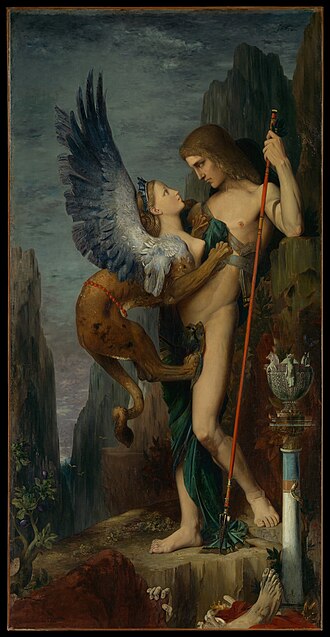 Edipo y la esfinge - Gustave Moreau (1864)
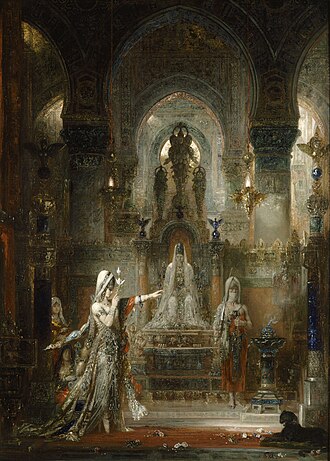 Salomé bailando ante Herodes - Gustave Moreau (1876)
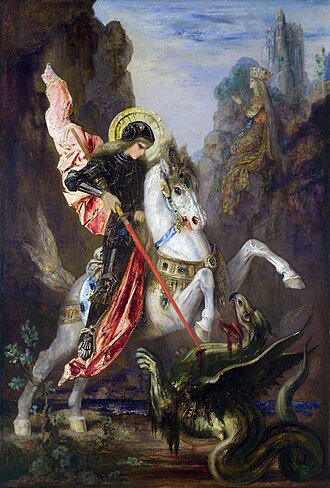 San Jorge - Gustave Moreau (1880s)
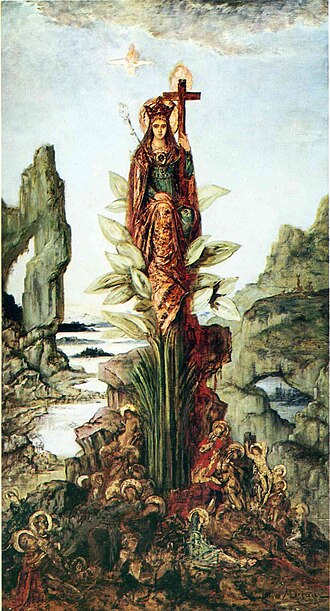 Flor Mística - Gustave Moreau (1890)
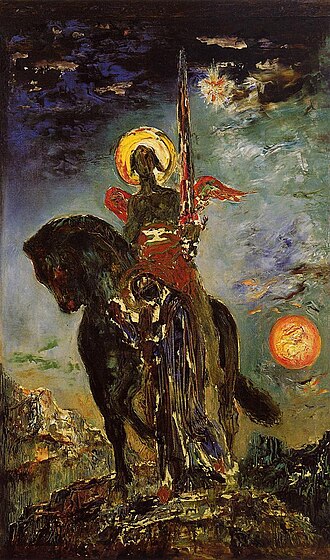 La Parca y el Ángel de la Muerte - Gustave Moreau (1890)
 Athenians being Delivered to the Minotaur in the Cretan Labyrinth - Gustave Moreau (1855)
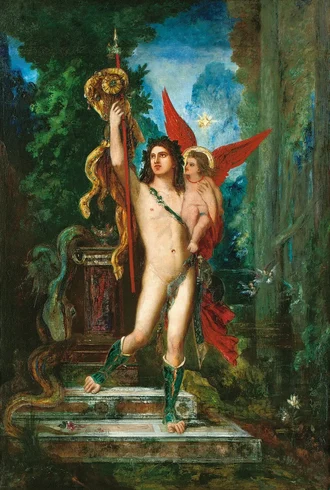 Jasón y Eros - Gustave Moreau (1891)
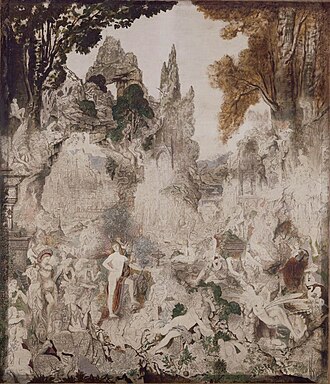 Les Chimères - Gustave Moreau (1884)
Obras de artistas relacionados
 Pollice verso - Jean-Léon Gérôme (1872)
 El mercado de esclavos - Jean-Léon Gérôme (1866)
 Almuerzo sobre la hierba - Édouard Manet (1863)
 Olympia - Édouard Manet (1863)
 El origen del mundo - Gustave Courbet (1866)
 Entierro en Ornans - Gustave Courbet (2020)
 Clavel, lirio, lirio, rosa - John Singer Sargent (1885-1886)
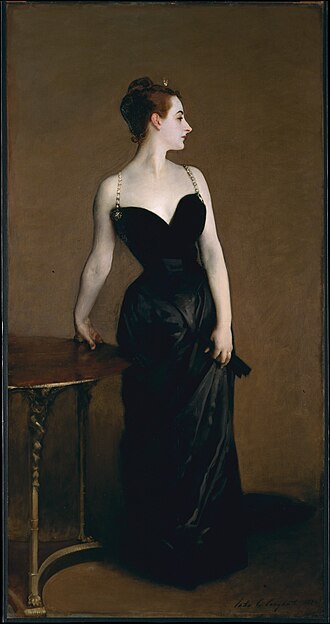 Retrato de Madame X - John Singer Sargent (1884)
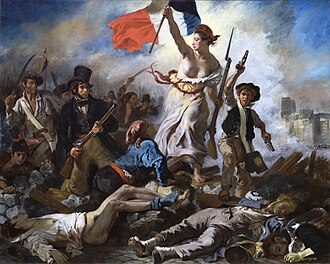 La Libertad guiando al pueblo - Eugène Delacroix (1830)
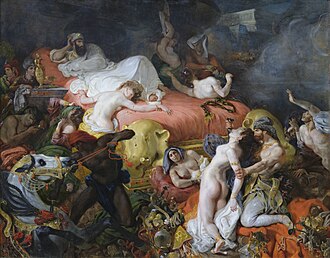 La muerte de Sardanápalo - Eugène Delacroix (1827)
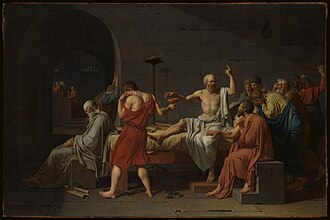 La muerte de Sócrates - Jacques-Louis David (1787)
 Juramento de los Horacios - Jacques-Louis David (1784)