La coronación de espinas
Jerónimo Bosch · 1495
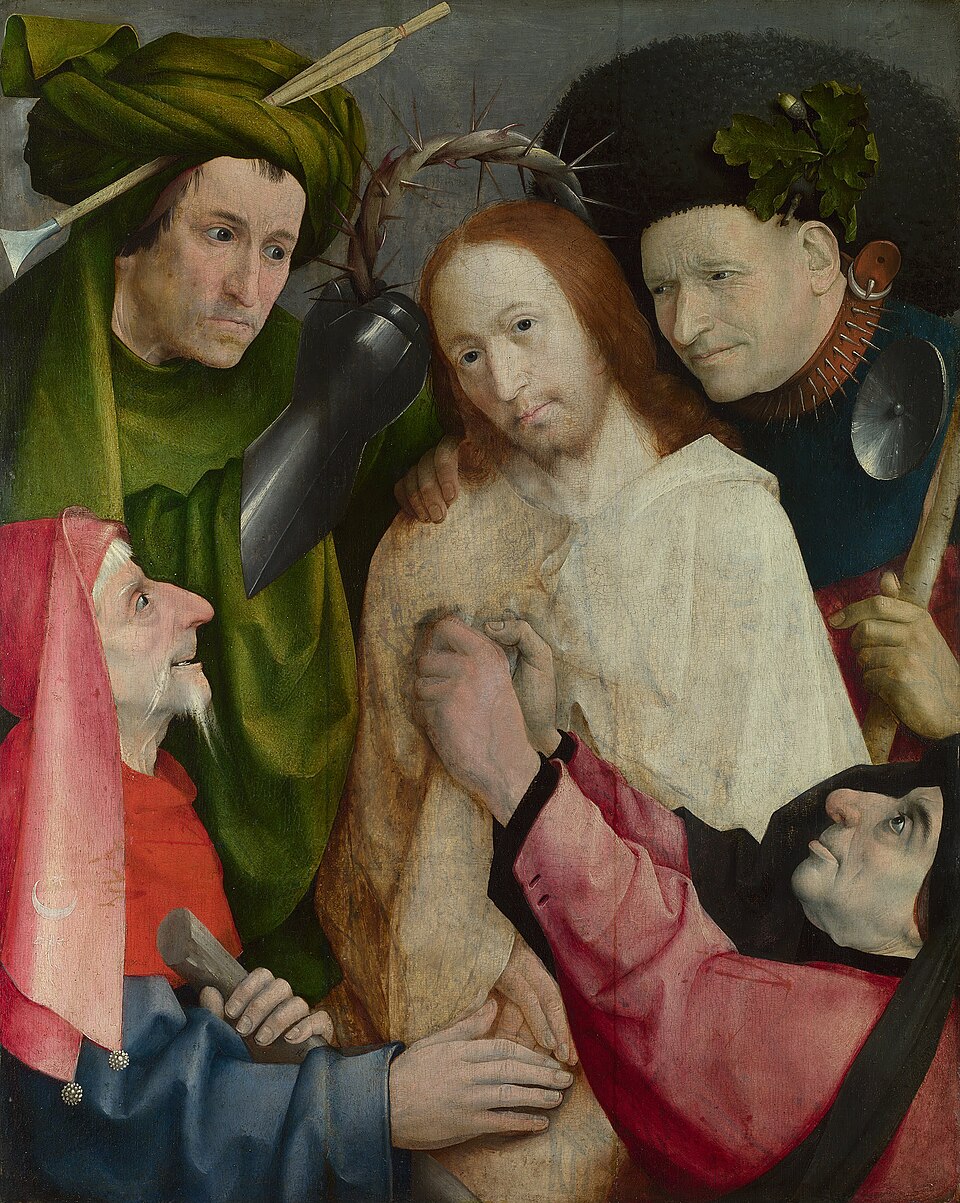
Four men close in on Christ, one with a spiked dog collar, one holding the crown of thorns in an armoured glove. In the middle, dressed in white, Christ looks calmly out at us. Bosch hid politics in their hats.
The story behind the painting
Christ Crowned with Thorns, sometimes called Christ Mocked, is an oil on oak panel by Hieronymus Bosch, about 73.8 by 59 cm. The National Gallery in London dates it to around 1510, though some art historians prefer earlier dates, and Wikidata gives 1495. Bosch painted it on top of an unfinished Saint Christopher, probably also his own. Examination has shown that the preliminary drawing was more brutal, and that the cruelty was softened in the final painting, leaving the men's expressions more enigmatic. A different composition of the same subject in the Escorial is now usually given to a follower.
What to look for
The painting joins two moments of the Passion, the Mocking and the Crowning with Thorns. Two armoured soldiers stand behind Christ. The one on the right, with oak leaves in his hat and a spiked collar, grips his shoulder. The one on the left, in green, with a hunting crossbow bolt through his headdress, holds the crown in a gauntleted hand, about to press it down; its position forms a halo. Below, a man in a blue robe and red head covering kneels on the left, and a man in light red on the right pulls at Christ's cloak. The figures crowd one shallow plane, like Flemish devotional art by Memling and Hugo van der Goes.
Meaning and intent
The picture departs from Bosch's usual manner and from the bloody, violent Passion scenes of his day. It looks simple but hides symbols. The oak leaves would have been read as Pope Julius II, of the della Rovere family, and the crossbow bolt as the alliance of the pope with Emperor Maximilian I and Louis XII of France in his military ambitions. The lower figures represent the bourgeoisie and the peasantry. The source describes the one on the left as a Turk, by the crescent and star on his headdress, and the one on the right as a Jew by his features, pointing to the pope's dealings with both. The four may also show the four humours.
Legacy
The painting is in good condition, though some colours have faded, especially red lakes, and the copper greens are turning brown. Thinning paint now reveals parts of the underdrawing and changes of mind. It belonged to Hollingworth Magniac in the Colworth collection, was sold from his son Charles's estate in 1892 to Robert Thompson Crawshay, then passed through the Galleria San Giorgio in Rome before the National Gallery bought it in 1934. Followers' versions close to it are in Antwerp, Philadelphia and Bern, probably based on another, lost Bosch of the subject.
¿Sabías que…?
- Oil on oak, painted over an unfinished Saint Christopher.
- Dated around 1510 by the National Gallery; Wikidata gives 1495.
- The underdrawing was more brutal than the final picture.
- Bought by the National Gallery, London, in 1934.
Sobre el artista
Jerónimo Bosch (1450-1516)
arte religioso · varón · Alto Renacimiento · National Gallery de Londres · Jesús de Nazaret · Primitivo flamenco · corona de espinas
Más obras de Jerónimo Bosch
 El jardín de las delicias - Hieronymus Bosch
 La nave de los locos - Hieronymus Bosch (1500s)
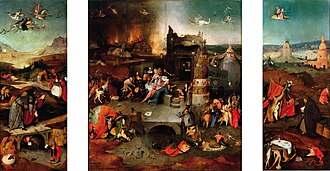 Tríptico de las Tentaciones de san Antonio - Hieronymus Bosch (1501)
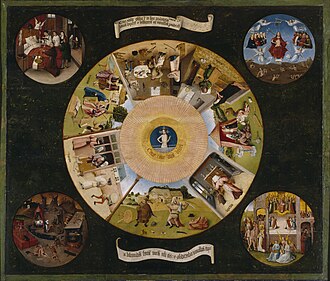 Mesa de los pecados capitales - Hieronymus Bosch (1500)
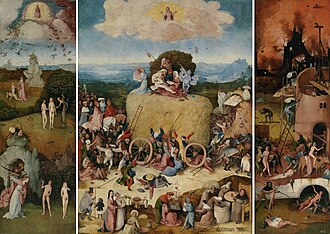 El carro de heno - Hieronymus Bosch (1510s)
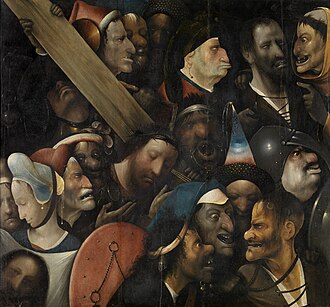 Cristo con la Cruz a cuestas - Hieronymus Bosch (1510s)
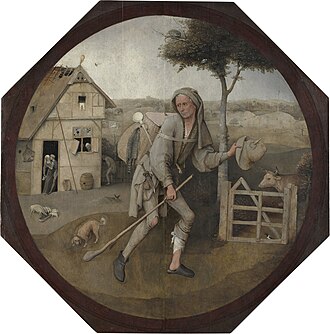 El vendedor ambulante - Hieronymus Bosch (1500)
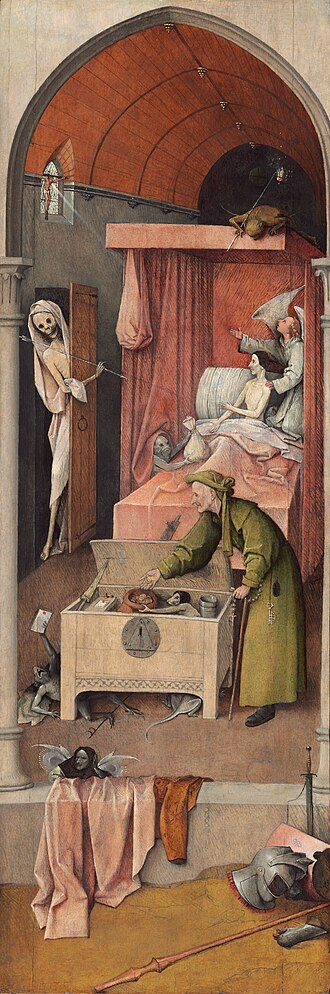 La muerte de un avaro - Hieronymus Bosch (1500s)
Obras de artistas relacionados
 Descendimiento de la cruz - Rogier van der Weyden (1440s)
 Retrato de una dama - Rogier van der Weyden (1460)
 Retrato de Arnolfini y su esposa - Jan van Eyck (1434)
 Políptico de Gante - Jan van Eyck (1432)
 Anunciación - Hans Memling (1480s)
 Escenas de la Pasión de Cristo - Hans Memling (1470)
 Cazadores en la nieve - Pieter Bruegel the Elder (1565)
 Los proverbios flamencos - Pieter Bruegel the Elder (1551)