Retablo Bladelin
Rogier van der Weyden · 1440s
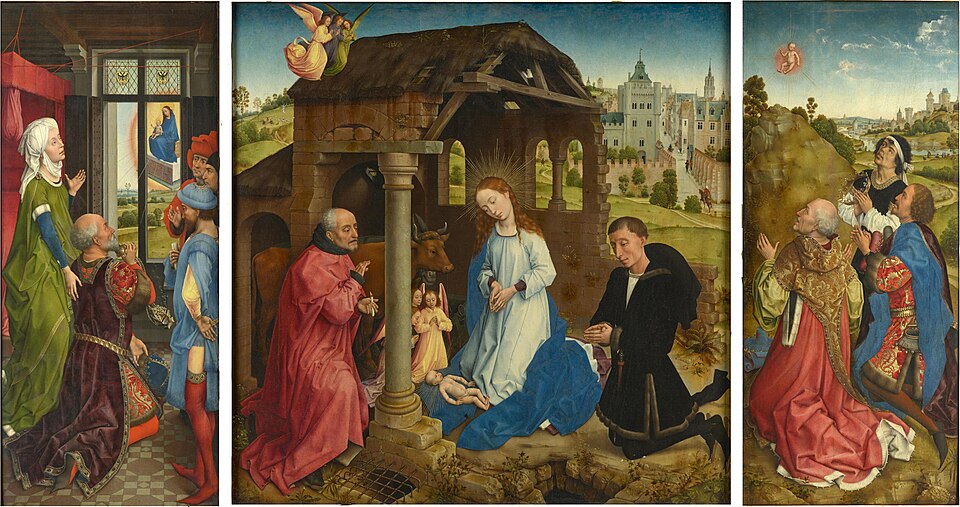
A newborn Christ in a half-ruined stone stable, Joseph holding a candle, a donor in black kneeling outside. Rogier van der Weyden's only certain Nativity hides four annunciations in one triptych.
The story behind the painting
Rogier van der Weyden created this triptych around 1450, towards the end of his career; Wikidata dates it to the 1440s. It is also called the Middelburg Altarpiece. The work may have been given by Pieter Bladelin, treasurer of Philip the Good, Duke of Burgundy, for the new church of Saints Peter and Paul in Middelburg in Flanders, a town Bladelin founded in 1450 as a personal project. The church was consecrated by Bishop Jean Chevrot shortly before his death in 1460, and the altarpiece was donated that year.
What to look for
The central panel, 93.5 by 92 cm, shows the birth of Jesus. The stable is a half-ruined Romanesque stone building with arched windows and one classical pillar, uniquely in van der Weyden's work shown in oblique perspective. Mary wears a light blue gown and deep blue cloak; Joseph in red holds a lit candle; a donor in black kneels outside at right. Below Joseph is a metal grate, perhaps over a cistern. Far off, an angel speaks to shepherds, and a walled town rises on the right. The left wing shows Emperor Augustus and the Tiburtine Sibyl; the right, the three Magi kneeling before a vision of the Child.
Meaning and intent
The composition draws much from the Nativity of about 1420 by van der Weyden's master, Robert Campin, in Dijon. The left wing follows a legend from the Speculum Humanae Salvationis: Augustus asked the Sibyl whether he should be worshipped as a god, and she showed him the Virgin and Child, after which he founded an altar to the firstborn of God. He looks through a window marked with the Habsburg double eagle. Closed, the wings showed a grisaille Annunciation by an unknown artist, so the triptych holds four annunciations: to Mary, Augustus, the Magi and the shepherds.
Legacy
The bright inner images were revealed only for weekend services and special occasions; most of the time the doors stayed closed. The donor's identity is uncertain: there is a single man in black with a fur-trimmed cloak and pointed wooden sandals, and Bladelin would more usually have appeared with his wife, Margerite van de Vageviere. The castle in the central panel is thought to be the one at Middelburg. The triptych has been in the Gemäldegalerie in Berlin since 1834.
¿Sabías que…?
- Painted around 1450 by Rogier van der Weyden.
- His only Nativity scene definitively attributed to him.
- Donated to the new church of Middelburg in 1460.
- In the Gemäldegalerie, Berlin, since 1834.
Sobre el artista
Rogier van der Weyden (1390s-1464)
arte religioso · Primitivo flamenco · Gemäldegalerie de Berlín · Anunciación · Reyes Magos · Agustín de Hipona
Más obras de Rogier van der Weyden
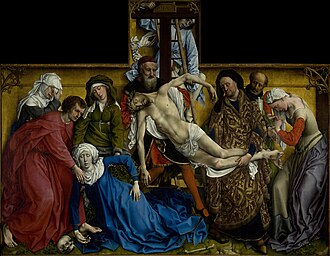 Descendimiento de la cruz - Rogier van der Weyden (1440s)
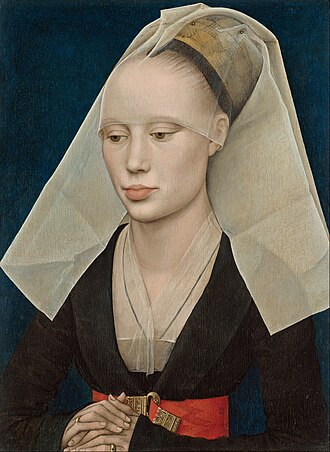 Retrato de una dama - Rogier van der Weyden (1460)
.jpg) Políptico del juicio final - Rogier van der Weyden (1443)
Políptico del juicio final - Rogier van der Weyden (1443)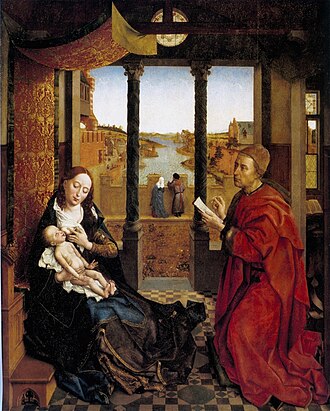 San Lucas dibujando a la Virgen - Rogier van der Weyden (1490)
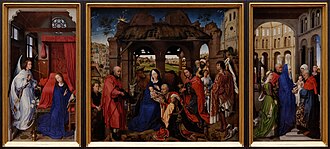 Tríptico del altar de Santa Columba - Rogier van der Weyden (1450s)
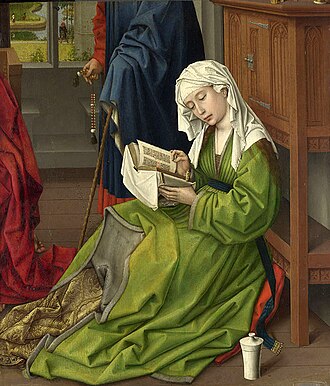 La Magdalena leyendo - Rogier van der Weyden (1435)
 Tríptico Braque - Rogier van der Weyden (1452)
%20-%20Prado%20P02722.jpg) Madonna Durán - Rogier van der Weyden (1430s)
Madonna Durán - Rogier van der Weyden (1430s)
Obras de artistas relacionados
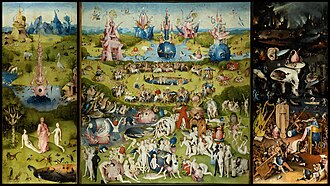 El jardín de las delicias - Hieronymus Bosch
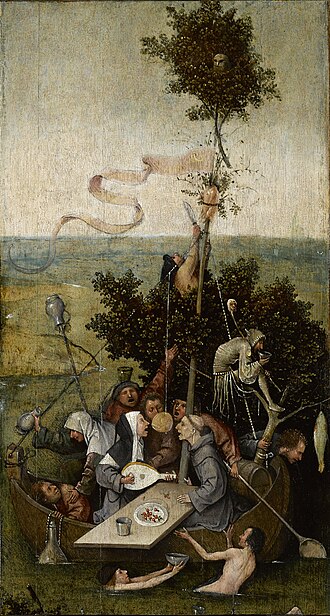 La nave de los locos - Hieronymus Bosch (1500s)
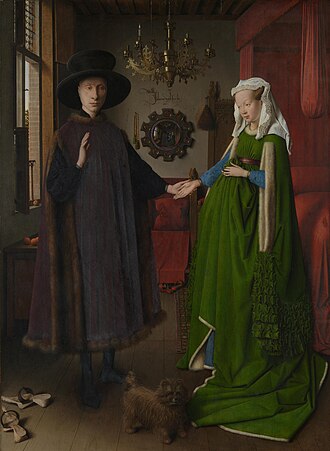 Retrato de Arnolfini y su esposa - Jan van Eyck (1434)
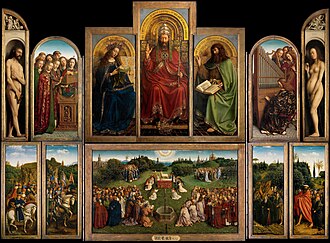 Políptico de Gante - Jan van Eyck (1432)
%20-%20Google%20Art%20Project.jpg) Cazadores en la nieve - Pieter Bruegel the Elder (1565)
Cazadores en la nieve - Pieter Bruegel the Elder (1565)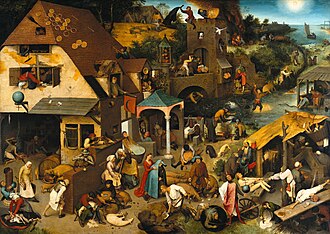 Los proverbios flamencos - Pieter Bruegel the Elder (1551)