Farmhouse in Provence
Vincent van Gogh · 1888
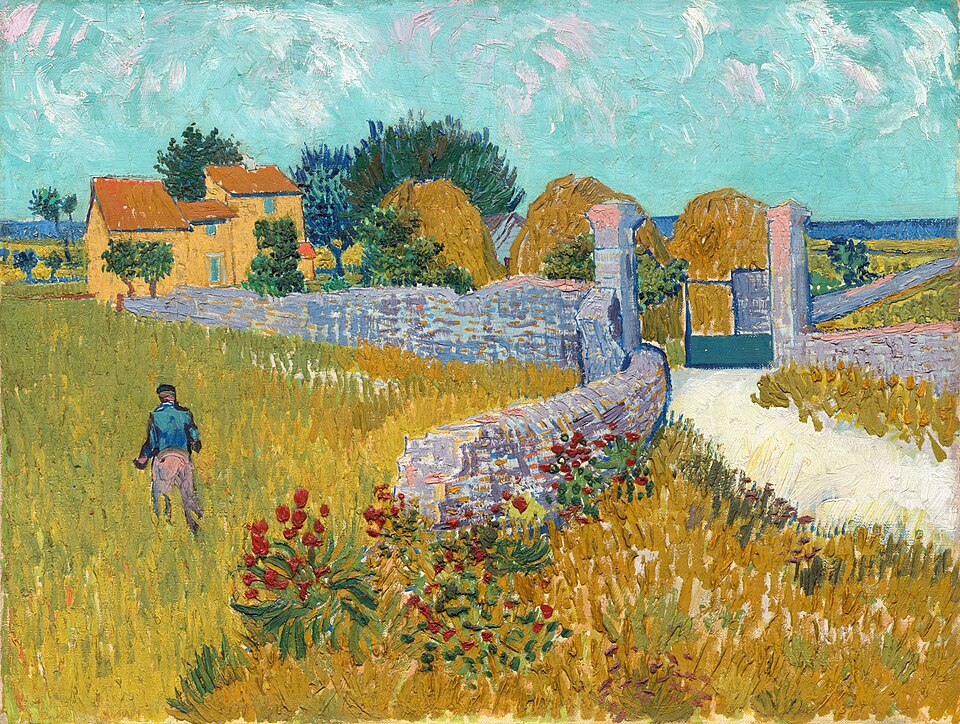
Orange against blue, red against green, pink clouds in a turquoise sky: in this sunlit farmyard, Van Gogh set colours side by side so that each makes the other blaze.
The story behind the painting
Farmhouse in Provence, also known as Entrance Gate to a Farm with Haystacks, was painted in Arles in 1888, when Van Gogh was 35 and at the height of his powers. He had come south partly because of the painter Adolphe Monticelli of Marseilles, whose rich colour and heavy paint he had admired in Paris; he once wrote to his sister Wil that he felt like Monticelli's son or brother. Provence astonished him: a hot, dry climate, vivid colours, light that simplified forms into patterns like the Japanese woodblock prints he loved. It was a prolific time. In less than 444 days he made about 100 drawings and more than 200 paintings, and still wrote more than 200 letters. This farm gate, under the southern sun, is one result of that burst of work.
What to look for
This is a painting built on colour pairs, and you can hunt for them one by one. Van Gogh used three sets of complementary colours, hues that sit opposite each other and intensify one another when placed side by side. First, orange and blue. Next, the red and green of the plants. Finally, look up: pink clouds drift against a turquoise sky. Notice how none of these colours is allowed to rest quietly; each is pushed brighter by its neighbour. The scene itself is simple, a farm entrance with haystacks and trees, on a canvas of about 46 by 61 centimetres. Its excitement comes not from drama in the subject, but from the vibration of the colours across the surface.
Meaning and intent
The painting is a practical demonstration of a theory Van Gogh cared about deeply. In Nuenen he had learned of Michel Eugène Chevreul's laws, developed for weaving, on how colours gain intensity through contrast with their neighbours, known as the law of simultaneous contrast. He also saw Monticelli's colour as an extension of Delacroix's ideas. Van Gogh wrote of the wedding of two complementary colours, their mingling and opposition, the mysterious vibrations of two kindred souls. In another letter to Theo he hoped painting would become more like music and less like sculpture. Here an ordinary farmyard becomes exactly that: a chord of colours sounding together under the southern sun.
Legacy
The painting's path after Van Gogh's death is unusually well documented. In November 1890 his sister-in-law Johanna van Gogh-Bonger sold it through Julien Tanguy in Paris to the Danish dealer Willy Gretor, who gave it to the German painter Maria Slavona. From 1919 to at least 1933 it belonged to Gaston Bernheim de Villers, then to Captain Edward H. Molyneux, and in 1955 to Ailsa Mellon Bruce of New York, who bequeathed it in 1970 to the National Gallery of Art in Washington, D.C., where it hangs today. Note that the sources disagree: J.-B. de la Faille's catalogue gave a different ownership sequence, which the museum regards as partly in error.
Did you know?
- The painting is also known as Entrance Gate to a Farm with Haystacks.
- In his roughly 444 days in Arles, Van Gogh produced more than 200 paintings.
- It uses three complementary pairs: orange and blue, red and green, and pink against turquoise.
- It entered the National Gallery of Art, Washington, in 1970 with the Ailsa Mellon Bruce Collection.
About the artist
Vincent van Gogh (1853-1890)
landscape painting · tree · Galería Nacional de Arte · house
More by Vincent van Gogh
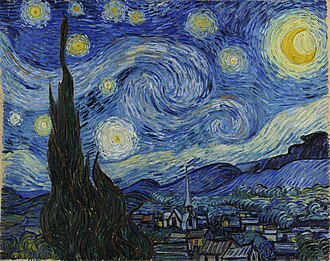 The Starry Night - Vincent van Gogh (1889)
.jpg) Café Terrace at Night - Vincent van Gogh (1888)
Café Terrace at Night - Vincent van Gogh (1888)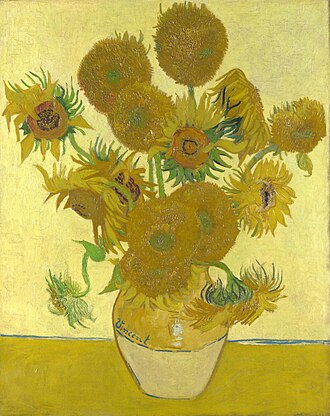 Sunflowers - Vincent van Gogh (1888)
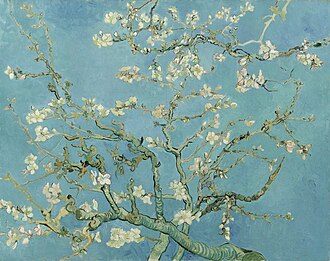 Almond Blossoms - Vincent van Gogh (1890)
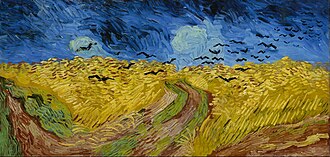 Wheatfield with Crows - Vincent van Gogh (1890)
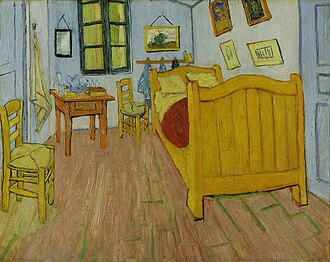 The Bedroom - Vincent van Gogh (1888)
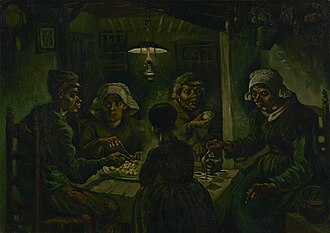 The Potato Eaters - Vincent van Gogh (1885)
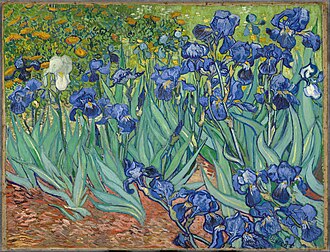 Irises - Vincent van Gogh (1889)
Paintings by related artists
 Where Do We Come From? What Are We? Where Are We Going? - Paul Gauguin (1897-1898)
%201889.jpg) The Yellow Christ - Paul Gauguin (1889)
The Yellow Christ - Paul Gauguin (1889) Luncheon on the Grass - Édouard Manet (1863)
 Olympia - Édouard Manet (1863)