Die sieben Werke der Barmherzigkeit
Caravaggio · 1607
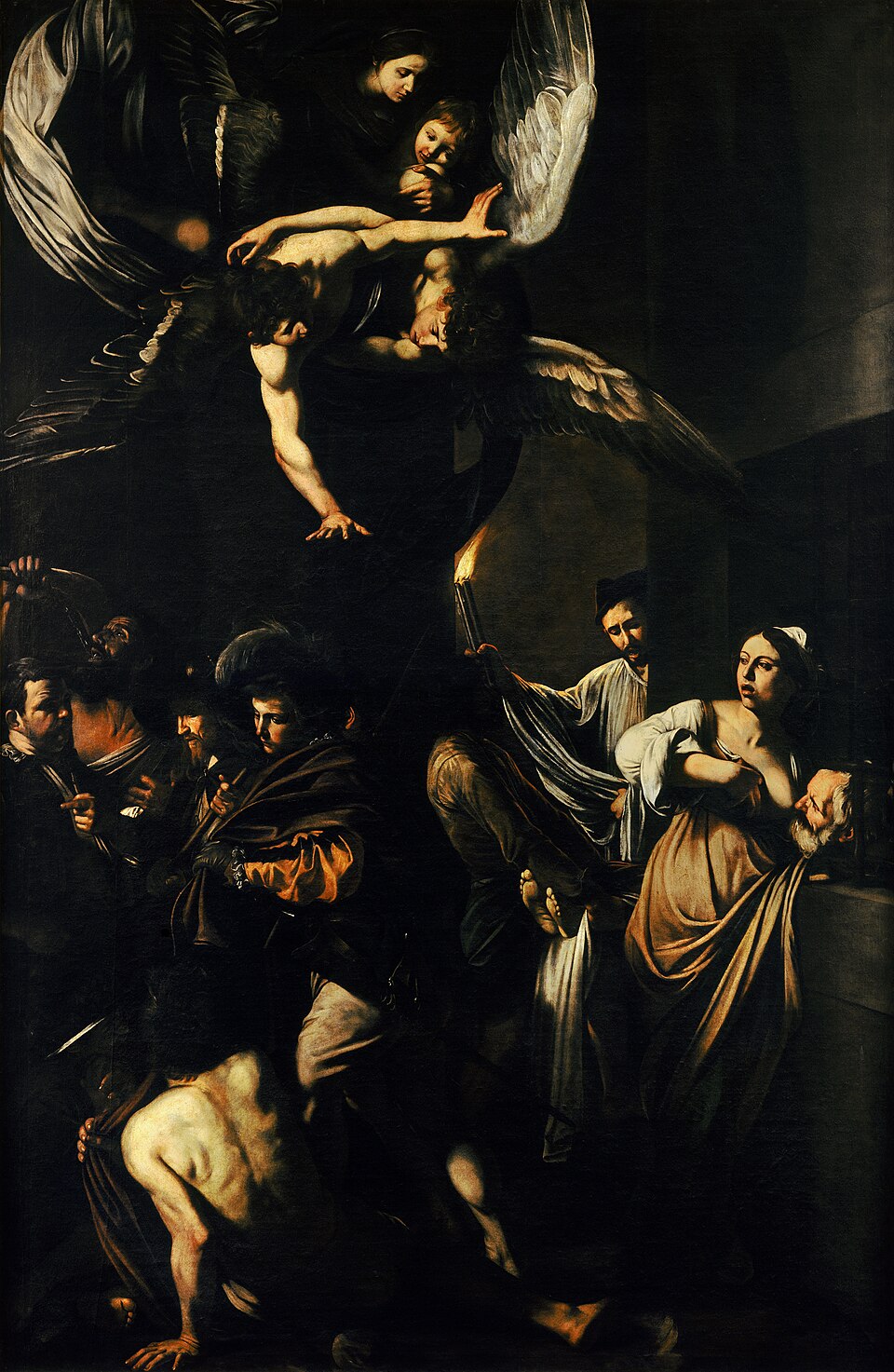
On one crowded Naples street at night, a woman feeds a prisoner, a saint tears his cloak for a beggar, and the dead are carried away, while angels tumble down from above. Caravaggio packed all seven works of mercy into a single picture.
The story behind the painting
Caravaggio painted this altarpiece around 1607 for the church of Pio Monte della Misericordia in Naples, where it still hangs today. The plan was originally for seven separate panels placed around the church, one for each of the seven corporal works of mercy, the traditional Catholic list of compassionate acts that meet the material needs of others. Caravaggio instead combined all seven into a single composition, which became the church's altarpiece. The painting is said to be best seen from the little choir, il coretto, on the first floor.
What to look for
Read the scene piece by piece. In the background two men carry a dead man, of whom only the feet show: burying the dead. On the right a woman visits an imprisoned man and gives him milk from her breast, recalling the classical story of Roman Charity: visiting the prisoner and feeding the hungry. A pilgrim, marked by the shell in his hat, asks an innkeeper for shelter. Saint Martin of Tours has torn his cloak in half for a naked, crippled beggar: clothing the naked and visiting the sick. Samson drinks water from the jawbone of an ass for giving drink to the thirsty.
Meaning and intent
The American art historian John Spike notes that the angel at the centre transmits the grace that inspires people to be merciful. He also finds Samson a peculiar choice for the thirsty: God gave the flawed hero water from a jawbone when he was dying of thirst, a miracle rather than an act of human charity. The German art historian Ralf van Bühren reads the sharp contrasts of light and dark as a metaphor for mercy, which helps viewers explore mercy in their own lives. Scholars have also linked the iconography to the cultural, scientific and philosophical circles of the patrons.
Legacy
Four centuries later the painting still moves people to make new work. In 2016 the Royal Shakespeare Company staged The Seven Acts of Mercy, written by Anders Lustgarten and directed by Erica Whyman. The same year Terence Ward published The Guardian of Mercy, a biographical thriller about the painting and how it continues to affect lives today. Also in 2016 the Irish poet Catherine Ann Cullen wrote seven poems on the painting, published in The Other Now. The picture has never left the church it was made for.
Schon gewusst?
- Painted around 1607 for the Pio Monte della Misericordia, Naples.
- Seven planned panels became one altarpiece.
- Samson stands for giving drink to the thirsty.
- Adapted for the stage by the Royal Shakespeare Company in 2016.
Über den Künstler
Caravaggio (1571-1610)
Mehr von Caravaggio
 Das Abendmahl in Emmaus - Caravaggio (1601)
 Die Berufung des Hl. Matthäus - Caravaggio (1609)
 Die Enthauptung Johannes des Täufers - Caravaggio (1608)
 Abendmahl in Emmaus - Caravaggio (1601)
 Medusa - Caravaggio (1597)
 Judith enthauptet Holofernes - Caravaggio (1598)
 Amor als Sieger - Caravaggio (1600s)
 Selbstporträt als Bacchus - Caravaggio (1595)
Werke verwandter Künstler
 Las Meninas - Diego Velázquez (1656)
 Die Übergabe von Breda - Diego Velázquez (1635)
 Saint Francis in Meditation - Francisco de Zurbarán (1639)
 The Immaculate Conception - Francisco de Zurbarán (1661)
 Dreifachporträt von Karl I. - Anthony van Dyck (1635)
 Karl I mit M. de St. Antoine - Anthony van Dyck (1636)
 Die Aufrichtung des Kreuzes - Peter Paul Rubens (1609)
 Der Raub der Töchter des Leukippos - Peter Paul Rubens (1618)
 Die Nachtwache - Rembrandt van Rijn (1642)
 Selbstbildnis - Rembrandt van Rijn (1659)
 Ein Schütze einen Berkemeyer haltend, bekannt als „Der fröhliche Trinker" - Frans Hals (1620s)
 Der lachende Kavalier - Frans Hals (1624)