Amor als Sieger
Caravaggio · 1600s
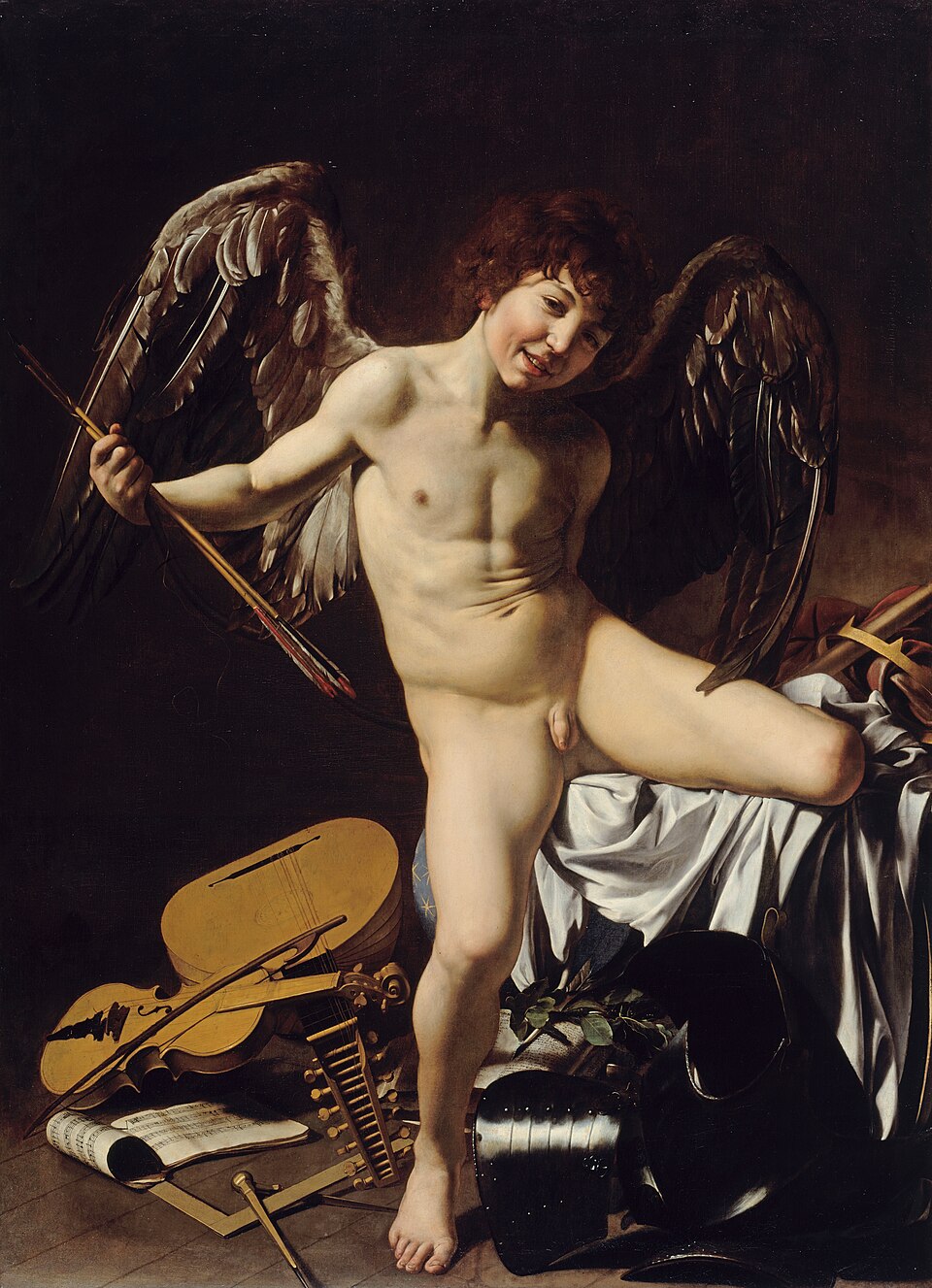
A grinning boy with dark eagle wings steps down among broken instruments, armour and books: Caravaggio's Cupid tramples every human ambition, and seems to enjoy it.
The story behind the painting
Caravaggio painted Amor Vincit Omnia in Rome at the start of the seventeenth century for Marchese Vincenzo Giustiniani, one of the city's great collectors. The sources disagree slightly on the date: Wikipedia gives 1601 to 1602, yet also notes that the painter Orazio Gentileschi lent Caravaggio the wings used as props, which allows a dating of 1602 to 1603. Caravaggio worked directly from a live model, and the life-size boy was remembered by later writers. Joachim von Sandrart described a Cupid after a boy of about twelve, while an English visitor, Richard Symonds, recorded around 1649 to 1651 that it was the body and face of Caravaggio's own boy or servant. Some historians link this model, called Cecco, to the later painter Cecco del Caravaggio, though that identification remains debated.
What to look for
Cupid is caught mid-movement, half-sitting on or climbing down from what looks like a table. Look at his wings first: large, dark eagle's wings that Sandrart praised for their correct drawing, strong colour and relief. Then let your eye drop to the floor. Scattered and trampled under his foot lie the emblems of human endeavour: a violin and a lute, armour, a coronet, a square and compasses, a pen and manuscript, bay leaves and a flower. A musical sheet on the floor bears a large letter V. Everything is lit with dramatic chiaroscuro, the strong contrast of light and shadow that makes the figure seem to step out of the dark. There is a photographic clarity to the flesh that feels startlingly real, and yet the pose recalls Michelangelo's statue of Victory in Florence.
Meaning and intent
The painting illustrates a line from Virgil's Eclogues: Omnia vincit Amor, love conquers all. Music, war, power, science, learning and fame all lie defeated at the feet of a mischievous child. What makes the picture so striking is the mingling of allegory and reality: this is not an idealised, generic Cupid, as in many works of the time, but an unmistakably real boy. The large V on the manuscript has led scholars to suggest a reference to the achievements of Vincenzo Giustiniani himself. Many writers have also discussed the painting's perceived eroticism. The title came later: a Latin epigram first coupled the image with Virgil's phrase, but it only became the painting's name after the critic Giovanni Pietro Bellori wrote his life of Caravaggio in 1672.
Legacy
The painting was an immediate success among Rome's intellectual and cultural elite. A poet wrote three madrigals about it, and Giustiniani is said to have prized it above all other works in his collection. It also sparked a bitter rivalry. In 1602 Cardinal Benedetto Giustiniani commissioned Giovanni Baglione to paint Divine Love Conquering Earthly Love, a clear challenge to Caravaggio's picture. The quarrel that followed lasted years, and Baglione later became Caravaggio's first biographer. The canvas stayed in the Giustiniani collection until 1812, when it was bought by the dealer Féréol Bonnemaison and then acquired by Frederick William III of Prussia in 1815 for the Berlin museums. Today it hangs in the Gemäldegalerie in Berlin.
Schon gewusst?
- Orazio Gentileschi lent Caravaggio the wings used as props for Cupid.
- A large letter V on the musical manuscript may allude to Vincenzo Giustiniani.
- The title only became fixed after Bellori's 1672 biography of Caravaggio.
- It entered the Berlin collections in 1815 via Frederick William III of Prussia.
Über den Künstler
Caravaggio (1571-1610)
mythologische Malerei · Italian Baroque painting · Akt · Nacktheit · Amor · Gemäldegalerie Berlin · Laute
Mehr von Caravaggio
 Das Abendmahl in Emmaus - Caravaggio (1601)
 Die Berufung des Hl. Matthäus - Caravaggio (1609)
 Die Enthauptung Johannes des Täufers - Caravaggio (1608)
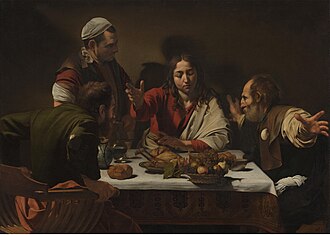 Abendmahl in Emmaus - Caravaggio (1601)
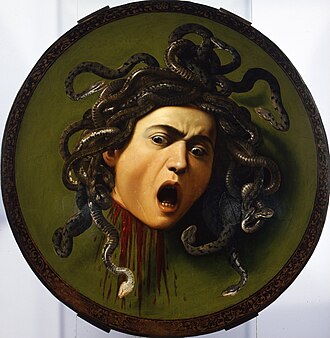 Medusa - Caravaggio (1597)
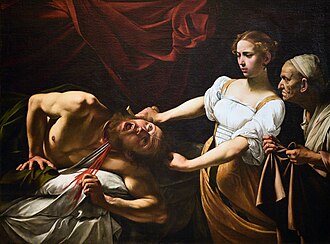 Judith enthauptet Holofernes - Caravaggio (1598)
%2C%201595%20circa%2C%20534.jpg) Selbstporträt als Bacchus - Caravaggio (1595)
Selbstporträt als Bacchus - Caravaggio (1595).jpg) Der Tod Mariens - Caravaggio (1600s)
Der Tod Mariens - Caravaggio (1600s)
Werke verwandter Künstler
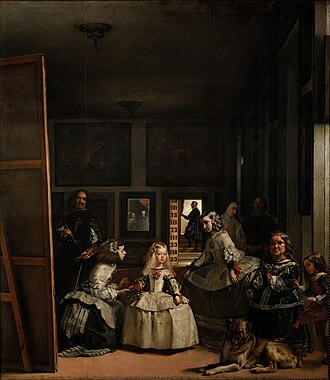 Las Meninas - Diego Velázquez (1656)
 Die Übergabe von Breda - Diego Velázquez (1635)
 Die Nachtwache - Rembrandt van Rijn (1642)
 Selbstbildnis - Rembrandt van Rijn (1659)
 Das Mädchen mit dem Perlenohrgehänge - Johannes Vermeer (1665)
 Dienstmagd mit Milchkrug - Johannes Vermeer (c. 1658)