The Immaculate Conception
Francisco de Zurbarán · 1661
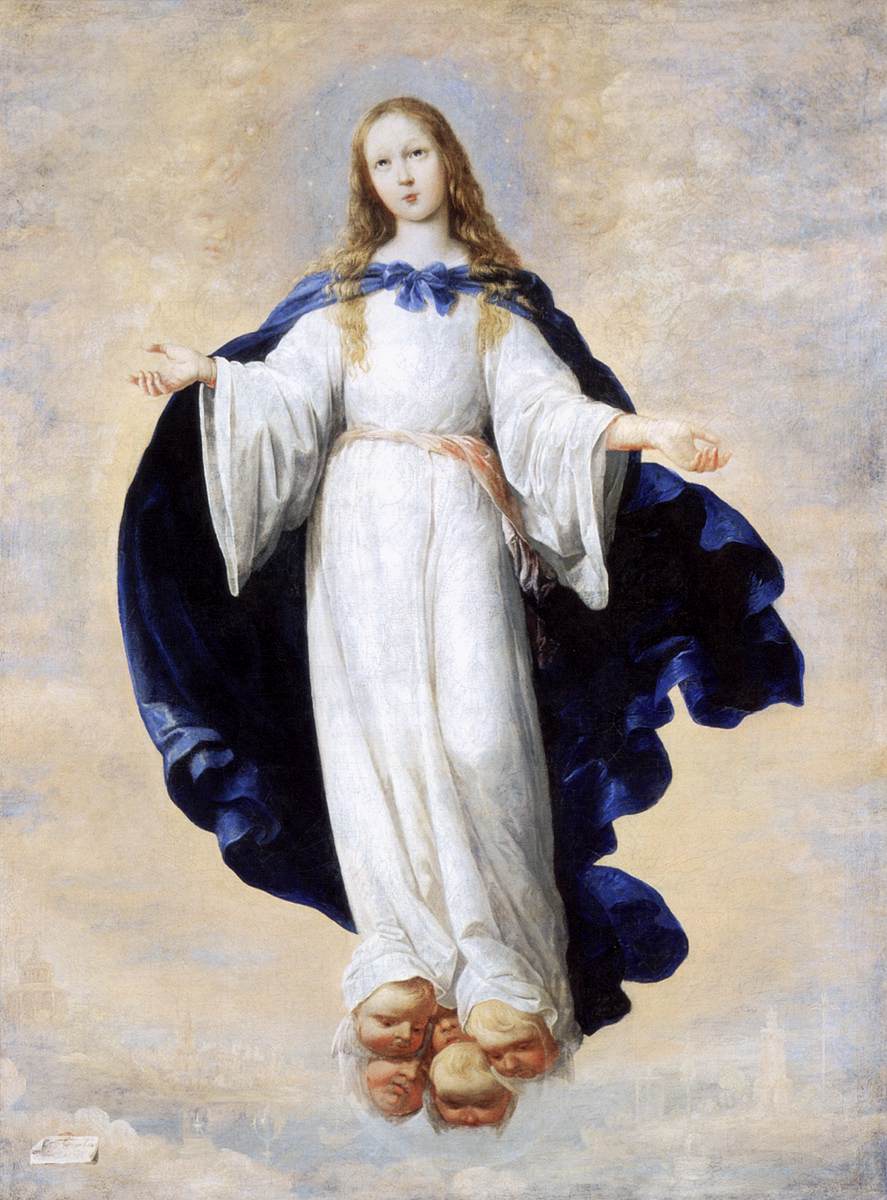
Zurbarán was so proud of this canvas that he signed it on a painted card, held by red wax, its corners curling and casting a shadow. Painted in 1661, it is one of his last two Immaculate Conceptions and one of his finest feats of colour.
The story behind the painting
Over some thirty years Zurbarán painted thirteen versions of the Immaculate Conception, evolving in style and imagery within the rules of the Counter-Reformation. This canvas and the one in Langon, France, are his last two. Both date from 1661, the year Pope Alexander VII approved the doctrine, banned writings against it and authorised its cult, news Spain celebrated after years of enforced silence, though the dogma was only defined on 8 December 1854. The model for Mary in both may have been María Manuela, the painter's daughter with his third wife. It is number 284 in Odile Delenda's catalogue.
What to look for
Mary's pose probably comes from an engraving after an Assumption by Giuseppe Valeriano and Scipione Pulzone: as there, she lifts her face and open hands toward heaven. Around her the heavenly litany symbols are barely visible, almost melted into the clouds. Under her feet are the usual angel heads and a round, barely sketched moon. Below lies a silvery, ethereal landscape where some earthly symbols are clearer. She looks very young, almost a teenager, in a simple white tunic with few folds, very wide sleeves and a pale pink draped belt, while the blue mantle ripples on both sides. Her bluish halo shifts to pale pink, then orange and red, and the light makes her hair shine.
Meaning and intent
The landscape below recreates those of earlier versions, but here the city of Seville is replaced by the New Jerusalem, turning a familiar view into a heavenly city. The background combines blues and golds with great skill, and the source counts this among Zurbarán's best achievements in colour. He must have been especially proud of it. His signature, Franco dezurbaran/facie 1661, appears on a trompe l'oeil cartouche stuck to the canvas with red sealing wax, its edges seeming to come loose, folding and casting shadows on the painted surface: a small joke about illusion inside a sacred image.
Legacy
The history of the painting has some uncertain early steps. It may have been in the Palacio de Boadilla in Madrid in the eighteenth century and in the Kaunitz collection, both marked with question marks in the source. In 1820 a man named Fischer bought it for the Esterházy collection, and in 1871 Prince Nikolaus III Esterházy sold it to the Museum of Fine Arts in Budapest, where it remains. It was restored in 1956 by Sándor Devich. The museum gives its size as 136.5 by 102 cm.
Schon gewusst?
- Signed and dated 1661 on a painted trompe l'oeil card.
- One of Zurbarán's last two Immaculate Conceptions, with the Langon canvas.
- Seville in the landscape is replaced by the New Jerusalem.
- In Budapest's Museum of Fine Arts since 1871.
Über den Künstler
Francisco de Zurbarán (1598-1664)
religiöse Kunst · Barock · Szépművészeti Múzeum
Mehr von Francisco de Zurbarán
 Saint Francis in Meditation - Francisco de Zurbarán (1639)
 Saint Francis - Francisco de Zurbarán (1635)
 The Immaculate Conception - Francisco de Zurbarán (1635)
 The Immaculate Conception - Francisco de Zurbarán (1661)
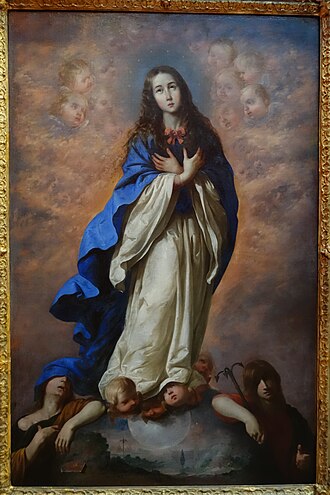 The Immaculate Conception - Francisco de Zurbarán (1658)
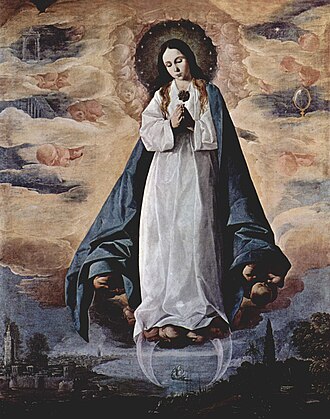 Unbefleckte Empfängnis - Francisco de Zurbarán (1630)
 Heiliger Laurentius - Francisco de Zurbarán (1630s)
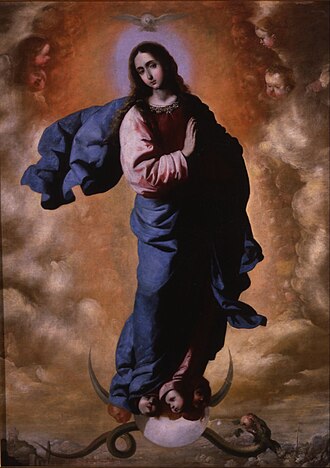 The Immaculate Conception - Francisco de Zurbarán (1645)
Werke verwandter Künstler
 Das Abendmahl in Emmaus - Caravaggio (1601)
 Die Berufung des Hl. Matthäus - Caravaggio (1609)
 Las Meninas - Diego Velázquez (1656)
 Die Übergabe von Breda - Diego Velázquez (1635)
 Dreifachporträt von Karl I. - Anthony van Dyck (1635)
 Karl I mit M. de St. Antoine - Anthony van Dyck (1636)
 Die Aufrichtung des Kreuzes - Peter Paul Rubens (1609)
 Der Raub der Töchter des Leukippos - Peter Paul Rubens (1618)
 Die Nachtwache - Rembrandt van Rijn (1642)
 Selbstbildnis - Rembrandt van Rijn (1659)
 Ein Schütze einen Berkemeyer haltend, bekannt als „Der fröhliche Trinker" - Frans Hals (1620s)
 Der lachende Kavalier - Frans Hals (1624)