Auferweckung des Lazarus
Caravaggio · 1609
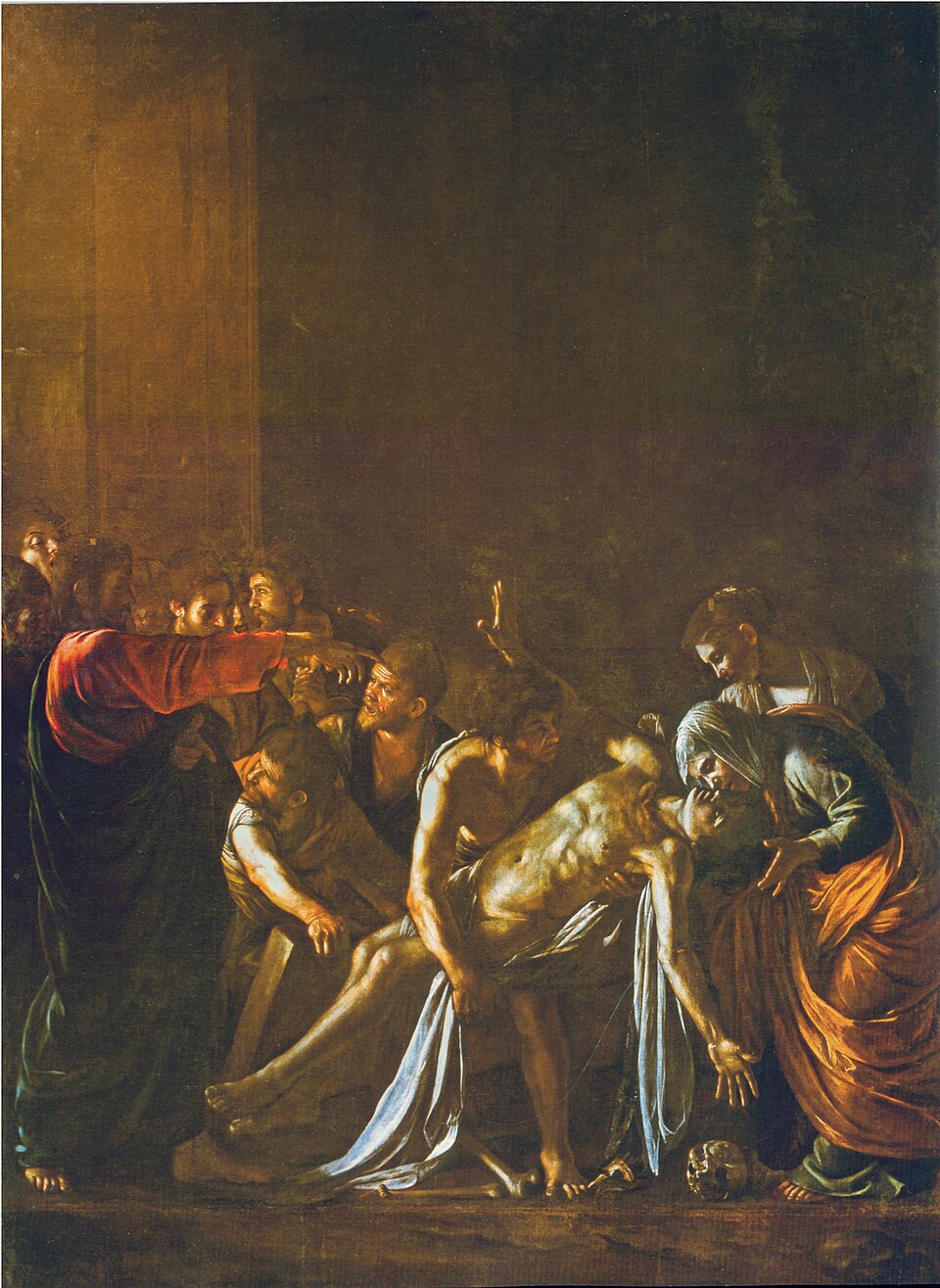
A dead man stiffens back toward life in the arms of the people around him, one hand hanging open, the other reaching for Christ. Caravaggio painted it in Messina in 1609, while on the run, under a vast dark wall.
The story behind the painting
In August 1608 Caravaggio fled from Malta, where he had been imprisoned for an unknown crime, and took refuge in Sicily with his friend the painter Mario Minniti. Through Minniti he won important commissions, including this altarpiece for the church of the Padri Crociferi in Messina. It was presented on 10 June 1609 by the wealthy Genoese merchant Giovanni Battista de' Lazzari, whose patron saint was Lazarus. The fee was a thousand scudi, more than double any Caravaggio had received before. The Gospel of John tells how Lazarus, brother of Martha and Mary of Bethany, fell sick, died, was buried and was raised by Christ.
What to look for
The canvas is tall, 380 by 275 cm, and as in several works of this period, the figures form a frieze against blank walls, with a huge empty space above them. Light picks out the crucial details: Lazarus's hands, one lax and open to receive, the other reaching toward Christ, and the wonder-struck faces of the onlookers. Christ, at left, is a reversed image of the Christ in Caravaggio's earlier Calling of Saint Matthew, and the whole design is based on an engraving after Giulio Romano. Some figures were said to be modelled on local people.
Meaning and intent
The interplay of a group caught in shared effort and emotion with the great void above is quite different from the closely focused, individual dramas of Caravaggio's early and middle years. The darkness presses down on the small human crowd, and the light falls on the moment of return. Stories gathered around the picture. An old tale says Caravaggio had a freshly buried body dug up to paint from; the scholar John Gash calls it probably apocryphal, but not beyond possibility. According to Francesco Susinno, he slashed a first version with a razor after criticism and finished this one in record time, an account the source calls probably fanciful.
Legacy
The painting is in poor condition and has been heavily restored, and some passages may be the work of assistants. It is now kept in the Regional Museum of Messina in Sicily. Beyond the miracle it shows, it belongs to a remarkable chapter of Caravaggio's life: a fugitive from Malta, sheltered by an old friend, receiving the largest fee of his career for an altarpiece in a Sicilian church. Wikipedia describes it as completed around 1609, and Wikidata gives 1609, the year it was presented.
Schon gewusst?
- Presented on 10 June 1609 in Messina.
- Commissioned by Giovanni Battista de' Lazzari, whose patron saint was Lazarus.
- The fee of a thousand scudi was double any Caravaggio had received.
- Now in the Regional Museum of Messina.
Über den Künstler
Caravaggio (1571-1610)
religiöse Kunst · Mann · Jesus Christus · Barock
Mehr von Caravaggio
 Das Abendmahl in Emmaus - Caravaggio (1601)
 Die Berufung des Hl. Matthäus - Caravaggio (1609)
 Die Enthauptung Johannes des Täufers - Caravaggio (1608)
 Abendmahl in Emmaus - Caravaggio (1601)
 Medusa - Caravaggio (1597)
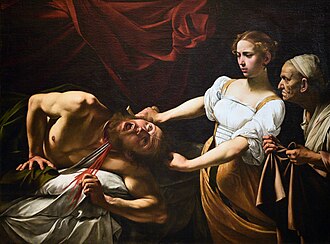 Judith enthauptet Holofernes - Caravaggio (1598)
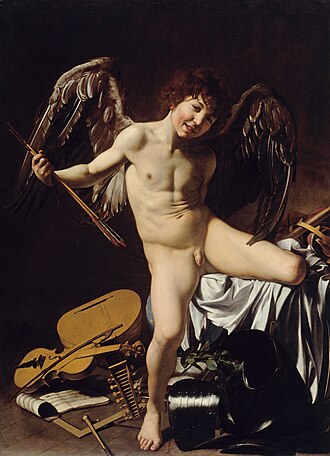 Amor als Sieger - Caravaggio (1600s)
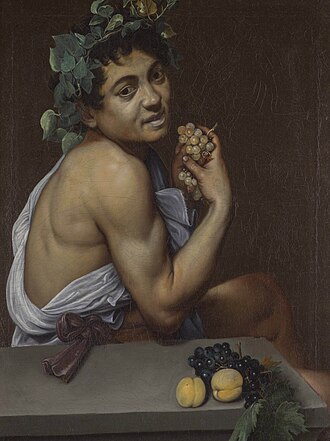 Selbstporträt als Bacchus - Caravaggio (1595)
Werke verwandter Künstler
 Las Meninas - Diego Velázquez (1656)
 Die Übergabe von Breda - Diego Velázquez (1635)
 Saint Francis in Meditation - Francisco de Zurbarán (1639)
 The Immaculate Conception - Francisco de Zurbarán (1661)
 Dreifachporträt von Karl I. - Anthony van Dyck (1635)
 Karl I mit M. de St. Antoine - Anthony van Dyck (1636)
 Die Aufrichtung des Kreuzes - Peter Paul Rubens (1609)
 Der Raub der Töchter des Leukippos - Peter Paul Rubens (1618)
 Die Nachtwache - Rembrandt van Rijn (1642)
 Selbstbildnis - Rembrandt van Rijn (1659)
 Ein Schütze einen Berkemeyer haltend, bekannt als „Der fröhliche Trinker" - Frans Hals (1620s)
 Der lachende Kavalier - Frans Hals (1624)