Eremiten-Triptychon
Hieronymus Bosch · 1493
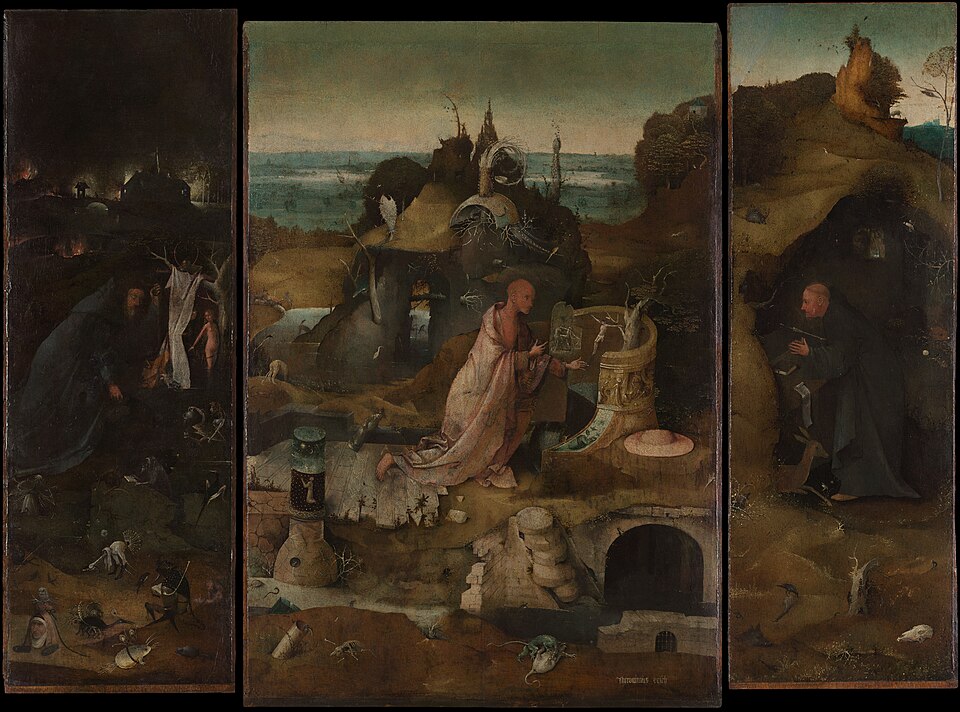
Three hermits, three lonely places: Anthony among demons by a burning village, Jerome praying in a ruined desert, Giles wounded by an arrow in his cave. Bosch painted their solitude around 1493, and the triptych has crossed the Alps twice.
The story behind the painting
Bosch painted The Hermit Saints, a triptych in oil on panel, around 1493, a date confirmed by dendrochronology. The whole triptych measures about 86 by 60 centimetres according to Wikipedia, while Wikidata gives 86.5 by 120 cm. It is first recorded in 1771 in the Doge's Palace in Venice, hanging in the Eccelso Tribunale Hall. In 1838 the Austrian authorities then ruling Venice took it to the Imperial Gallery in Vienna, and in 1893 it passed to the Kunsthistorisches Museum. In 1919 it was returned to Venice. Saints are a common theme in Bosch, models of faith set against suffering and sin.
What to look for
On the left, Saint Anthony the Abbot draws marshy water with a jar in a night landscape, while a village burns behind him. Around him are demonic visions: a naked woman behind a tent with devils, a devil-fish pouring wine, and grotesque crickets, one reading a missal, one made of a nun's head with feet carrying an owl and its nest. In the centre, Saint Jerome kneels in a ruined oratory before a crucifix on a stick, at an altar carved with reliefs such as Judith and Holofernes and a knight with a unicorn. His red cardinal's hat and a bony lion are nearby. On the right, Saint Giles prays in a grotto, an arrow in his chest and a fawn at his feet.
Meaning and intent
Each panel shows a different anchorite, and each is a lesson in holding to faith alone. Anthony stands for resisting temptation; here he looks secluded, unlike the chaos of Bosch's Temptation of Saint Anthony. The burning village may allude to ergotism, or to the saint's reputed power to quench fires. Jerome contemplates the suffering of Christ, surrounded by signs of evil: an idolater on a column, skeletons, fighting beasts. A man diving into a beehive may allude to carnal love or to alchemical mercury. Giles's grotto holds a scroll that, in the Golden Legend, lists all those saved through his intercession; the arrow was meant for the fawn.
Legacy
The triptych has been badly damaged, perhaps by fire. In the central panel the sky, the landscape and Jerome's head have been repainted, so part of what we see is not Bosch's own hand. The Bosch Research and Conservation Project examined it closely and found the usual Renaissance pigments, azurite, lead-tin yellow, vermilion and ochres, without the costly natural ultramarine. Wikipedia places the work today in the Gallerie dell'Accademia in Venice. Damaged and travelled, it still holds three quiet figures praying while the world around them burns.
Schon gewusst?
- Painted around 1493, dated by dendrochronology.
- Recorded in the Doge's Palace, Venice, in 1771.
- Taken to Vienna in 1838 and returned to Venice in 1919.
- Shows Saints Anthony, Jerome and Giles.
Über den Künstler
Hieronymus Bosch (1450-1516)
religiöse Kunst · Flämische Primitive · Kunsthistorisches Museum Wien · Dogenpalast
Mehr von Hieronymus Bosch
 Der Garten der Lüste - Hieronymus Bosch
 Das Narrenschiff - Hieronymus Bosch (1500s)
 Die Versuchungen des heiligen Antonius - Hieronymus Bosch (1501)
 Die sieben Todsünden und vier letzten Dinge - Hieronymus Bosch (1500)
 Heuwagen-Triptychon - Hieronymus Bosch (1510s)
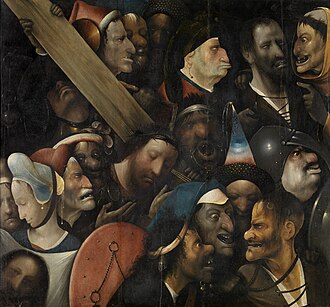 Kreuztragung - Hieronymus Bosch (1510s)
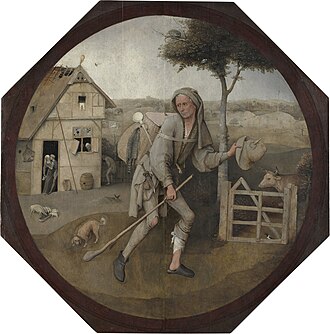 Der Wanderer - Hieronymus Bosch (1500)
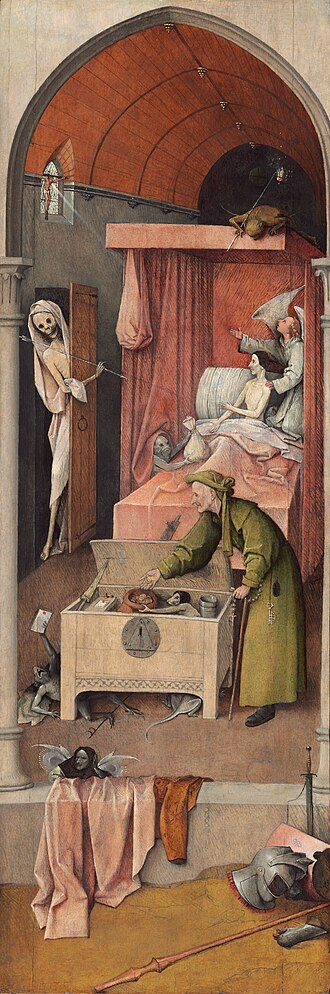 Der Tod und der Geizhals - Hieronymus Bosch (1500s)
Werke verwandter Künstler
 Kreuzabnahme - Rogier van der Weyden (1440s)
 Porträt einer Dame - Rogier van der Weyden (1460)
 Arnolfini-Porträt - Jan van Eyck (1434)
 Genter Altar - Jan van Eyck (1432)
 Die Verkündigung - Hans Memling (1480s)
 Szenen der Passion Christi - Hans Memling (1470)
 Die Jäger im Schnee - Pieter Bruegel the Elder (1565)
 Die niederländischen Sprichwörter - Pieter Bruegel the Elder (1551)