Die Wahrsagerin
Caravaggio · 1594
.jpg)
A young man smiles into the eyes of the girl reading his palm, utterly charmed. Look closer at her fingers: while she strokes his hand, she is quietly slipping off his ring.
The story behind the painting
Caravaggio painted The Fortune Teller twice, and this is the second version, the one now in the Louvre. The first, from about 1594, aroused real interest among younger artists and adventurous collectors in Rome, yet according to the early writer Giulio Mancini, Caravaggio's poverty forced him to sell it for only eight scudi. It went to the banker Vincente Giustiniani, who became an important patron. In 1595 Giustiniani's friend Cardinal Francesco Maria del Monte bought the companion piece, Cardsharps, and that year Caravaggio entered the cardinal's household. For del Monte he painted this second Fortune Teller, copied from Giustiniani's picture but with changes. The model for the boy is believed to be Caravaggio's companion, the Sicilian painter Mario Minniti. Dating is disputed: the Wikipedia account places this version around 1595, while the Wikidata record gives 1594.
What to look for
Two half-length figures fill the canvas. On one side stands a foppishly dressed young man in a doublet, gloves, hat and sword; facing him is a Romani girl holding his hand to read his palm. Their eyes meet, he pleased, she returning his gaze. Now follow her fingers: as she gently strokes his hand, she is removing his ring, something he has failed to notice. Compared with the first version, the background here is no longer an empty field but a real wall, broken by the shadows of a half-drawn curtain and a window sash. The figures fill the space more completely and give it three dimensions. The light is more radiant, and the cloth of the boy's doublet and the girl's sleeves is more finely textured. The boy looks younger and more vulnerable, while the girl leans in, in command of the scene.
Meaning and intent
On the surface this is a little comedy of vanity: a well-groomed young man so dazzled by a seductive smile that he is robbed in plain sight. But in 1603 the poet Gaspare Murtola addressed a madrigal to Caravaggio about this subject, wondering who was the greater sorcerer, the woman portrayed or the painter who made her seem to live and breathe. The idea is delicious: Caravaggio's illusion deceives us just as the girl deceives the boy, so the viewer becomes the dupe too. The biographer Giovanni Pietro Bellori later told how Caravaggio picked the girl from passers-by in the street, to show that nature gave him masters enough without copying ancient statues. That story is probably apocryphal, written more than half a century after the painter's death, but it captures his revolution: art as a picture of real life.
Legacy
The Fortune Teller is one of two known genre pieces Caravaggio painted around 1594, the other being Cardsharps, and it is thought to be the earlier. He had recently left the workshop of Giuseppe Cesari and was selling paintings through a dealer named Costantino. The subject itself was not new: Giorgio Vasari recorded a shop sign painted by Agnolo, brother of a follower of Franciabigio, showing a gipsy woman telling a lady's fortune. What was new was Caravaggio's insistence on painting from life, which his sources describe as the essence of his impact on contemporaries, beginning with this very picture. The first version hangs in the Musei Capitolini in Rome. This second version, painted for Cardinal del Monte, belongs to the Department of Paintings of the Louvre in Paris.
Schon gewusst?
- Second of two versions; this one is in the Louvre, Paris
- Painted for Cardinal Francesco Maria del Monte; date disputed (Wikipedia: c. 1595; Wikidata: 1594)
- Size: 99 × 131 cm
- The first version, c. 1594, is in the Musei Capitolini, Rome
Über den Künstler
Caravaggio (1571-1610)
Genreszene · Italian Baroque painting · Gemäldeabteilung des Louvre · Stehen · Hut · Schwert
Mehr von Caravaggio
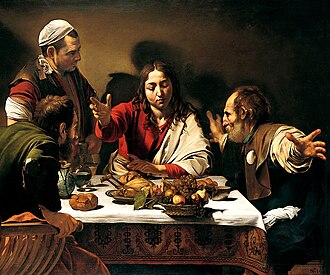 Das Abendmahl in Emmaus - Caravaggio (1601)
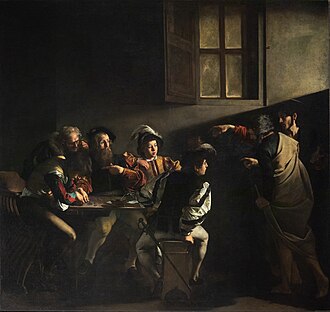 Die Berufung des Hl. Matthäus - Caravaggio (1609)
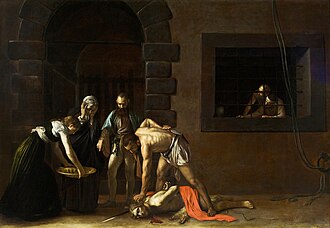 Die Enthauptung Johannes des Täufers - Caravaggio (1608)
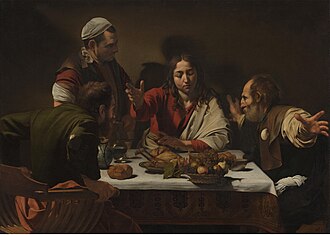 Abendmahl in Emmaus - Caravaggio (1601)
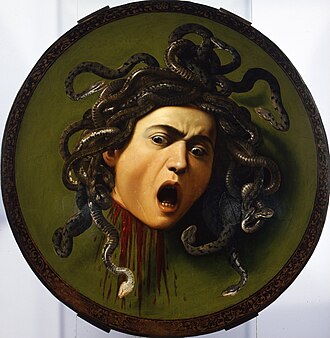 Medusa - Caravaggio (1597)
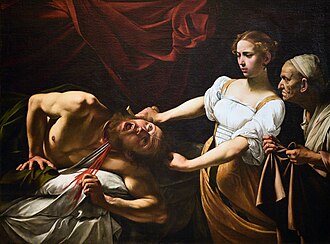 Judith enthauptet Holofernes - Caravaggio (1598)
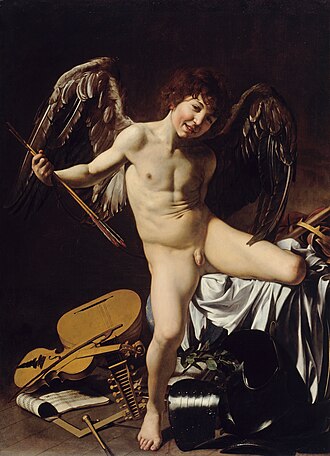 Amor als Sieger - Caravaggio (1600s)
%2C%201595%20circa%2C%20534.jpg) Selbstporträt als Bacchus - Caravaggio (1595)
Selbstporträt als Bacchus - Caravaggio (1595)
Werke verwandter Künstler
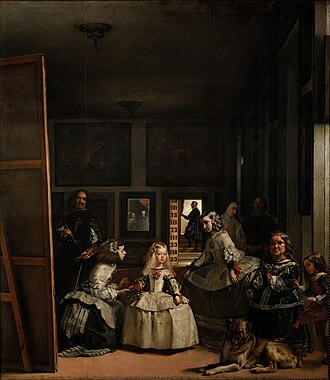 Las Meninas - Diego Velázquez (1656)
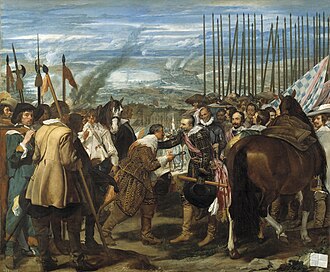 Die Übergabe von Breda - Diego Velázquez (1635)
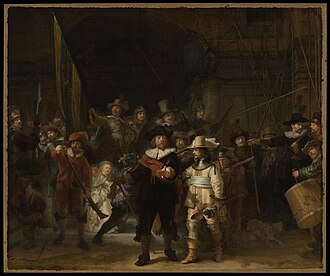 Die Nachtwache - Rembrandt van Rijn (1642)
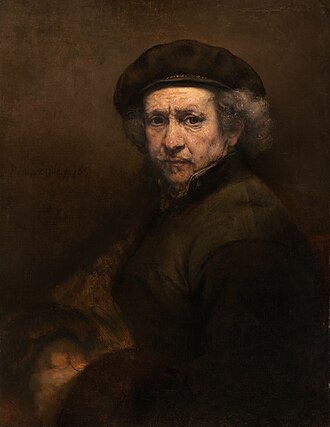 Selbstbildnis - Rembrandt van Rijn (1659)
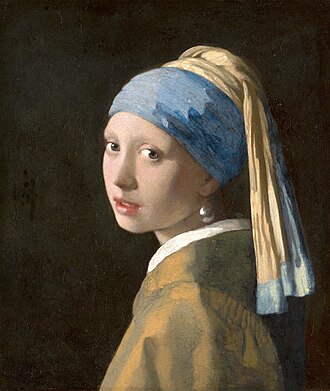 Das Mädchen mit dem Perlenohrgehänge - Johannes Vermeer (1665)
 Dienstmagd mit Milchkrug - Johannes Vermeer (c. 1658)