Begräbnis der Hl. Lucia
Caravaggio · 1608
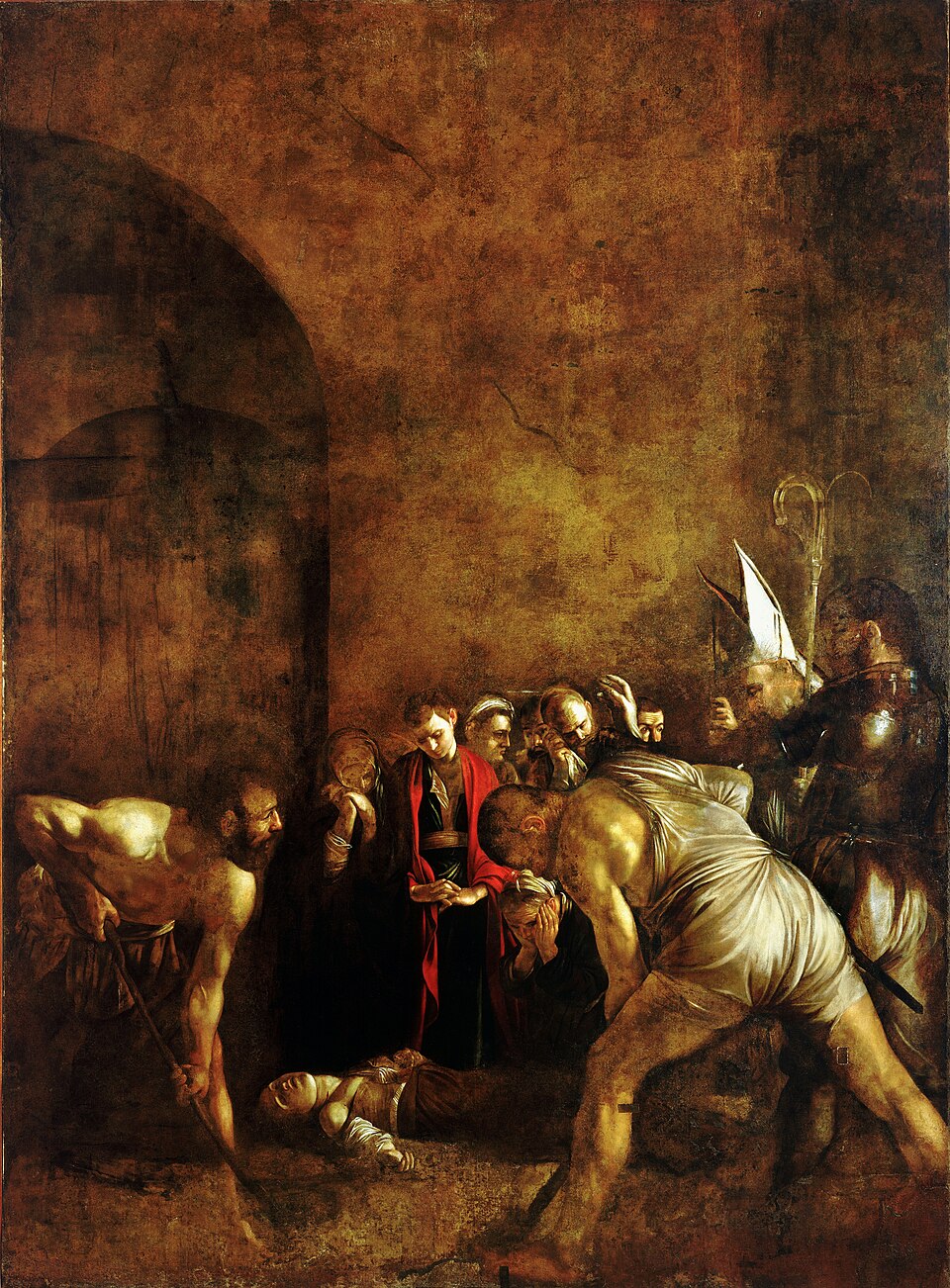
Two gravediggers loom over the body of a young martyr while mourners gather in a vast, empty space above. Caravaggio painted it in 1608, a fugitive just escaped from prison on Malta, for the church built where Saint Lucy fell.
The story behind the painting
Caravaggio escaped from prison on Malta in 1608 and fled to Syracuse in Sicily. There his old Roman companion Mario Minniti helped him obtain the commission for this altarpiece, painted the same year for the Franciscan church of Santa Lucia al Sepolcro. Saint Lucy was the patron saint of Syracuse and had been buried below the church. The subject was unusual, but important to the local authorities, who wanted to strengthen her cult after her relics were stolen in the Middle Ages.
What to look for
The canvas is very large, about 408 by 207 cm, and much of it is given to the dark space above the figures. The scholar Howard Hibbard spoke of the powerful emptiness of the final version. Scholars have also pointed out its similarity to Caravaggio's Resurrection of Lazarus. Look at the saint's throat: X-rays show that Caravaggio first painted Lucy beheaded, then changed it to show only a cut in her throat.
Meaning and intent
According to The Golden Legend, Lucy gave her wealth to the poor in thanks for her mother's healing. Denounced as a Christian by a suitor who wrongly suspected her, she refused to recant, and nothing could move her from where she stood when she was to be dragged away. She was stabbed in the throat, and the church was built where she fell. The first beheading followed the Greek version of her story; the throat wound follows the Latin one, probably at the request of the city's senate.
Legacy
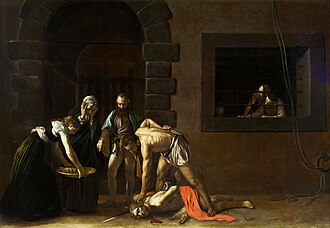
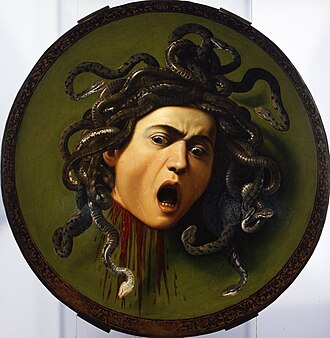
The painting is still in Syracuse, in the church of Santa Lucia al Sepolcro for which it was made, above the place where the saint was said to have been buried. Caravaggio had often painted beheadings, in Judith Beheading Holofernes, The Beheading of Saint John the Baptist, David with the Head of Goliath and Medusa, which makes the change to a single wound here, hidden under the paint and found by X-rays, all the more telling.
Schon gewusst?
- Painted in 1608 after Caravaggio escaped prison on Malta.
- Commissioned with the help of his friend Mario Minniti.
- X-rays show Lucy was first painted beheaded.
- Still in Santa Lucia al Sepolcro, Syracuse.
Über den Künstler
Caravaggio (1571-1610)
religiöse Kunst · Frau · Barock
Mehr von Caravaggio
 Das Abendmahl in Emmaus - Caravaggio (1601)
 Die Berufung des Hl. Matthäus - Caravaggio (1609)
 Die Enthauptung Johannes des Täufers - Caravaggio (1608)
 Abendmahl in Emmaus - Caravaggio (1601)
 Medusa - Caravaggio (1597)
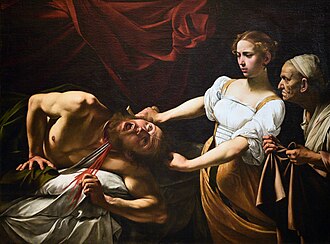 Judith enthauptet Holofernes - Caravaggio (1598)
 Amor als Sieger - Caravaggio (1600s)
 Selbstporträt als Bacchus - Caravaggio (1595)
Werke verwandter Künstler
 Las Meninas - Diego Velázquez (1656)
 Die Übergabe von Breda - Diego Velázquez (1635)
 Saint Francis in Meditation - Francisco de Zurbarán (1639)
 The Immaculate Conception - Francisco de Zurbarán (1661)
 Dreifachporträt von Karl I. - Anthony van Dyck (1635)
 Karl I mit M. de St. Antoine - Anthony van Dyck (1636)
 Die Aufrichtung des Kreuzes - Peter Paul Rubens (1609)
 Der Raub der Töchter des Leukippos - Peter Paul Rubens (1618)
 Die Nachtwache - Rembrandt van Rijn (1642)
 Selbstbildnis - Rembrandt van Rijn (1659)
 Ein Schütze einen Berkemeyer haltend, bekannt als „Der fröhliche Trinker" - Frans Hals (1620s)
 Der lachende Kavalier - Frans Hals (1624)