Die Versuchung des Heiligen Antonius
Hieronymus Bosch · 1550s
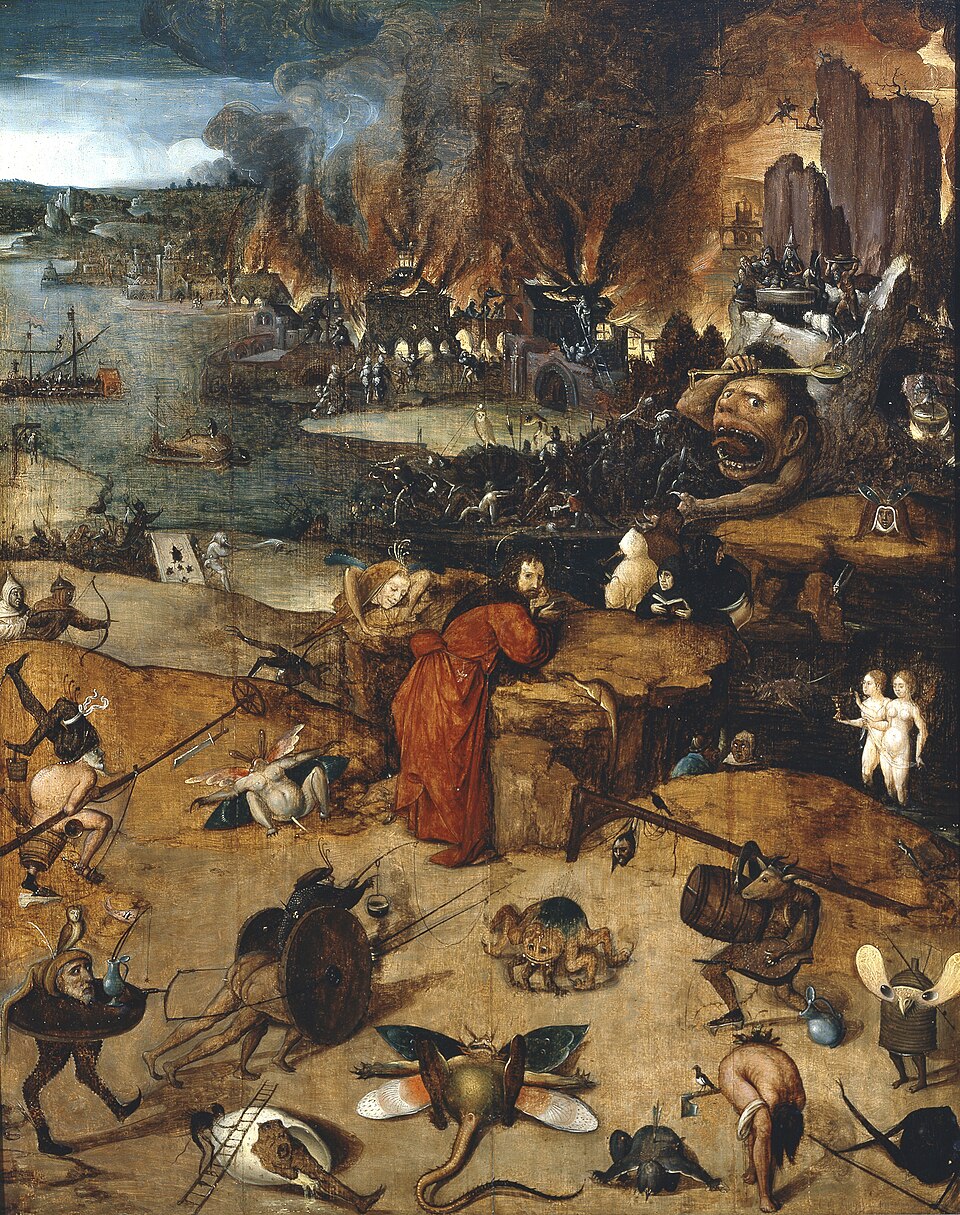
Demons swarm, a city burns and two strange galleys sail past, while Saint Anthony leans on a rock with his book and turns to look at us. Once hailed as a Bosch, this Prado panel is now given to a follower painting decades after the master's death.
The story behind the painting
This Temptation of Saint Anthony is an oil painting on an oak panel, 88.3 by 70 cm, from the middle of the 16th century. It is one of the very many versions of the subject painted by Hieronymus Bosch and, above all, by his followers. Its history is hard to trace before the 1940s. Lucie Ninane reported, as a hypothesis, that it may have come from Philip II's collections and passed to his grandson and later to noble families in Madrid. In the 1950s it belonged to the Brussels patrons David and Alice van Buuren, and Alice gave it to the Prado in 1964 to 1965.
What to look for
At the centre, Anthony the Great, haloed and recognisable by the Tau cross on his robe, reads the Bible or a prayer book, propped on a rock, and turns toward the viewer as if calling on us with his gaze. That idea comes from the central panel of Bosch's Lisbon triptych. Around him demons of every shape rage to break his meditation: grotesque creatures, animal forms and armed naked figures. Beyond lies water with two fantastic galleys and two naked temptresses, then a burning city, marching armies and a huge monster with gaping jaws under an infernal banquet. At least two owls, symbols of evil, appear.
Meaning and intent
The question here is who painted it. In 1955 Gaston van Camp gave it to Bosch himself, citing transparent colours that reveal the underdrawing, white highlights and a spiral composition. He also noted a small wheeled war machine pushed by two naked figures that appears almost identically on a sheet of monster studies in Oxford. But that Oxford drawing is now considered the work of a disciple too. Cinotti in 1966 saw a somewhat random assembly of Bosch motifs, and Unverfehrt dated the panel around 1520 or later. The naked figure with an axe is copied from another Temptation in Antwerp.
Legacy
The panel may once have been the centre of a triptych, flanked by old copies of the Lisbon wings that are also in the Prado and measure 90 by 37 cm each, though the landscape does not continue onto them and it is not a copy of the Lisbon centre. The Prado's curators now date it to around 1550 to 1560, several decades after Bosch died. The owls recall Herri met de Bles, nicknamed Civetta, owl, a talented follower active in Antwerp around 1530. The painting shows how Bosch's visions lived on in other hands.
Schon gewusst?
- Oil on oak panel, 88.3 x 70 cm.
- Given to the Prado by Alice van Buuren in 1964-1965.
- Attributed to Bosch in 1955, now to a follower.
- Dated by the Prado to around 1550-1560.
Über den Künstler
Hieronymus Bosch (1450-1516)
religiöse Kunst · Museo del Prado · Antonius der Große
Mehr von Hieronymus Bosch
 Der Garten der Lüste - Hieronymus Bosch
 Das Narrenschiff - Hieronymus Bosch (1500s)
 Die Versuchungen des heiligen Antonius - Hieronymus Bosch (1501)
 Die sieben Todsünden und vier letzten Dinge - Hieronymus Bosch (1500)
 Heuwagen-Triptychon - Hieronymus Bosch (1510s)
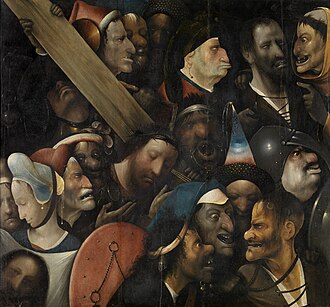 Kreuztragung - Hieronymus Bosch (1510s)
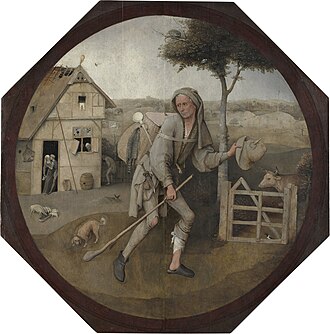 Der Wanderer - Hieronymus Bosch (1500)
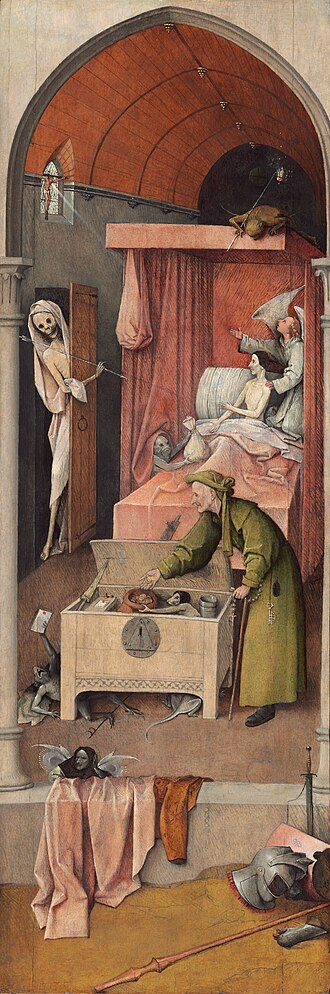 Der Tod und der Geizhals - Hieronymus Bosch (1500s)
Werke verwandter Künstler
 Kreuzabnahme - Rogier van der Weyden (1440s)
 Porträt einer Dame - Rogier van der Weyden (1460)
 Arnolfini-Porträt - Jan van Eyck (1434)
 Genter Altar - Jan van Eyck (1432)
 Die Verkündigung - Hans Memling (1480s)
 Szenen der Passion Christi - Hans Memling (1470)
 Die Jäger im Schnee - Pieter Bruegel the Elder (1565)
 Die niederländischen Sprichwörter - Pieter Bruegel the Elder (1551)