Brustbild einer jungen Frau
Caravaggio · 1601
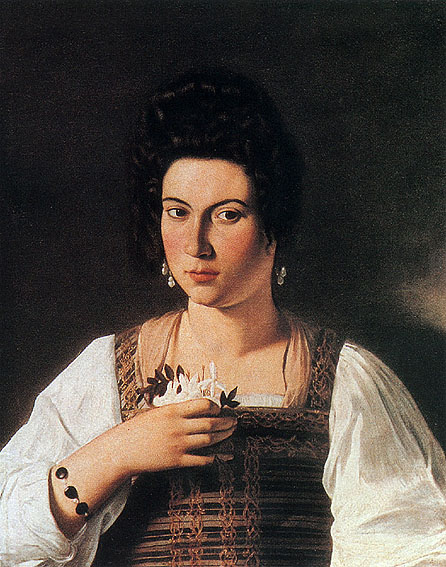
A young woman presses a small white flower to her breast and looks out at us. Caravaggio probably painted the Roman courtesan Fillide Melandroni, and the original burned in Berlin in 1945, so today we know her only from photographs.
The story behind the painting
Wikipedia dates the portrait between 1597 and 1599, while Wikidata gives 1601. The 1638 inventory of the collection of Marchese Vincenzo Giustiniani, Caravaggio's patron, lists a portrait of a courtesan named Fillide, and modern scholars identify her as Fillide Melandroni. Yet the person who commissioned it was Giulio Strozzi, a nobleman and one of her clients, and Fillide left the painting to him in her will of 8 October 1614. It has also been suggested that she appears here as the goddess Flora.
What to look for
Look at the flowers she holds against her chest. Earlier scholars saw orange blossom or bergamot, a symbol of marriage and fidelity, and named the sitter Caterina Campi, wife of Caravaggio's friend Onorio Longhi. The Caravaggio scholar John Gash calls them definitely jasmine, a flower of erotic love, better suited to a courtesan than to a respectable wife. A Florentine expert, Roberta Lapucci, has argued that Caravaggio used optical devices for this picture, and that they left a visible distortion in the face.
Meaning and intent
Fillide was one of Rome's most successful courtesans, sought after by the elite, but her real life was in the streets. In the last years of the 1590s she posed for Caravaggio as Saint Catherine, as Mary in Martha and Mary Magdalene, and as Judith in Judith Beheading Holofernes, then she seems to vanish from his paintings after 1599. In February 1599 she was arrested with Ranuccio Tomassoni over a noisy carnival party at her house. In 1606 Caravaggio killed Tomassoni. The portrait sits between those two worlds, the refined patrons and the street.
Legacy
In 1812 the Giustiniani heirs, short of money, sold much of the family collection, and Frederick William III of Prussia bought it in 1815. The portrait is believed to have gone to the Kaiser Friedrich Museum in Berlin, and it was probably destroyed in a great fire in 1945, along with other Caravaggios from the same collection. In 2017 the Tasmanian artist Johannes Verhoeff painted two versions at MONA in Hobart to test Lapucci's theory, one with the distortion and one without. In 2020 the German novelist Ingrid Noll imagined Fillide's meeting with Caravaggio in a short story.
Schon gewusst?
- Probably shows the courtesan Fillide Melandroni.
- Commissioned by Giulio Strozzi; Fillide left it to him in 1614.
- Dated 1597-1599 by Wikipedia, 1601 by Wikidata.
- Probably destroyed by fire in Berlin in 1945.
Über den Künstler
Caravaggio (1571-1610)
Frau · Porträt · Barock · langes Haar · Kleid · Gemäldegalerie Berlin · Ohrring · schwarzhaarig · Armband · Fillide Melandroni
Mehr von Caravaggio
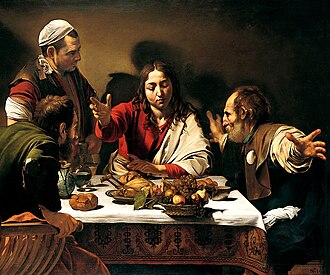 Das Abendmahl in Emmaus - Caravaggio (1601)
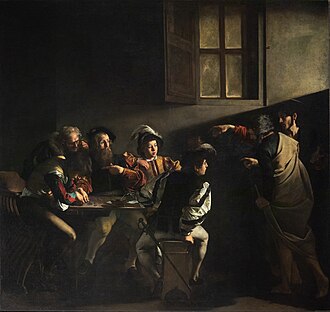 Die Berufung des Hl. Matthäus - Caravaggio (1609)
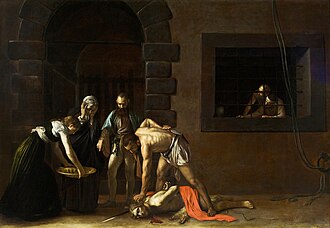 Die Enthauptung Johannes des Täufers - Caravaggio (1608)
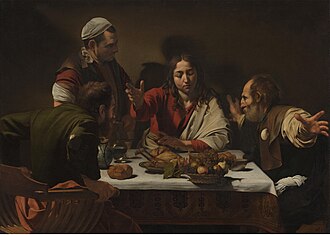 Abendmahl in Emmaus - Caravaggio (1601)
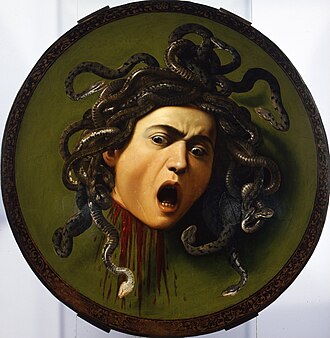 Medusa - Caravaggio (1597)
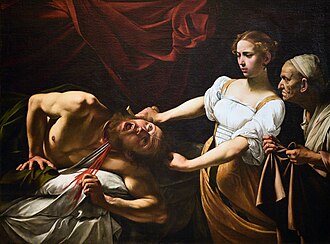 Judith enthauptet Holofernes - Caravaggio (1598)
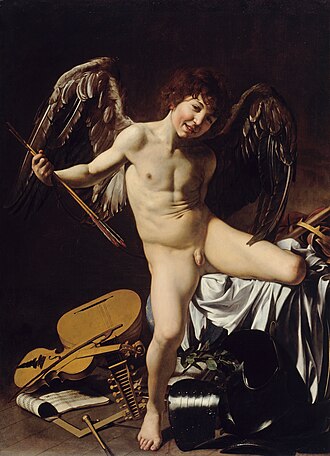 Amor als Sieger - Caravaggio (1600s)
%2C%201595%20circa%2C%20534.jpg) Selbstporträt als Bacchus - Caravaggio (1595)
Selbstporträt als Bacchus - Caravaggio (1595)
Werke verwandter Künstler
 Las Meninas - Diego Velázquez (1656)
 Die Übergabe von Breda - Diego Velázquez (1635)
 Die Nachtwache - Rembrandt van Rijn (1642)
 Selbstbildnis - Rembrandt van Rijn (1659)
 Das Mädchen mit dem Perlenohrgehänge - Johannes Vermeer (1665)
 Dienstmagd mit Milchkrug - Johannes Vermeer (c. 1658)