Lautenspieler
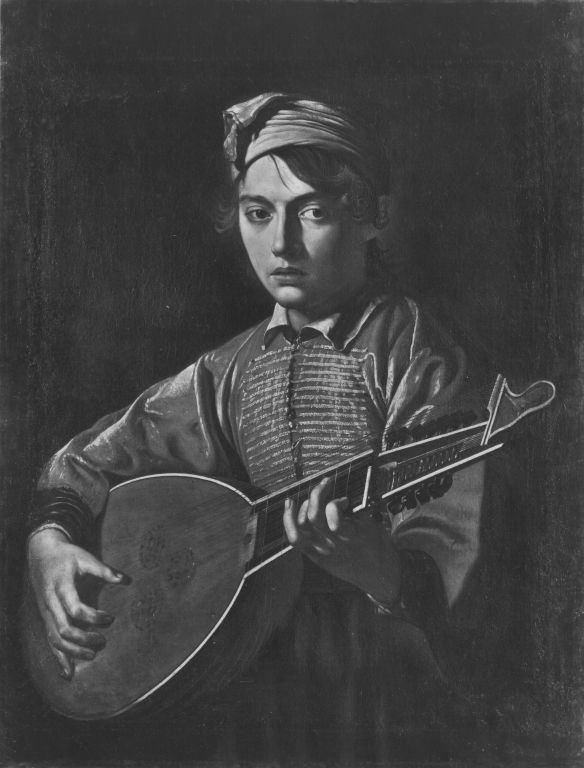
A boy in a red shirt looks up from his lute, as if someone has just interrupted his practice. The painting carries Caravaggio's name, but it was probably made by one of the many painters who followed him.
The story behind the painting
This Lute Player belongs to the Bavarian State Painting Collections and hangs in the Staatsgalerie in the New Palace of Schleissheim, near Munich, among the Italian paintings. It is oil on canvas, 96.6 by 78.6 cm. The year it was painted is unknown, but it is thought to date from between 1610 and 1630, which is why the attribution to Caravaggio is uncertain: it was probably made by one of his followers. It does not appear in the Munich catalogue of 1886 or the Schleissheim list of 1885, so it was likely acquired after 1886. A 1983 catalogue first said it was painted by a pupil of Caravaggio.
What to look for
The canvas is filled by a young man playing a lute. He wears a red shirt with black cuffs, a white collar and gold embroidery on the chest, and a white cloth tied around his head, with a lock of brown hair falling on his forehead. His dark eyes, red cheeks and lips, slightly open mouth and focused, slightly sullen gaze to the right make it seem he was disturbed during a rehearsal. His fingers seem drawn together on a chord. Light comes from the left onto face, shirt and hands, against a completely dark background. Compared with Caravaggio's own Lute Player of 1595 to 1597, the perspective here is rather inexact.
Meaning and intent
The picture seems inspired by genre scenes Caravaggio painted during his first stay in Rome, when he worked for Cardinal Francesco Maria del Monte and the banker Vincenzo Giustiniani, a collector of art and musical instruments. Two lute player paintings by Caravaggio are secure, The Musicians of about 1595 and The Lute Player of 1595 to 1597. The headcloth, which does not suit an elegant performance, suggests a moment of practice. Painting is silent, and from the early modern period instruments were shown to evoke sound. Leonardo da Vinci called music the sister of painting, an idea that kept returning in art theory since the Renaissance.
Legacy
In the two decades after Caravaggio died in 1610, many artists in Rome studied his works and imitated his style and motifs. Among the most important were Mario Minniti, Carlo Saraceni, Orazio Borgianni and Orazio Gentileschi, as well as Antiveduto Gramatica and Francesco Buoneri, known as Cecco del Caravaggio. From the 1620s came Paolo Guidotti, Bartolomeo Manfredi, the Frenchman Valentin de Boulogne and the Flemish painters Dirck van Baburen and Gerrit van Honthorst. This boy with his lute is a quiet witness to that wave: a picture that keeps the master's name while showing how far his way of painting spread.
Schon gewusst?
- Oil on canvas, 96.6 x 78.6 cm.
- Dated to about 1610-1630; probably by a follower of Caravaggio.
- Kept by the Bavarian State Painting Collections at Schleissheim.
- Probably acquired after 1886.
Über den Künstler
Caravaggio (1571-1610)
Porträt · Bayerische Staatsgemäldesammlungen
Mehr von Caravaggio
 Das Abendmahl in Emmaus - Caravaggio (1601)
 Die Berufung des Hl. Matthäus - Caravaggio (1609)
 Die Enthauptung Johannes des Täufers - Caravaggio (1608)
 Abendmahl in Emmaus - Caravaggio (1601)
 Medusa - Caravaggio (1597)
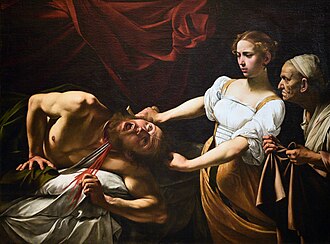 Judith enthauptet Holofernes - Caravaggio (1598)
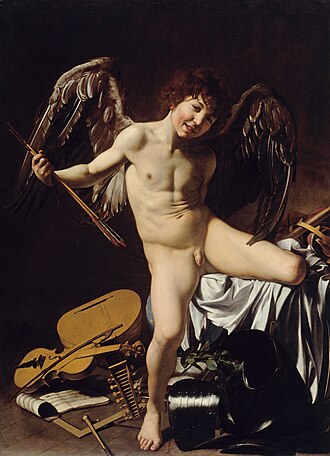 Amor als Sieger - Caravaggio (1600s)
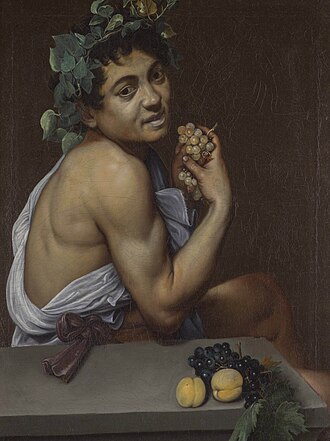 Selbstporträt als Bacchus - Caravaggio (1595)
Werke verwandter Künstler
 Las Meninas - Diego Velázquez (1656)
 Die Übergabe von Breda - Diego Velázquez (1635)
 Saint Francis in Meditation - Francisco de Zurbarán (1639)
 The Immaculate Conception - Francisco de Zurbarán (1661)
 Dreifachporträt von Karl I. - Anthony van Dyck (1635)
 Karl I mit M. de St. Antoine - Anthony van Dyck (1636)
 Die Aufrichtung des Kreuzes - Peter Paul Rubens (1609)
 Der Raub der Töchter des Leukippos - Peter Paul Rubens (1618)
 Die Nachtwache - Rembrandt van Rijn (1642)
 Selbstbildnis - Rembrandt van Rijn (1659)
 Ein Schütze einen Berkemeyer haltend, bekannt als „Der fröhliche Trinker" - Frans Hals (1620s)
 Der lachende Kavalier - Frans Hals (1624)