Das Jüngste Gericht
Hieronymus Bosch · 1500
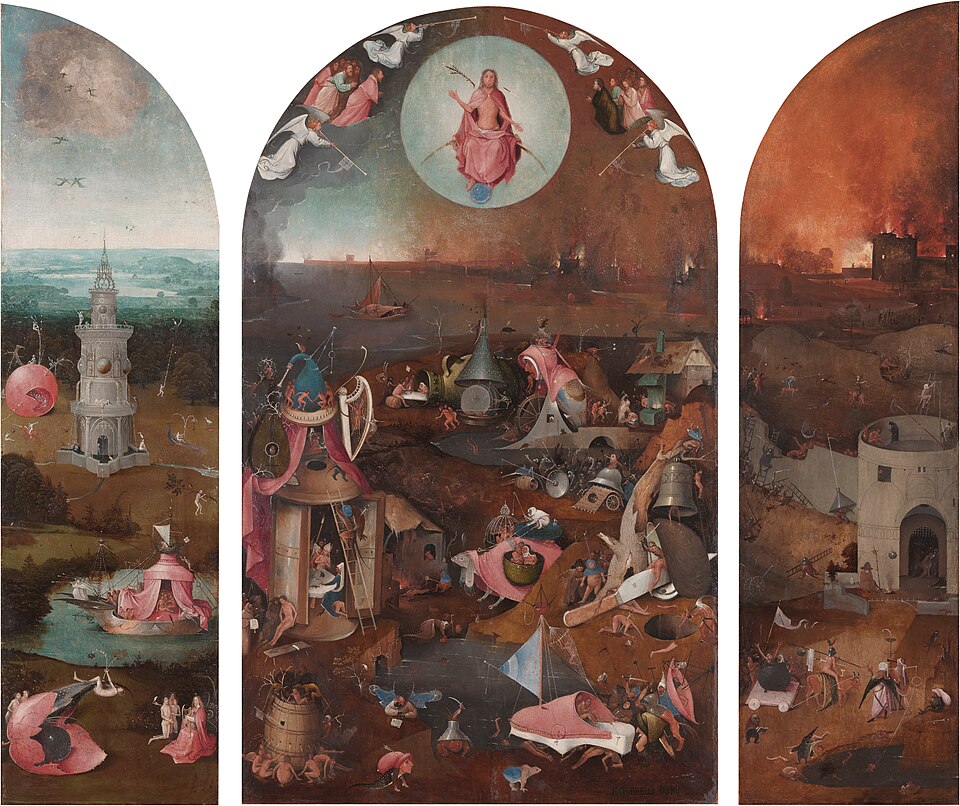
Paradise on the left, Hell on the right, and in the middle insect-like demons torturing the damned. This Last Judgment in Bruges carries Bosch's name, yet nobody is sure whether his own hand painted it.
The story behind the painting
The triptych was made after 1486, a date set by dendrochronological analysis of the wood; Wikidata records it as 1500. Its authorship is disputed: it may be by Hieronymus Bosch, by his workshop, or by both together, and some doubt it because of its mediocre quality. It counts among the eight surviving triptychs attributed to Bosch. It passed through the collection of E. Gravet and the Paris firm Jacques Seligmann and Company before A. Bernaert acquired it in 1907 and gave it to the city of Bruges.
What to look for
Open the shutters and read from left to right. In the left panel, blessed souls are carried to Eden on a boat with a pink tent, near a tower that stands for the Fountain of Eternal Youth. In the centre Christ sits as judge inside a celestial sphere, among angels blowing the trumpets of the Last Judgment and the apostles. Below him, insect-like demons torment sinners by fire and by forcing the gluttonous to eat impure food. On the right, a city of Hell is besieged by demons, with a fire in the far distance. The outside of the shutters, in grey grisaille, shows the Crowning with Thorns.
Meaning and intent
The layout echoes Bosch's Last Judgment in Vienna and The Garden of Earthly Delights, which also place Eden on the left and Hell on the right. The punishments are drawn from Netherlandish proverbs, so each torment is a sin turned into an image that viewers of the time could read. The journey runs from innocence through judgement to a burning world. Whoever painted it, the vision is unmistakably in Bosch's manner.
Legacy
The work was cleaned in 1936 and restored again in 1959, when the damaged grisaille on the outer shutters was discovered; the painting above the inner frames is lost. It is now in the Groeningemuseum in Bruges, and it appears in the 2008 film In Bruges, in a scene where the main characters visit the museum. Its doubtful attribution has not kept it from becoming one of the best-known treasures of the city.
Schon gewusst?
- Made after 1486, per tree-ring dating.
- Attribution disputed: Bosch, workshop, or both.
- Given to the city of Bruges in 1907.
- Seen in the 2008 film In Bruges.
Über den Künstler
Hieronymus Bosch (1450-1516)
religiöse Kunst · Hochrenaissance · Jesus Christus · Flämische Primitive · Engel · Boot · Vlaamse Kunstcollectie · Fließgewässer · Groeningemuseum · Jüngstes Gericht
Mehr von Hieronymus Bosch
 Der Garten der Lüste - Hieronymus Bosch
 Das Narrenschiff - Hieronymus Bosch (1500s)
 Die Versuchungen des heiligen Antonius - Hieronymus Bosch (1501)
 Die sieben Todsünden und vier letzten Dinge - Hieronymus Bosch (1500)
 Heuwagen-Triptychon - Hieronymus Bosch (1510s)
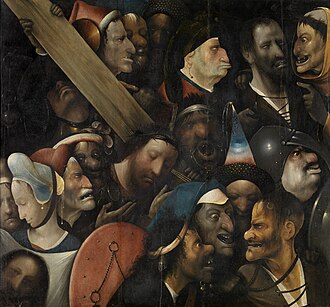 Kreuztragung - Hieronymus Bosch (1510s)
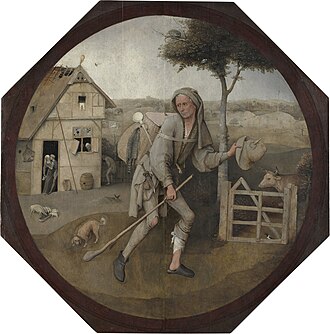 Der Wanderer - Hieronymus Bosch (1500)
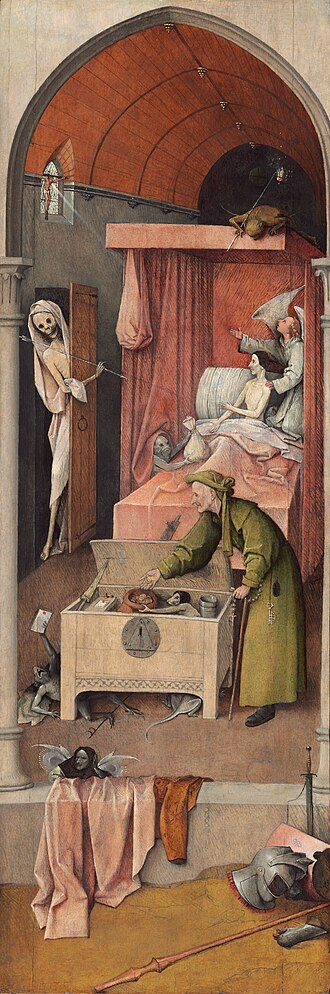 Der Tod und der Geizhals - Hieronymus Bosch (1500s)
Werke verwandter Künstler
 Kreuzabnahme - Rogier van der Weyden (1440s)
 Porträt einer Dame - Rogier van der Weyden (1460)
 Arnolfini-Porträt - Jan van Eyck (1434)
 Genter Altar - Jan van Eyck (1432)
 Die Verkündigung - Hans Memling (1480s)
 Szenen der Passion Christi - Hans Memling (1470)
 Die Jäger im Schnee - Pieter Bruegel the Elder (1565)
 Die niederländischen Sprichwörter - Pieter Bruegel the Elder (1551)