Jupiter, Neptun und Pluto
Caravaggio · 1599
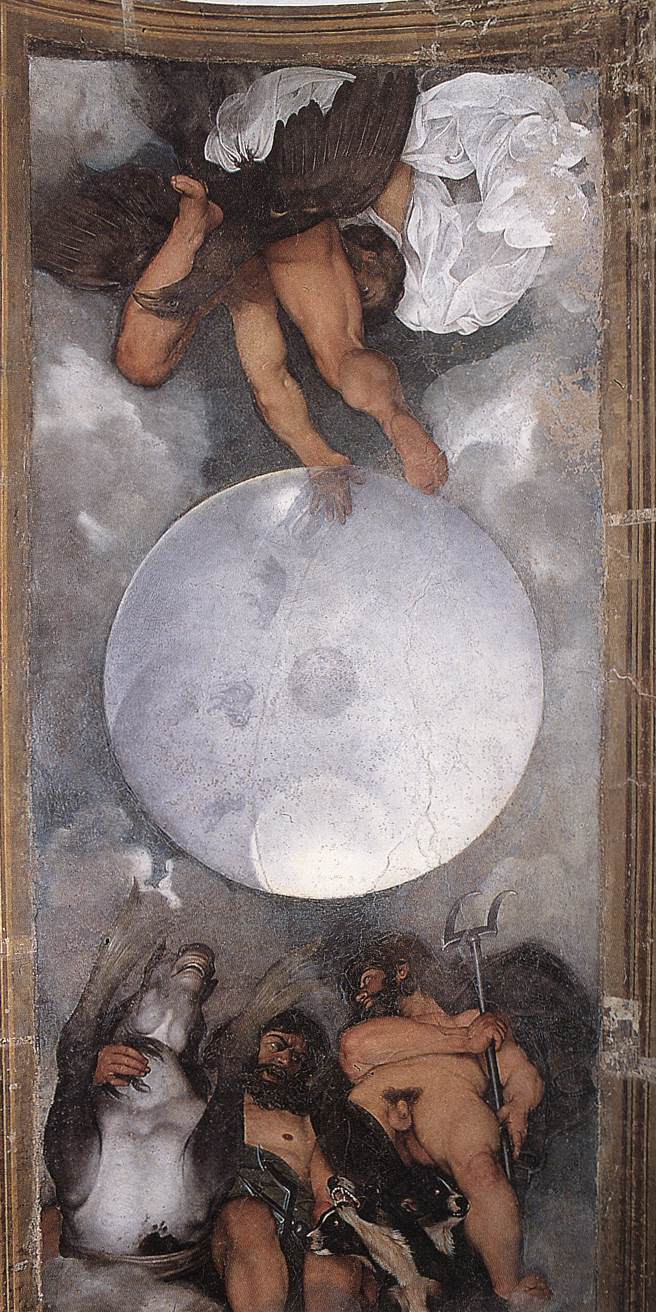
Look up at a ceiling in Rome and three gods tumble toward you in impossible foreshortening. Caravaggio painted them for his patron's alchemy, and seems to have given all three his own face.
The story behind the painting
Caravaggio painted this work for his patron, Cardinal Francesco Maria del Monte, on the ceiling of the cardinal's garden casino on his country estate, later known as the Villa Ludovisi. Wikipedia dates it around 1597, while Wikidata gives 1599. According to an early biographer, one of Caravaggio's aims was to silence critics who claimed he had no grasp of perspective. Unusually, it is painted in oil on plaster, so it is not a true fresco, although it is sometimes wrongly called one.
What to look for
The three gods are seen from below in the most dramatic foreshortening imaginable, their bodies thrust upward into the ceiling. Each is identified by his beast: Jupiter by the eagle, Neptune by the hippocamp, a sea horse, and Pluto by the three-headed dog Cerberus. Jupiter reaches out to move a celestial sphere in which the Sun revolves around the Earth. The figures also contradict the claim that Caravaggio always painted from live models, and the artist seems to have used his own face for all three gods.
Meaning and intent
Cardinal del Monte had a keen interest in alchemy, and the ceiling is read as an allegory of the alchemical triad of Paracelsus. Jupiter stands for sulphur and air, Neptune for mercury and water, and Pluto for salt and earth. So the painting is both a learned puzzle for a scholarly patron and a bold display of skill by a painter determined to prove his critics wrong about perspective. It is a rare mythological ceiling by an artist best known for scenes on canvas.
Legacy
The painting is in the Villa Aurora, the former hunting lodge of the old Villa Ludovisi in Rome, private property of the Ludovisi family. After the death of its last owner, Prince Nicolò Boncompagni Ludovisi, in 2018, an inheritance dispute led to the property being put up for sale in 2021. The presence of the Caravaggio was a major reason for the high value placed on the villa. A notary's auction in January 2022 received no offers, and the villa is said to need extensive restoration.
Schon gewusst?
- Painted for Cardinal Francesco Maria del Monte, c. 1597 (Wikidata: 1599).
- Oil on plaster, not a true fresco.
- Read as an allegory of Paracelsus's alchemical triad.
- On a ceiling of the Villa Aurora, Rome, privately owned.
Über den Künstler
Caravaggio (1571-1610)
mythologische Malerei · Barock · Jupiter
Mehr von Caravaggio
 Das Abendmahl in Emmaus - Caravaggio (1601)
 Die Berufung des Hl. Matthäus - Caravaggio (1609)
 Die Enthauptung Johannes des Täufers - Caravaggio (1608)
 Abendmahl in Emmaus - Caravaggio (1601)
 Medusa - Caravaggio (1597)
 Judith enthauptet Holofernes - Caravaggio (1598)
 Amor als Sieger - Caravaggio (1600s)
%2C%201595%20circa%2C%20534.jpg) Selbstporträt als Bacchus - Caravaggio (1595)
Selbstporträt als Bacchus - Caravaggio (1595)
Werke verwandter Künstler
 Las Meninas - Diego Velázquez (1656)
 Die Übergabe von Breda - Diego Velázquez (1635)
.jpg) Die Aufrichtung des Kreuzes - Peter Paul Rubens (1609)
Die Aufrichtung des Kreuzes - Peter Paul Rubens (1609) Der Raub der Töchter des Leukippos - Peter Paul Rubens (1618)
%20-%20Google%20Art%20Project.jpg) Dreifachporträt von Karl I. - Anthony van Dyck (1635)
Dreifachporträt von Karl I. - Anthony van Dyck (1635)%20with%20M.%20de%20St%20Antoine%20-%20Google%20Art%20Project.jpg) Karl I mit M. de St. Antoine - Anthony van Dyck (1636)
Karl I mit M. de St. Antoine - Anthony van Dyck (1636) Die Nachtwache - Rembrandt van Rijn (1642)
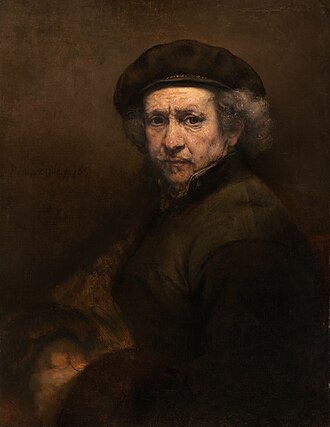 Selbstbildnis - Rembrandt van Rijn (1659)
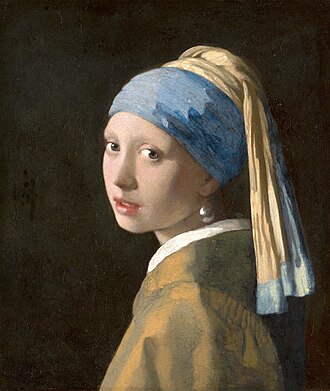 Das Mädchen mit dem Perlenohrgehänge - Johannes Vermeer (1665)
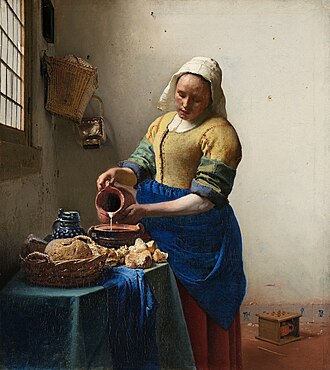 Dienstmagd mit Milchkrug - Johannes Vermeer (c. 1658)