Obstkorb
.jpg)
A wicker basket balances on the edge of a ledge, heavy with summer fruit, and every leaf and apple carries a small wound. Caravaggio painted beauty already beginning to fade.
The story behind the painting
Basket of Fruit hangs in the Biblioteca Ambrosiana in Milan, and its early history is tied to one remarkable collector. By 1607 it belonged to Cardinal Federico Borromeo, archbishop of Milan, who had been in Rome around 1597-1602 and stayed as a guest of Caravaggio's patron Cardinal del Monte in 1599. Borromeo was fascinated by Northern painters such as Jan Brueghel the Elder, who treated flowers and landscape as subjects in their own right, something not yet known in Italian art. When the picture was made is disputed. Wikipedia gives c. 1599, while John T. Spike places it in 1596 and Catherine Puglisi prefers 1601; nearly every year in between has been proposed. An X-ray study revealed that Caravaggio painted it over a canvas already decorated with grotesques in the style of his friend Prospero Orsi.
What to look for
Begin with the basket itself, perched so near the edge that it seems about to fall out of the picture and into our space. Then let your eye move slowly through the fruit. There is a light-red peach, a bicoloured apple with two insect holes, a yellow pear, figs splitting with ripeness and a single quince. Four clusters of grapes, black, red, golden and white, hang among the leaves; some berries are shrivelled or overripe. Now study the leaves: one grape leaf is dry and curled, another spotted, a large fig leaf is scorched by disease. To the sides float two loose shoots, their leaves chewed by insects. The detail is so exact that the source compares its realism to photography.
Meaning and intent
Much has been made of the less than perfect state of the fruit. In line with the culture of the age, the theme appears to be fading beauty and the natural decay of all things. Scholars have also read the basket as a metaphor for the Church, and Borromeo's ownership makes a conscious reference to the Book of Amos more plausible. Caravaggio himself took such subjects seriously. His friend Vincenzo Giustiniani recalled the painter saying it took as much workmanship to paint a good picture of flowers as one of human figures, even though the conventions of the time ranked flowers low. Here a humble basket becomes a meditation on time, held up for close and patient attention.
Legacy
Basket of Fruit is often seen as a key moment in the birth of independent still life in Italy. Its illusion is so central that the source suggests trompe l'oeil seems almost the whole purpose of the painting, if one sets aside any lesson it might teach. The same basket, and perhaps even the same quince, appears to return in the first of Caravaggio's two versions of Supper at Emmaus, where the teetering basket adds tension to a dramatic scene. The work can also be compared with his Still Life with Fruit of around 1603, which Spike calls the source of all subsequent Roman still-life paintings. Four centuries later, its bruised fruit still asks us to look closely.
Schon gewusst?
- The painting was in Cardinal Federico Borromeo's collection by 1607.
- X-rays show it was painted over grotesques in the style of Prospero Orsi.
- Its date is disputed: Spike suggests 1596, Puglisi 1601, Wikipedia gives c. 1599.
- The same basket seems to reappear in Caravaggio's first Supper at Emmaus.
Über den Künstler
Caravaggio (1571-1610)
Italian Baroque painting · Stillleben · Korb · Obst
Mehr von Caravaggio
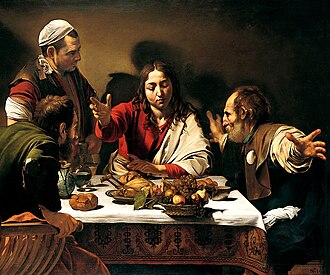 Das Abendmahl in Emmaus - Caravaggio (1601)
 Die Berufung des Hl. Matthäus - Caravaggio (1609)
 Die Enthauptung Johannes des Täufers - Caravaggio (1608)
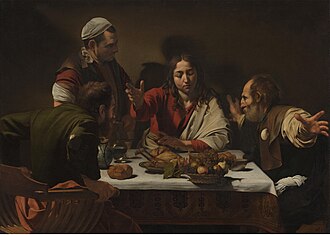 Abendmahl in Emmaus - Caravaggio (1601)
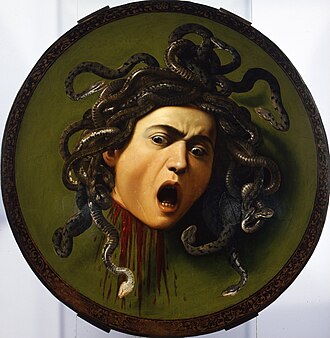 Medusa - Caravaggio (1597)
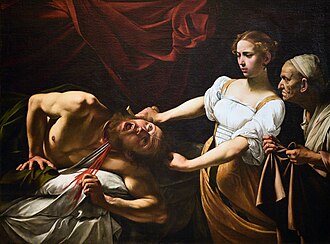 Judith enthauptet Holofernes - Caravaggio (1598)
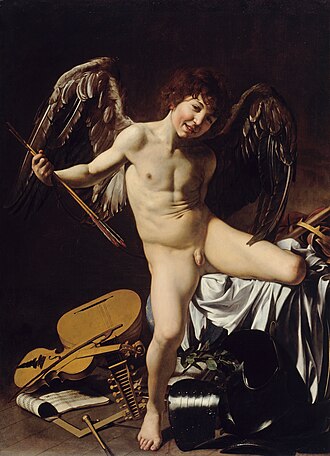 Amor als Sieger - Caravaggio (1600s)
%2C%201595%20circa%2C%20534.jpg) Selbstporträt als Bacchus - Caravaggio (1595)
Selbstporträt als Bacchus - Caravaggio (1595)
Werke verwandter Künstler
 Las Meninas - Diego Velázquez (1656)
 Die Übergabe von Breda - Diego Velázquez (1635)
 Die Nachtwache - Rembrandt van Rijn (1642)
 Selbstbildnis - Rembrandt van Rijn (1659)
 Das Mädchen mit dem Perlenohrgehänge - Johannes Vermeer (1665)
 Dienstmagd mit Milchkrug - Johannes Vermeer (c. 1658)