Jacopo Tintoretto
1518-1594
Tintoretto, the dyer's boy of Venice, painted so fast and so boldly that people called him il Furioso. Over his studio he wrote his dream: Michelangelo's drawing and Titian's colour.
Origins
Jacopo Robusti was born in Venice in late September or early October 1518. His father Battista was a dyer, tintore in Italian, so the son became Tintoretto, the little dyer. He had at least one brother, Domenico, though one unreliable seventeenth-century account claims there were twenty-two siblings. The family was believed to come from Brescia, while older studies pointed to Lucca. Little is known of his training. His early biographers say his only formal apprenticeship was in Titian's studio, and that Titian angrily sent him away after a few days, out of jealousy of so promising a pupil according to Carlo Ridolfi, or because of a clash of personalities according to Marco Boschini. Tintoretto never sought another teacher. He worked beside furniture painters, studied anatomy from live models and dissection, collected casts and prints, and drew models of Michelangelo's sculptures from every angle, often working by night as well as by day.
Life and turning points
At first Tintoretto often worked for almost nothing to win commissions, helping his young friend Andrea Schiavone with wall paintings. His great chance came in 1548 with the Miracle of the Slave for the Scuola di San Marco, a triumph that brought many commissions. When Paolo Veronese arrived in 1551 and began winning prestigious work, Tintoretto offered his own parish church, the Madonna dell'Orto, two colossal canvases at cost, the Worship of the Golden Calf and the Last Judgment, about 14.5 metres tall. About 1560 he married Faustina de Vescovi, daughter of a Venetian nobleman. From 1564 he worked for decades at the Scuola Grande di San Rocco, and also painted many works in the Doge's Palace, starting afresh after the fire of 1577. When Veronese died in 1588 before starting the vast Paradise for the palace, the commission passed to Tintoretto. He died on 31 May 1594.
Style and technique
Tintoretto's contemporaries both admired and criticised his speed and the unprecedented boldness of his brushwork. His work is Mannerist in spirit, with muscular figures, dramatic gestures and daring perspective. In the Miracle of the Slave the story becomes theatre, with unusual colour and vigorous execution. For paintings hung on the side walls of chapels, he set the perspective off centre so that the illusion of depth worked for worshippers seeing them at an angle. His Presentation of the Virgin in the Temple replaces Titian's classical balance with a startling drama of figures on a receding staircase. A fast technique known as prestezza, along with assistants, let him produce more paintings for the Venetian state than any rival. The fifty-two paintings at San Rocco have been described as vast suggestive sketches, with mastery rather than deliberate precision, made to be seen in a dusky half-light.
Stories and anecdotes
In 1564 the Scuola di San Rocco asked four painters, Tintoretto, Zuccaro, Salviati and Veronese, to submit sketches for a ceiling showing Saint Roch in Glory. Instead of a sketch, Tintoretto painted the full picture, secretly installed it on the ceiling and, on the day of the competition, offered it as a gift, perhaps knowing that the rules forbade refusing any gift. It has been called the most notorious incident of his career. While the Paradise commission was still undecided, he liked to tell the senators that he had prayed to be given it, so that paradise itself might be his reward after death. When it was finished, Ridolfi wrote that it seemed to everyone that heavenly beatitude had been revealed to mortal eyes. Asked to name his own fee, he left it to the authorities and is said to have accepted less than they offered.
Legacy
Tintoretto stands among the great painters of the Venetian Renaissance, one of the few who reached the highest rank without any recorded formal training. The Paradise in the Doge's Palace, about 9.1 by 22.6 metres, is reputed to be the largest painting ever made on canvas, though modern historians generally judge it weaker than his two preparatory sketches, now in the Louvre and the Thyssen-Bornemisza Museum. His work is still being rediscovered: until 2012 The Embarkation of St Helena in the Holy Land at the Victoria and Albert Museum was credited to Schiavone, before new analysis showed it to be one of three Tintoretto paintings on the legend of the True Cross. He had very few pupils, among them his daughter Marietta, his sons and Maerten de Vos of Antwerp. In the half-light of San Rocco, his furious energy still fills the walls.
Schon gewusst?
- Tintoretto means little dyer, after his father's trade.
- His two canvases for the Madonna dell'Orto are about 14.5 metres tall.
- The Paradise in the Doge's Palace is reputed to be the largest painting ever done on canvas.
- Until 2012 one of his St Helena paintings was attributed to Andrea Schiavone.
Venezianische Schule · Manierismus
Verwandte Künstler
Gemälde von Jacopo Tintoretto
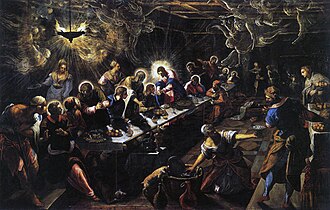 Das letzte Abendmahl - Jacopo Tintoretto (1563)
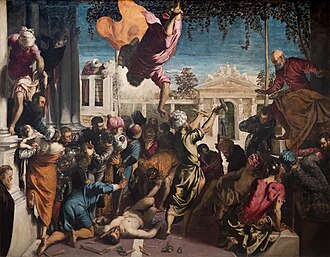 Der heilige Markus befreit den gefesselten Sklaven - Jacopo Tintoretto (1540s)
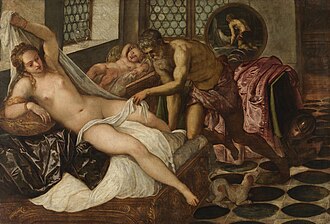 Vulkan überrascht Venus und Mars - Jacopo Tintoretto (1555)
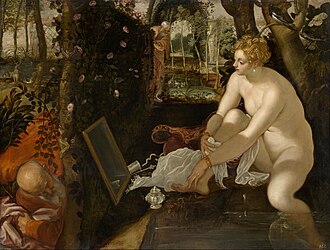 Susanna im Bade - Jacopo Tintoretto (1550s)
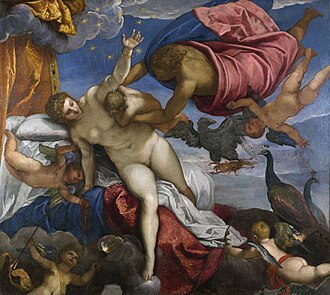 Die Entstehung der Milchstraße - Jacopo Tintoretto (1575)
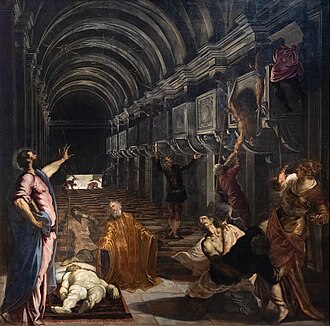 Auffindung der Leiche des hl. Markus - Jacopo Tintoretto (1562)
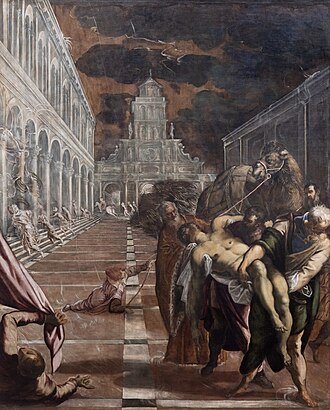 Die Bergung des Leichnams des heiligen Markus - Jacopo Tintoretto (1560s)
%20Jacopo%20Tintoretto%20-%20Gloria%20del%20Paradiso%20-%20Sala%20del%20Maggior%20Consiglio.jpg) Paradies - Jacopo Tintoretto
Paradies - Jacopo Tintoretto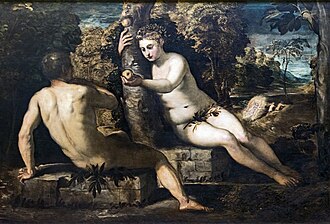 Die Versuchung Adams - Jacopo Tintoretto (1550s)
.jpg) Fußwaschung Christi - Jacopo Tintoretto (1540s)
Fußwaschung Christi - Jacopo Tintoretto (1540s)