Susanna im Bade
Jacopo Tintoretto · 1550
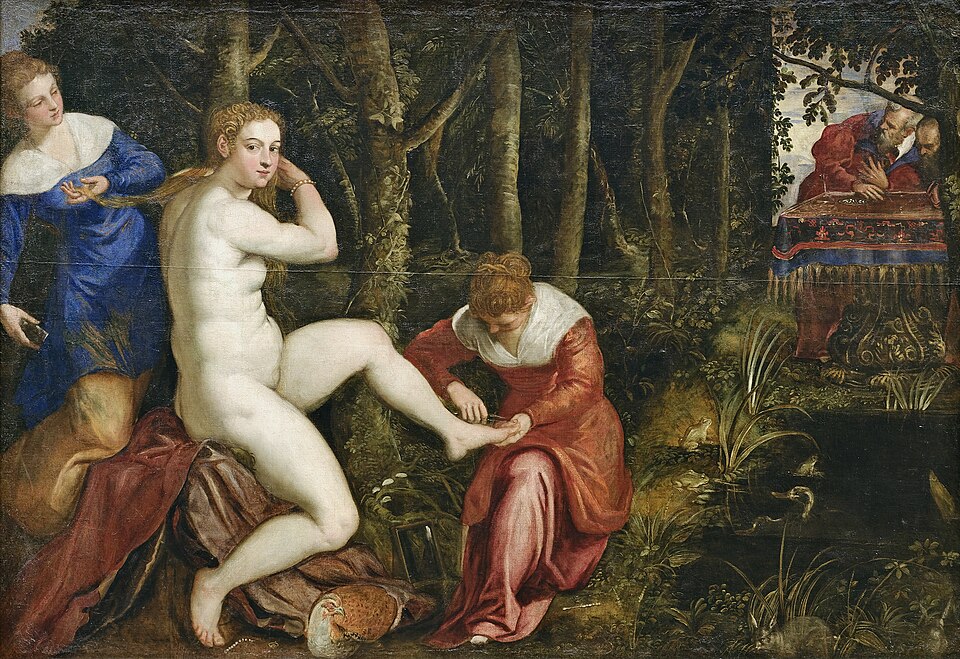
Susanna sits naked and unashamed in a green garden, looking straight at us, while two old judges peer from behind a table and a tree. Tintoretto filled the scene with watchers: servants, toads, a mirror, and the viewer.
The story behind the painting
This large oil on canvas, 167 by 238 cm, is by Jacopo Robusti, called Tintoretto, and the French Wikipedia article dates it between 1550 and 1575, while Wikidata gives 1550. Another version, dated 1555 and measuring 147 by 194 cm, also exists. Who first commissioned the painting is uncertain, perhaps the Marquis d'Aubespine. It eventually entered the royal collection of Louis XIV when the French state acquired it. Wikidata lists it with the Louvre's department of paintings, and the article says it is now held by the Louvre-Lens. Tintoretto had painted the subject more than once, as had Veronese, Giacomo Pacchiarotto and Jacopo Bassano.
What to look for
Susanna's twisting pose, typical of Mannerism, shows a large expanse of skin, and her pale body stands out against the dark background, lit from the front while her back is in shadow. The elders take up little space: they hide behind a table and the branches of a tree whose leaves suggest an oak, and the perspective of the trees opens from them towards her, as if materialising their gaze. A pheasant lies at Susanna's feet, while two toads by the pond turn towards the old men. A small mirror sits between her legs, reflecting nothing in particular. Two serving women flank her, one at each side.
Meaning and intent
The story, from the Book of Daniel, praises the virtue of Susanna, wife of Joakim of Babylon, who chose false accusation over yielding to two judges and was saved by Daniel. The article argues that the painting seems to oppose the text: where the Bible stresses modesty and virtue, Tintoretto shows raw nudity, unlike Pacchiarotto's earlier Judgement of Daniel, where Susanna prays with a halo. The oak's longevity stresses the elders' age and lechery; the pheasant suggests someone coveted, the toads something repellent. The mirror evokes looking itself. The elders mirror the viewer's own position, with Susanna as the axis between those who watch her.
Legacy
The painting marks, according to the article, a tipping point between the traditional buona maniera and Mannerism, the current into which Tintoretto was born. The openly displayed nude reflects the rise of humanism, in contrast to older images where human nakedness signified shame, like Adam and Eve in Eden or Michelangelo's Noah in the Sistine Chapel. Yet his training keeps a fairly classical palette, natural skin tones and a unified green setting. The work appeared in the Louvre exhibition Titian, Tintoretto, Veronese: Rivalry in Venice, from 17 September 2009 to 4 January 2010.
Schon gewusst?
- Oil on canvas, 167 x 238 cm.
- Dated 1550-1575 by Wikipedia, 1550 by Wikidata.
- Entered the royal collection of Louis XIV.
- A second version of 1555 measures 147 x 194 cm.
Über den Künstler
Jacopo Tintoretto (1518-1594)
religiöse Kunst · Gemäldeabteilung des Louvre · Akt · Garten · Dienstbote · Frisur · Kaninchen · Richter
Mehr von Jacopo Tintoretto
 Das letzte Abendmahl - Jacopo Tintoretto (1563)
 Der heilige Markus befreit den gefesselten Sklaven - Jacopo Tintoretto (1540s)
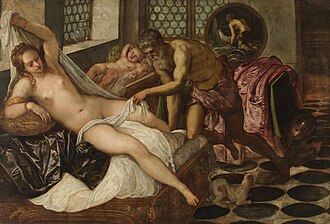 Vulkan überrascht Venus und Mars - Jacopo Tintoretto (1555)
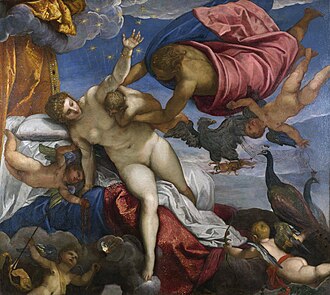 Die Entstehung der Milchstraße - Jacopo Tintoretto (1575)
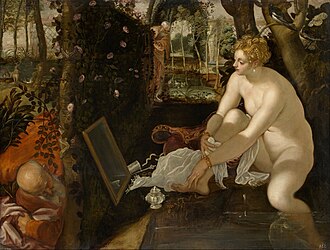 Susanna im Bade - Jacopo Tintoretto (1550s)
 Die Bergung des Leichnams des heiligen Markus - Jacopo Tintoretto (1560s)
 Auffindung der Leiche des hl. Markus - Jacopo Tintoretto (1562)
 Paradies - Jacopo Tintoretto
Werke verwandter Künstler
 Venus von Urbino - Titian (1538)
 Mariä Himmelfahrt - Titian (1510s)
 Die Hochzeit zu Kana - Paolo Veronese (1560s)
 Das Gastmahl im Hause des Levi - Paolo Veronese (1573)