Der heilige Markus befreit den gefesselten Sklaven
Jacopo Tintoretto · 1540s
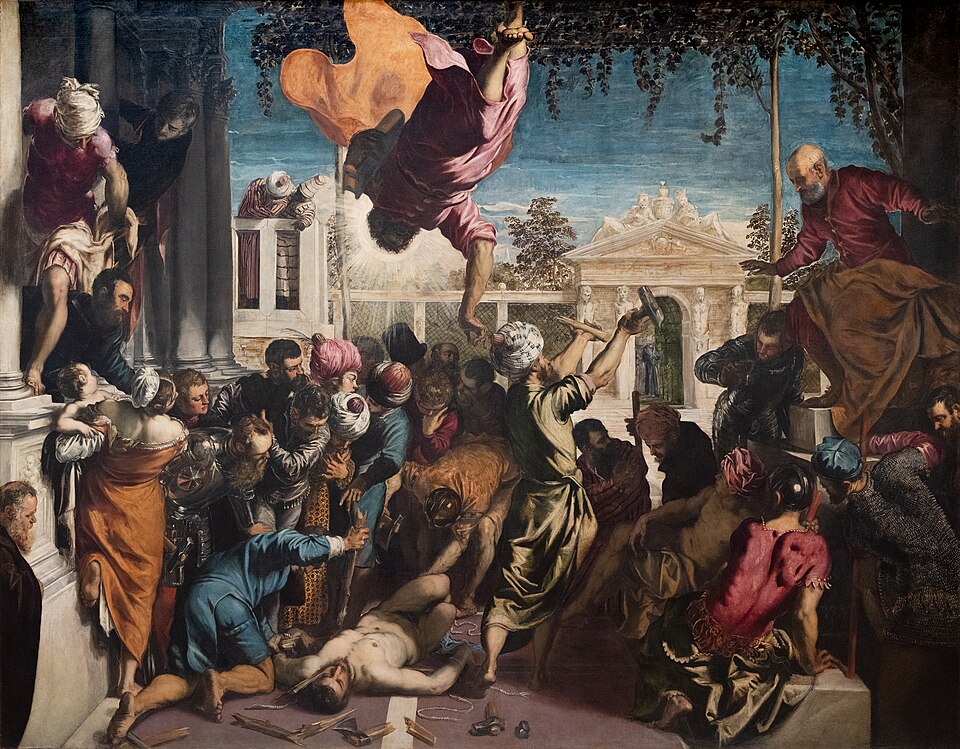
A man lies on the ground, about to be tortured, and the tools meant to hurt him are breaking apart. Above, Saint Mark plunges headfirst out of the sky to save him.
The story behind the painting
Tintoretto completed this huge canvas in 1548 for the Scuola Grande di San Marco in Venice, a charitable confraternity that was the largest and wealthiest lay organisation in the city. Wikidata dates it to the 1540s and gives its size as 415 by 541 cm. It hung opposite the altar in the Scuola until the French seized it in 1797, and it returned to Venice, to the Gallerie dell'Accademia, in 1815. Before this, Tintoretto had no powerful backers and was told his brushwork was too rushed; Titian openly criticised him. This was by far his biggest commission, a real test of his career.
What to look for
The story comes from accounts of Saint Mark's life, such as the Golden Legend, and from Jacopo Sansovino's bronze relief in St. Mark's Basilica. A slave visited the saint's tomb against his master's will. On his return, the master, seated on the right, ordered his eyes gouged out, his legs broken and his mouth shattered. But the instruments keep breaking as the slave calls on Mark, who appears at the top of the picture. The crowd on the left stands stunned. Colour organises the scene: the vibrant pink of the saint's robe against a brilliant white turban below makes him seem to float in the air.
Meaning and intent
The painting is about rescue from cruelty, told at the very moment the violence fails. Tintoretto does not dwell on wounds; instead he shows broken tools, astonished faces and a saint arriving with sudden force. Later authors place this work at the start of his lifelong exploration of miraculous intervention, a theme he returned to often in Venice. The biographer Carlo Ridolfi wrote that Tintoretto changed the course of religious painting in the city, since everyone after him painted scenes with the great strength and energy he expressed through his figures. Here that energy carries a message of hope for the powerless.
Legacy
Success did not come at once. Some members of the confraternity first insisted the painting be returned to the artist. Theories about the dispute range from Tintoretto's personality to favouritism from his father-in-law, who held a leading post in the Scuola. In the end, though, the work was praised and brought him many new commissions. It has been described as Tintoretto's public consecration in Venice, combining classic features of the Venetian school with themes that would shape his whole career. Today in the Accademia, its sheer scale still makes visitors stop, as if they too had just joined that astonished crowd.
Schon gewusst?
- Completed in 1548 for the Scuola Grande di San Marco, Venice
- Seized by the French in 1797; in the Gallerie dell'Accademia since 1815
- Wikidata size: 415 x 541 cm
- Tintoretto's first major commission
Über den Künstler
Jacopo Tintoretto (1518-1594)
religiöse Kunst · Venezianische Schule · Manierismus · Gallerie dell'Accademia
Mehr von Jacopo Tintoretto
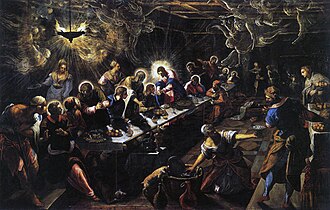 Das letzte Abendmahl - Jacopo Tintoretto (1563)
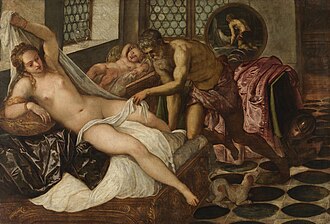 Vulkan überrascht Venus und Mars - Jacopo Tintoretto (1555)
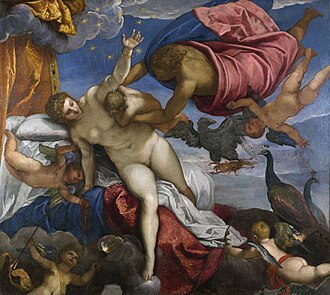 Die Entstehung der Milchstraße - Jacopo Tintoretto (1575)
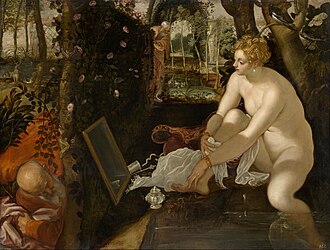 Susanna im Bade - Jacopo Tintoretto (1550s)
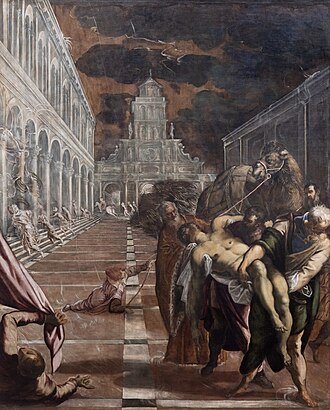 Die Bergung des Leichnams des heiligen Markus - Jacopo Tintoretto (1560s)
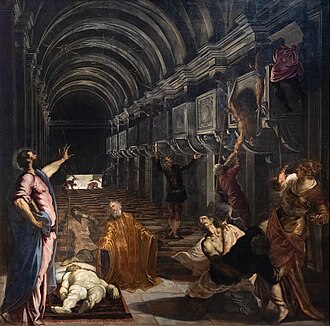 Auffindung der Leiche des hl. Markus - Jacopo Tintoretto (1562)
%20Jacopo%20Tintoretto%20-%20Gloria%20del%20Paradiso%20-%20Sala%20del%20Maggior%20Consiglio.jpg) Paradies - Jacopo Tintoretto
Paradies - Jacopo Tintoretto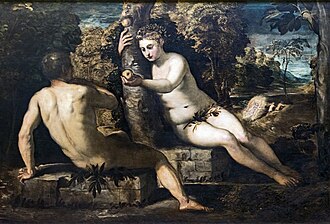 Die Versuchung Adams - Jacopo Tintoretto (1550s)
Werke verwandter Künstler
.jpg) Venus von Urbino - Titian (1538)
Venus von Urbino - Titian (1538) Mariä Himmelfahrt - Titian (1510s)