Fußwaschung Christi
Jacopo Tintoretto · 1540s
.jpg)
A wide hall, scattered figures, a dog lying in the middle of the floor. Tintoretto's Washing of the Feet looks almost random from the front. Step to the right, as worshippers in a Venetian church once did, and everything falls into place.
The story behind the painting
In 1547 the Scuola del Santissimo Sacramento of the church of San Marcuola in Venice commissioned this work from Tintoretto, together with a Last Supper that is still in the church. He painted it between 1548 and 1549, and it is considered one of his finest works. After about 70 years in Venice it was acquired by Ferdinando Gonzaga, Duke of Mantua, and placed in the Corridoio del Bertani of the Ducal Palace. In 1627 Charles I of England, a great collector, bought it.
What to look for
The canvas is very wide, about 210 by 533 cm. It follows the Gospel of John: at the Last Supper Jesus rises, takes off his cloak, ties a towel around his waist and washes his disciples' feet. Tintoretto shows Simon Peter first trying to refuse, then agreeing and even asking for his head and hands to be washed. Most of the picture shows the supper itself. In one corner is a miracle of Saint Mark from the Golden Legend. In the centre a dog lies on the floor.
Meaning and intent
Tintoretto composed the painting for the space of San Marcuola. Seen from the front, the figures can seem randomly scattered, but seen from the right, as the church allowed, the empty spaces disappear and the figures find their harmony. The dog may simply fill a space that would otherwise be too large, or it may stand for the faithfulness of the disciples. Either way the scene of humility unfolds slowly across the room, inviting the viewer to walk with it.
Legacy
After the English Revolution and the execution of Charles I, Parliament sold his collection to pay the king's debts. Many of the best works went to the Spanish ambassador Alonso de Cárdenas, who gave them to the minister Luis Méndez de Haro, and he presented them to Philip IV of Spain. The Washing of the Feet was among them. Today it hangs in the Museo del Prado in Madrid, far from the Venetian church it was designed for.
Schon gewusst?
- Commissioned in 1547 for San Marcuola in Venice; painted 1548-1549.
- Owned in turn by the Duke of Mantua, Charles I of England and Philip IV of Spain.
- Designed to be seen from the right side of the church.
- Now in the Museo del Prado.
Über den Künstler
Jacopo Tintoretto (1518-1594)
religiöse Kunst · Museo del Prado · Venezianische Schule · Manierismus
Mehr von Jacopo Tintoretto
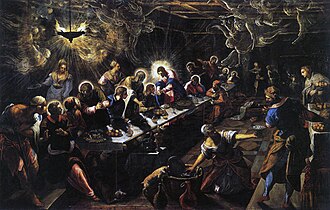 Das letzte Abendmahl - Jacopo Tintoretto (1563)
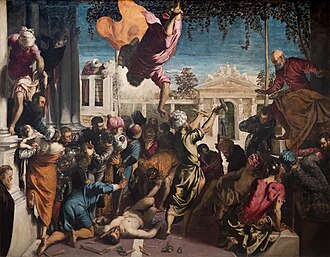 Der heilige Markus befreit den gefesselten Sklaven - Jacopo Tintoretto (1540s)
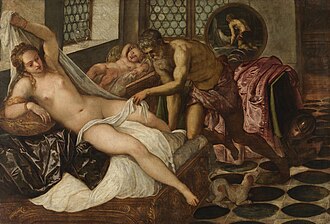 Vulkan überrascht Venus und Mars - Jacopo Tintoretto (1555)
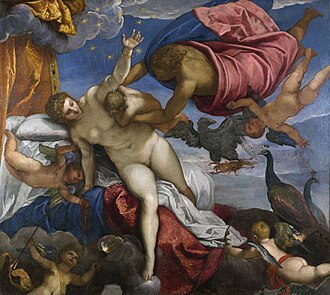 Die Entstehung der Milchstraße - Jacopo Tintoretto (1575)
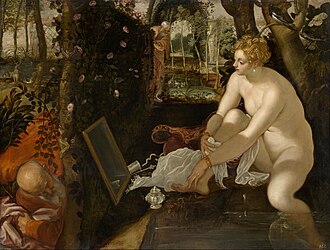 Susanna im Bade - Jacopo Tintoretto (1550s)
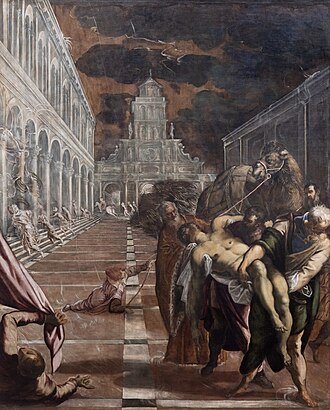 Die Bergung des Leichnams des heiligen Markus - Jacopo Tintoretto (1560s)
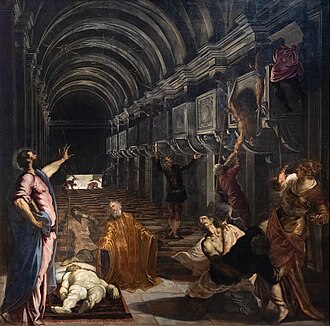 Auffindung der Leiche des hl. Markus - Jacopo Tintoretto (1562)
%20Jacopo%20Tintoretto%20-%20Gloria%20del%20Paradiso%20-%20Sala%20del%20Maggior%20Consiglio.jpg) Paradies - Jacopo Tintoretto
Paradies - Jacopo Tintoretto
Werke verwandter Künstler
.jpg) Venus von Urbino - Titian (1538)
Venus von Urbino - Titian (1538)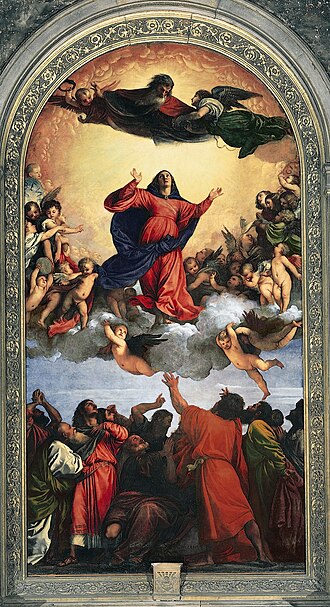 Mariä Himmelfahrt - Titian (1510s)