Die Bergung des Leichnams des heiligen Markus
Jacopo Tintoretto · 1560s
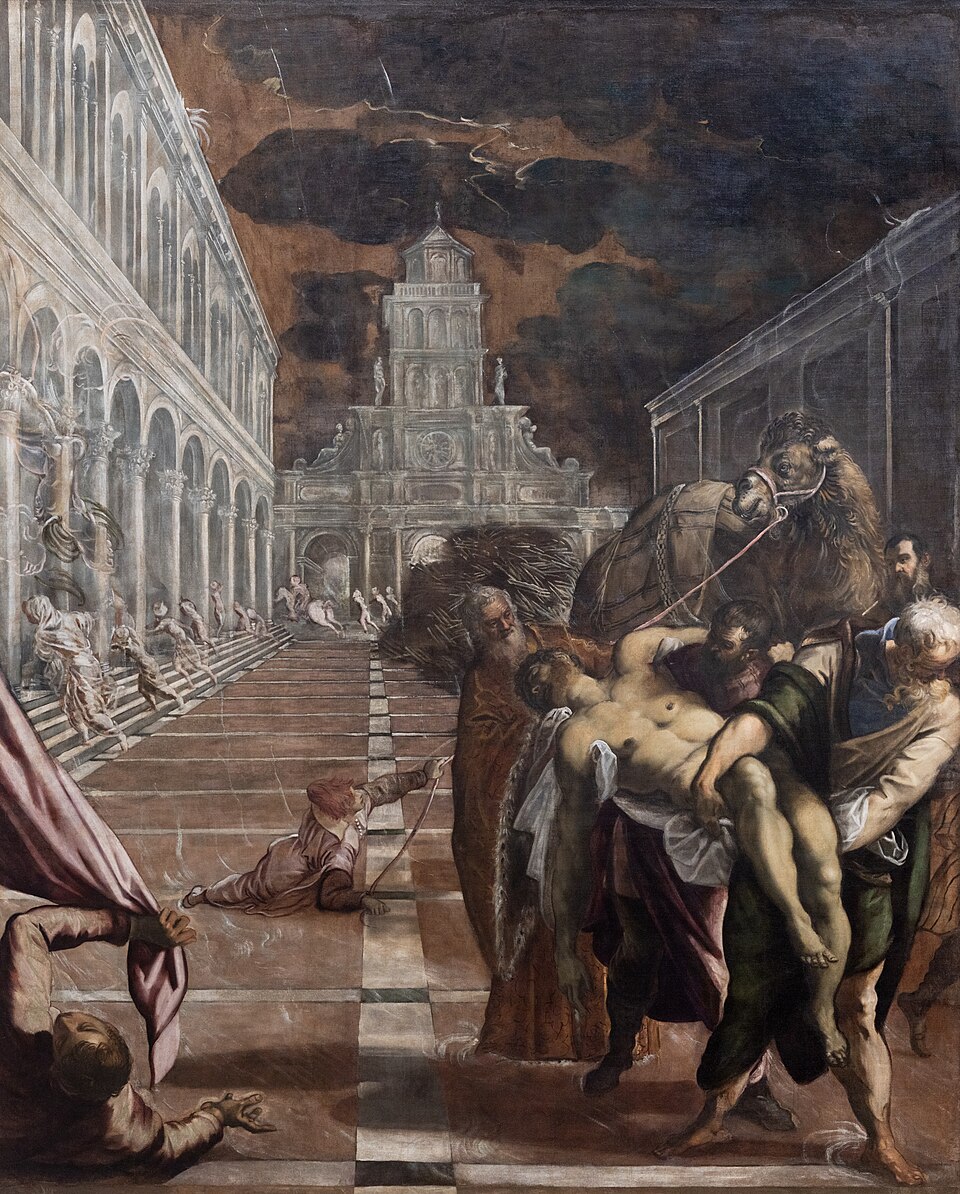
A red sky split by lightning, a square emptying in panic, and two men carrying a saint's body through the storm. Tintoretto painted the night Venice claimed Saint Mark, and put himself in the crowd.
The story behind the painting
Tintoretto painted this canvas between 1562 and 1566 for the Sala Capitolare of the Scuola Grande di San Marco in Venice, as one of a series on Saint Mark. The others are the Miracle of the Slave, Saint Mark Saving a Saracen from Shipwreck and the Finding of the Body of Saint Mark. The subject is the translatio, the transfer of the saint's relics from Alexandria to Venice. The painting is also known as the Abduction or the Translation of the Body of Saint Mark, and it now hangs in the Gallerie dell'Accademia in Venice.
What to look for
Notice the deep perspective lines that pull the eye far into the background. The near figures are painted in darker colours, while the figures further back are white, almost transparent, like ghosts. The strange red sky churns with ominous grey clouds and is torn by a thunderbolt, giving the scene a heavy, restless energy. The Piazza San Marco appears narrow, with onlookers fleeing, to convey the tension of the moment. Look for the bearded man beside the camel: Tintoretto painted himself there.
Meaning and intent
The story behind the scene is one of pious theft. Saint Mark spent most of his life in Alexandria, and his body came to Venice eight centuries after his death in AD 68. Venice's ruling class wanted him as patron saint, so they arranged to smuggle the body out of Egypt. The thieves, Buono da Malamocco and Rustico da Torcello, hid it under pork and vegetables. In the painting they carry the body home, while the storm and the fleeing crowd turn a theft into something close to a miracle.
Legacy
The body reached Venice on 31 January 828 and was kept in the palace of Doge Giustiniano; after his death his widow was ordered to build the Basilica di San Marco to house it. Fear that it would be stolen again lingered. When the basilica's chapel was rebuilt in 1063, the body could not be found, and thirty years later it was said to have reappeared, an arm emerging from an old pillar. It was then laid in a sculpted coffin below the high altar. Tintoretto's canvas keeps that founding legend alive in the city.
Schon gewusst?
- Painted 1562-1566 for the Scuola Grande di San Marco.
- Tintoretto painted himself as the bearded man beside the camel.
- Saint Mark's body reached Venice on 31 January 828.
- Now in the Gallerie dell'Accademia, Venice.
Über den Künstler
Jacopo Tintoretto (1518-1594)
religiöse Kunst · Venezianische Schule · Manierismus · Leichnam · Gallerie dell'Accademia · Säule · Markus
Mehr von Jacopo Tintoretto
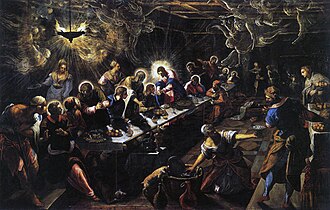 Das letzte Abendmahl - Jacopo Tintoretto (1563)
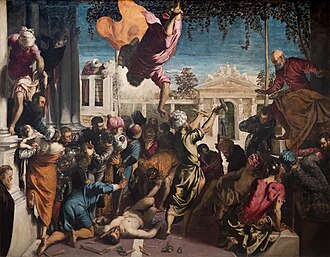 Der heilige Markus befreit den gefesselten Sklaven - Jacopo Tintoretto (1540s)
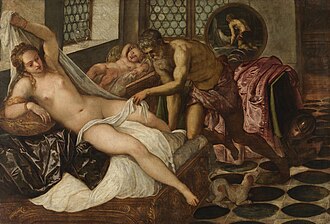 Vulkan überrascht Venus und Mars - Jacopo Tintoretto (1555)
 Die Entstehung der Milchstraße - Jacopo Tintoretto (1575)
 Susanna im Bade - Jacopo Tintoretto (1550s)
 Auffindung der Leiche des hl. Markus - Jacopo Tintoretto (1562)
%20Jacopo%20Tintoretto%20-%20Gloria%20del%20Paradiso%20-%20Sala%20del%20Maggior%20Consiglio.jpg) Paradies - Jacopo Tintoretto
Paradies - Jacopo Tintoretto Die Versuchung Adams - Jacopo Tintoretto (1550s)
Werke verwandter Künstler
.jpg) Venus von Urbino - Titian (1538)
Venus von Urbino - Titian (1538) Mariä Himmelfahrt - Titian (1510s)