聖母子と幼児聖ヨハネ
Sandro Botticelli · 1490s
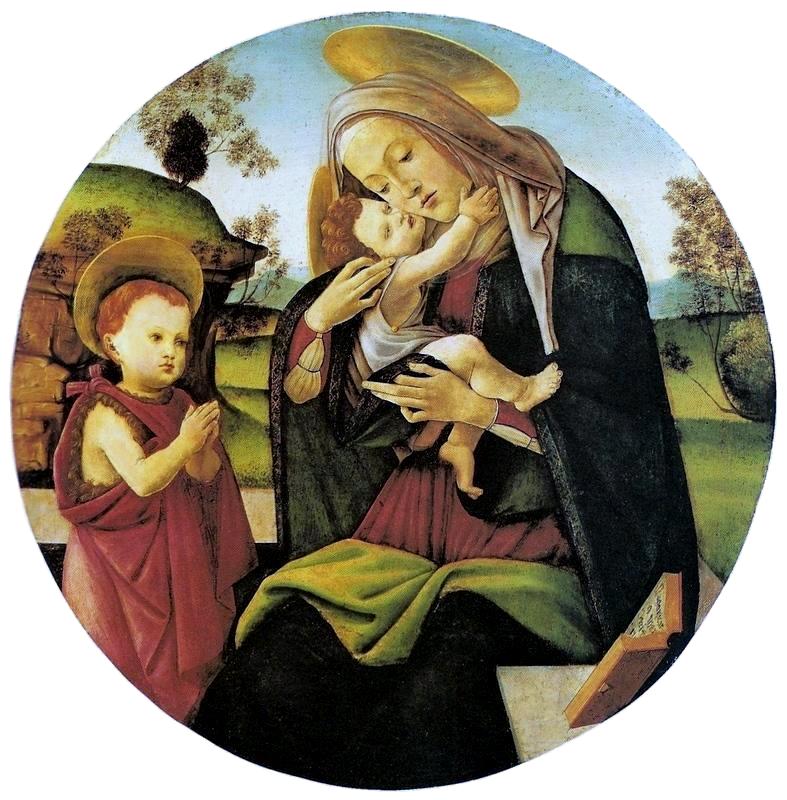
Inside a round panel, Mary bends close to her child, their hands and faces intertwined, while the young John the Baptist looks on. Late in his career Botticelli let tenderness break the neat symmetry of his youth.
The story behind the painting
This tondo, a round painting in tempera on wood about 74 cm across, was made in Florence between 1490 and 1500 by Sandro Botticelli and his studio. Botticelli painted many Madonnas in the 1480s and 1490s, a good number of them tondi showing the Virgin, the Christ Child and the infant John the Baptist in worship. Round pictures of sacred or historical subjects were much loved in the fifteenth century, often ordered by patrons and guilds to decorate palaces or for private devotion. This one first decorated the Palazzo Capponi in Florence, a palace designed by Lorenzo di Bicci in 1410 for Niccolo da Uzzano.
What to look for
See how boldly the Virgin and Child stand inside the circle. The composition is built on cross and radial lines rather than flexible arcs, as the art historian Roberto Longhi observed. Look for the angled seat on which rests a book, the Magnificat, propped against the painted frame in an almost illusionistic way. Antonino Santangelo admired the free and harmonious intertwining of hands and faces, the mobility and precision that recall Botticelli's works shortly before 1500. Compare the figures: the landscape behind and the young John the Baptist differ clearly in style from the Virgin and Child.
Meaning and intent
The painting takes up a central theme of Italian Renaissance art, divine motherhood. Renaissance painters spread the image of the Virgin of Tenderness, more emotional and human than the strictly sacred Byzantine approach. The critic Marcio Doctors linked these Madonnas to the Renaissance spirit of faith in mankind, placing the human being at the centre of the world as a mother's love does. Here the emotional bond uniting Mary and the infant Jesus is remarkably intense, unusual in the Madonnas of Botticelli's youth, and the freer composition marks his maturing style.
Legacy
In 1947 Longhi wrote to Pietro Maria Bardi that the tondo showed undoubtedly the hand of Botticelli, a view shared by Santangelo and later by Miklos Boskovits and Yukio Yashiro. Most critics believe part of the landscape and the figure of John were done by an assistant: Longhi proposed Bartolomeo di Giovanni, Santangelo named Raffaellino de' Carli. In the nineteenth century the tondo belonged to the English merchant Thomas Blayds in Liverpool, then to the Earl of Crawford and Balcarres. On 2 October 1947 the Sao Paulo Museum of Art acquired it with funds donated by Sinha Junqueira, a businesswoman and art patron from Ribeirao Preto.
豆知識
- Tempera on wood tondo, painted 1490 to 1500.
- Botticelli with help from his studio.
- Once in the Palazzo Capponi, Florence.
- Acquired by the Sao Paulo Museum of Art in 1947.
画家について
Sandro Botticelli (1445-1510)
宗教美術 · 女性 · 聖母マリア · イエスの幼少時代 · 少年 · Early Renaissance · 母 · Child Saint John
同じ画家の作品: Sandro Botticelli
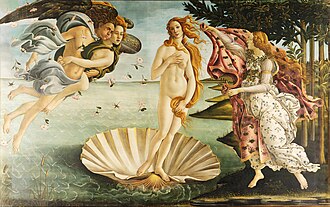 ヴィーナスの誕生 - Sandro Botticelli (c. 1485)
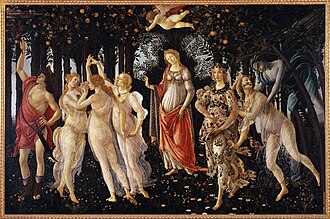 プリマヴェーラ - Sandro Botticelli (1480s)
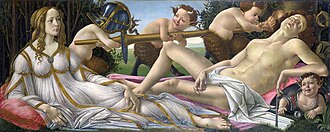 ヴィーナスとマルス - Sandro Botticelli (1485)
 東方三博士の礼拝 - Sandro Botticelli (1470s)
 マニフィカートの聖母 - Sandro Botticelli (1481)
 アペレスの誹謗 - Sandro Botticelli (1490s)
.jpg) パラスとケンタウロス - Sandro Botticelli (1482)
パラスとケンタウロス - Sandro Botticelli (1482)%20-%20Google%20Art%20Project.jpg) Idealized Portrait of a Lady - Sandro Botticelli (1480)
Idealized Portrait of a Lady - Sandro Botticelli (1480)
 モナ・リザ
モナ・リザ 白貂を抱く貴婦人
 受胎告知
受胎告知 東方三博士の礼拝